 |
|||||||||||||||||||||||||||||||||||||||||||
|
“There are a number of tricks for deceiving the weather ...
If, for instance I put on the warmest clothes I possess, the temperature rises. . . On the other hand, cursing, complaints, swearing, snuffling, saying “burr,” and other incantations have no influence on the weather.”
|
|||||||||||||||||||||||||||||||||||||||||||

|
 dense clouds, light fog: calm: 34ºF dense clouds, light fog: calm: 34ºF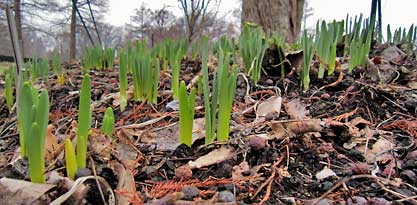 Noticeably longer days; days with temperatures that spike into the 50’s. It begins again. 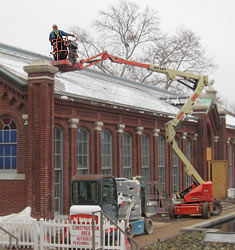 Work on the re-do of the Linnean glasshouse has speeded up. Each week I see more workers on the job and more open spaces on the roof filled-in with glass. This week for the first time work is going on both on the roof and inside the house. I can’t get too close to greenhouse because of the barriers, but from what I’m able to see, there’s a small earthmover inside shaping drainage gravel into new berms that will be topped with soil. When work on the glasshouse is complete, the botanical garden’s camellia collection will return from wintering over in a florist’s greenhouse. I don’t know whether the make-over of the Linnean House will mean just putting all the camellias back where they were or whether the keepers of this garden will add some surprises to the old house. Work on the re-do of the Linnean glasshouse has speeded up. Each week I see more workers on the job and more open spaces on the roof filled-in with glass. This week for the first time work is going on both on the roof and inside the house. I can’t get too close to greenhouse because of the barriers, but from what I’m able to see, there’s a small earthmover inside shaping drainage gravel into new berms that will be topped with soil. When work on the glasshouse is complete, the botanical garden’s camellia collection will return from wintering over in a florist’s greenhouse. I don’t know whether the make-over of the Linnean House will mean just putting all the camellias back where they were or whether the keepers of this garden will add some surprises to the old house.The American holly trees still have their berries. But not for much longer. This morning as I stood close to one of the tall hollies, I could hear what sounded like rain falling on the leaves. Looking up I saw a couple of gray squirrels eating the berries and the discarding the debris. All winter the squirrels ignored the berries. Now probably because they’ve eaten all of their favorite things, they’re found that holly berries aren’t so bad after all. 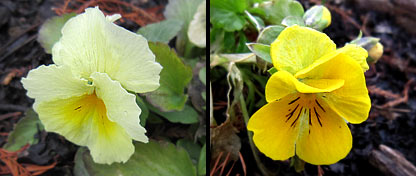 Because this winter has been fiercer than most recent ones, I didn’t think the pansies that were planted last fall would survived. They did though. Nearly all of the hundreds of pansies planted in the large display beds are back and beginning to bloom again. The keepers of this garden filled the display beds with just two varieties: a very light yellow one called ‘Clear Sky Primrose’ and a deep yellow one named ‘Clear Sky Yellow.’ Sources on the web tout the Sky series as being able to withstand extreme weather better than other pansies and as being tops for overwintering. Now that see how well they’ve done here, I’m a believer. 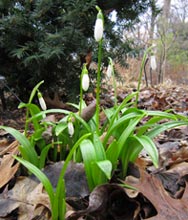 Snowdrops started to bloom here about three weeks ago. Every week since I’ve seen more and more of them in more and more places throughout the botanical garden. I look at them even more closely this year since I read that one snowdrop bulb sold for more than $500 on E-Bay. Granted it was a rare bulb with historical ties to that irrepressible English gardener and writer E. A. Bowles, but still I find myself looking for snowdrops other than the common Glanthus nivalis. This morning I found this one. In the English Garden where I saw it, it was identified as Galanthus ikariae subsp. latifolius. I noticed it because of its wide curved glossy strap-like leaves. The flowers buds look small, but I’ll have to come back on a sunny day to see them open. Snowdrops started to bloom here about three weeks ago. Every week since I’ve seen more and more of them in more and more places throughout the botanical garden. I look at them even more closely this year since I read that one snowdrop bulb sold for more than $500 on E-Bay. Granted it was a rare bulb with historical ties to that irrepressible English gardener and writer E. A. Bowles, but still I find myself looking for snowdrops other than the common Glanthus nivalis. This morning I found this one. In the English Garden where I saw it, it was identified as Galanthus ikariae subsp. latifolius. I noticed it because of its wide curved glossy strap-like leaves. The flowers buds look small, but I’ll have to come back on a sunny day to see them open.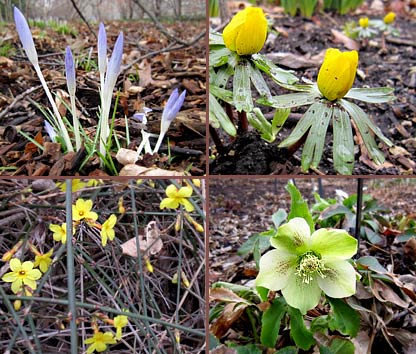 A week ago only the witch hazels and snowdrops were blooming. This morning out of nowhere come Winter aconites, the early Tommie crocuses, the Winter jasmine, and here and there a hellebore. Just to prove it, I’ve got the pictures. 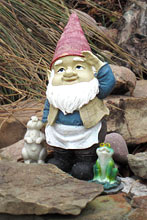 As far as I know, there’s only one gnome in this botanical garden – this one in the Children's Garden. Yet in the garden’s bookstore there are three different books on garden gnomes. Like pink flamingos and snow globes they’re so kitsch and so easy to poke fun at that they’ve become endearing. Have a look at this YouTube video for tips on how to use and manage garden gnomes from an expert at the Ogden Botanical Garden. As far as I know, there’s only one gnome in this botanical garden – this one in the Children's Garden. Yet in the garden’s bookstore there are three different books on garden gnomes. Like pink flamingos and snow globes they’re so kitsch and so easy to poke fun at that they’ve become endearing. Have a look at this YouTube video for tips on how to use and manage garden gnomes from an expert at the Ogden Botanical Garden.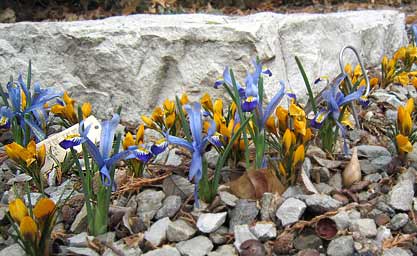 Before finishing my walk, I decided to check the rock garden. It gets a lot of sun and is sheltered on three sides so I thought this would be a friendly place for any early spring blooms. Beside a rock that sheltered and warmed, I saw this stand of egg-yolk yellow crocuses mixed up with these delft-blue iris reticulatas. I always thought that seeing the first true blue flower of the season is a far better predictor of spring that any groundhog ever will be.  clear: calm: 40ºF clear: calm: 40ºFThe sun’s been up about an hour and the botanical garden doesn’t open to non-members for another hour but the parking lot has many more cars than I would have expected. I think it has to do with orchids. The garden’s annual show opens this morning. The show with its hundred of orchids on display seems to whet everyone’s appetite to see and own an orchid. And to satisfy that craving to buy, there are orchid growers and venders already setting up in a room just outside the show. I went to the opening preview of the orchid show last night. Then after the show, I stopped by the vendor’s room to look and listen. Orchid vendors don’t use a hard sell. The beauty and the exotic look of the blooms sell themselves. Buying an orchid is like taking a vicarious vacation to somewhere you can’t afford to go. For the people who did need some convincing before they bought, the vendors made a couple of pitches: Orchid blooms last a long time. “Why I had a Phalaenopsis that bloomed in January and didn’t drop it’s flowers until July. Sure, orchids cost a bit more, but just think how much you’d have to spend buying fresh flowers for six months.” Failing that argument, I heard lots of variations on this theme: “Ah shucks, people think orchids are finicky, tough to grow, but you know they’re not much different from ordinary houseplants.” I didn’t buy an orchids last night; nor did I this morning when I visited the vendors room after my walk. But, I was tempted. 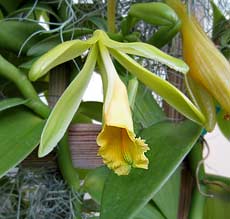 At each of the garden’s annual orchid shows the keepers display their venerable vanilla orchid (Vanilla planifolia). The botanical garden has had this orchid for 107 years. The plant is always given a place of honor near the door, but close to a wall where it can be seen yet out of the crowd flow. Unlike a lot of orchid blooms, that keep going and going and going, the blooms on a vanilla orchid last just a day. For years, I've tried to catch this oldster in bloom, but never did. This year I got lucky. Vanilla was blooming this morning. Very appropriate that I see it bloom this year since the theme of the orchid show is ancient Mayan culture and civilization and the oldest reports of vanilla use relate to the Mayan who used it to spice up their chocolate drinks. At each of the garden’s annual orchid shows the keepers display their venerable vanilla orchid (Vanilla planifolia). The botanical garden has had this orchid for 107 years. The plant is always given a place of honor near the door, but close to a wall where it can be seen yet out of the crowd flow. Unlike a lot of orchid blooms, that keep going and going and going, the blooms on a vanilla orchid last just a day. For years, I've tried to catch this oldster in bloom, but never did. This year I got lucky. Vanilla was blooming this morning. Very appropriate that I see it bloom this year since the theme of the orchid show is ancient Mayan culture and civilization and the oldest reports of vanilla use relate to the Mayan who used it to spice up their chocolate drinks.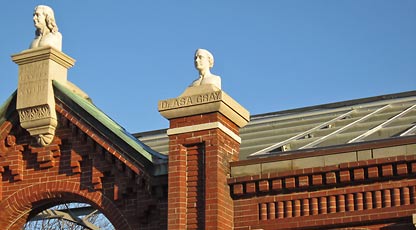 For the past two weeks we’ve seen workers setting up the beams and crossbars that will support the glass roof on the Linnean glasshouse. The 150 year-old glasshouse has been closed since fall for a complete redo. Once the supports are in and the glass is put in place, I think the inside work will begin. I miss the old glasshouse, especially this time of year. The botanical garden’s camellia collection lived here. And the japonicas, the best of all the camellias, would have been coming in bloom just about now. I wish the keepers of this botanical garden would have put a Camellia japonica or two on display in one of their other glasshouses just to help us all move winter along a little faster. 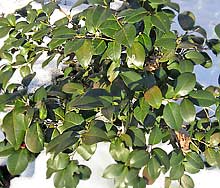 Outside there is a Camellia japonica that is holding up remarkable well to winter. It’s not billed as one of the “hardy camellias,” but it’s faring better than any the hardy varieties in the garden. This japonica named ‘Korean Fire’ was planted without much protection from the wind along a walkway in the English Woodland Garden. Even this late in the winter, the shrub is covered with glossy dark-green foliage with hardly a trace of burn or browning. ‘Korean Fire’ got a gold medal award from the Horticulture Society of the snow-covered state of Pennsylvania. They say it’s the hardiest of the japonica species and has survived temperatures of -12F with no injury last fall. I saw deep red blooms on the shrub last year. Maybe a repeat this spring? Outside there is a Camellia japonica that is holding up remarkable well to winter. It’s not billed as one of the “hardy camellias,” but it’s faring better than any the hardy varieties in the garden. This japonica named ‘Korean Fire’ was planted without much protection from the wind along a walkway in the English Woodland Garden. Even this late in the winter, the shrub is covered with glossy dark-green foliage with hardly a trace of burn or browning. ‘Korean Fire’ got a gold medal award from the Horticulture Society of the snow-covered state of Pennsylvania. They say it’s the hardiest of the japonica species and has survived temperatures of -12F with no injury last fall. I saw deep red blooms on the shrub last year. Maybe a repeat this spring?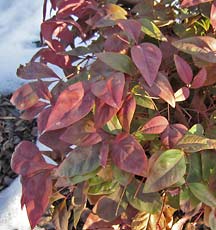 Then there’s this one -- Nandina domestica 'AKA' Pink Blush. It’s called Pink Blush because its new growth foliage starts out as red and then stays red all season long. The shrub was developed by a wholesale nursery outside Houston to add color to Southern gardens. Yet I found about a dozen small Pink Blush shrubs growing here – a zone or two further north than they like to be. In places where they are sheltered on three sides from cold winds and open to a south sun, they are look as like my photo. When planted in other less protected spots, they’ve turned so brown that I think they’re likely to see the compost heap before they see spring.
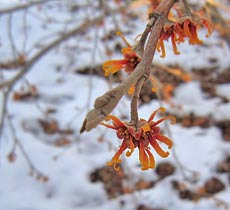 Perfectly at home in this zone though are the witch hazels. This week I saw this Vernal Witchhazel in bloom. All these early bloomers need is a few days of sun and warmer weather to get them to go from tightly closed buds to fragrant flowers. Perfectly at home in this zone though are the witch hazels. This week I saw this Vernal Witchhazel in bloom. All these early bloomers need is a few days of sun and warmer weather to get them to go from tightly closed buds to fragrant flowers. gradual clearing: calm: 24ºF gradual clearing: calm: 24ºF Work on the replacement of the panels on the barrel roof of the visitor’s center has started. So far the work has been limited to taking down the panels on the outside bonnet overhangs of the front and back entrances to the building. All of the panels over the inside are still in place, but I'll be interested to see how the contractors take off the inside roof panels and still keep us visitors warm. Maybe an even trade -- old for new -- replacement scheme. Work on the replacement of the panels on the barrel roof of the visitor’s center has started. So far the work has been limited to taking down the panels on the outside bonnet overhangs of the front and back entrances to the building. All of the panels over the inside are still in place, but I'll be interested to see how the contractors take off the inside roof panels and still keep us visitors warm. Maybe an even trade -- old for new -- replacement scheme.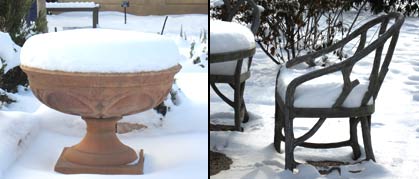 The ground is covered with about six inches of snow. The snow is still lying just where it fell. So this morning, container pots have whipped cream toppings and some concrete chairs have thick white cushions. This season the botanical garden set aside a plot for testing dozens of new varieties of Coneflowers (Echinacea purpurea). Coneflowers in the wild are purple, nothing but. But in the last few years, breeders have crossed Echinacea purpurea with other species of Echinacea to come up stunning new varieties. Don’t like purple – now there are red, bronzy, orange, white, green, yellow, pink, and even ones with two-toned petals. Petals now come shaped as quills, spiders, or spoons. Cones can be flat, elongated, fuzzy, fluffy or filled in with tiny petals. I think the most over-the-top variety I’ve even seen is one called ‘Double Decker.’ 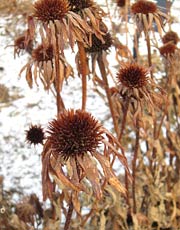 The keepers of the garden decided to let the flowers and foliage of the coneflowers winter over, rather than cutting them back. The plot that was filled with color all summer and fall now looks like a sepia print. The stems of coneflowers must be extremely tough because most of them still look as they did when they were in bloom.
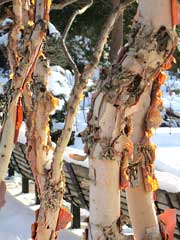 The peeling bark of a river birch, snow in the background, and sun shining through the papery layers. Glad I’m here this morning.
 overcast: a cold north wind: 34ºF overcast: a cold north wind: 34ºF“Take an early morning walk in the botanical garden.” More than a few people must have decided this would be a good way to start the new year because we see more couples and groups (mostly women) than are usually here on these not-so-pleasant mornings in January. The keepers of this botanical garden use the months between the end of the holiday train show and the beginning of spring to fix things. Renovation is a predictable part of this low attendance season. This year all of the fiberglass panels of the massive barrel vault ceiling of the main entrance to the botanical garden – the Ridgway Visitor’s Center -- are being replaced. I was part of the crowd in 1982 when the newly built Center was dedicated. Now nearly thirty years later, the fiberglass panels are discolored, they sometimes leak, and they have no insulation. The plan is to replace them with 3” thick panels that will allow light in while insulating as well as a solid wall does. The new skyroof will be in place by the end of May. During the winter lull next year, the plans are to redo the inside of the Visitor’s Center by adding another elevator, more restrooms, better display and exhibit space, and by making it easier for visitors to get into and out of the garden. When it’s all finished in a couple of years, a release from the garden’s PR office optimistically boasts that new entrance will be “a world-class gateway that reflects the Garden’s brand and mission and meets the needs of visitors in the 21st century.” 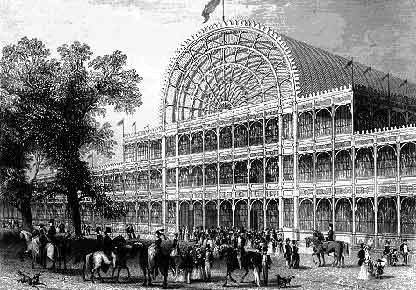 With all that’s new, what won’t change is the long barrel-roof design of the visitor’s center. It was designed to echo the design of the Crystal Palace of the 1851 Great Exhibition in London which Henry Shaw, the founder of this botanical gardens, visited while on one of his grand tours of Europe.  When the visitor’s center opened in 1982 I thought the design looked fresh, different, and adventurous. Now thirty years later the design looks hackneyed. Glass walls that use spokes radiating from central core have become an over-used feature of malls, strip centers, airports, casinos, and walkways. What was fresh then has been co-opted and copied too many times in the ensuing years. Odd how having too much of a good thing makes it seem insipid.
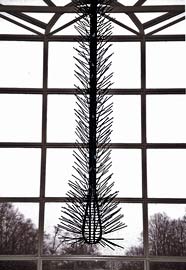 Until the renovations are complete, the ton and then some of glass pieces that make up the Blue Chandelier done by glass artist Dale Chihuly that hung atrium of the visitor’s center will go into storage. All that’s left now is this twenty foot long carcass of bones. Lest new visitors to the garden mistake the skeleton for art, a nearby sign says Blue Chandelier has been dismantled and removed for safekeeping. The sign adds when the renovation is complete “Chihuly Studio will send a representative to recertify its authenticity as a Chihuly piece.” Until the renovations are complete, the ton and then some of glass pieces that make up the Blue Chandelier done by glass artist Dale Chihuly that hung atrium of the visitor’s center will go into storage. All that’s left now is this twenty foot long carcass of bones. Lest new visitors to the garden mistake the skeleton for art, a nearby sign says Blue Chandelier has been dismantled and removed for safekeeping. The sign adds when the renovation is complete “Chihuly Studio will send a representative to recertify its authenticity as a Chihuly piece.”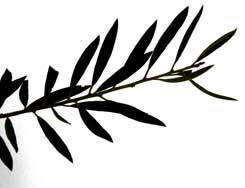 When everything outside is covered with a snow I look for plants that are thriving in spite of the weather. Failing that I go for scenic shots. This morning I got both. In the Ottoman Garden I found this small shrub of Myrtle-leaved holly (Ilex myrtifolia) named ‘Wollander’s Weeping’ that looks great surrounded by snow. The USDA database says the shrub is native to the wetlands around the Gulf of Mexico. At a glace the shrub looks like rosemary because of its long stems and leaf arrangement. The stem and leaves make a striking silhouette against the snow.
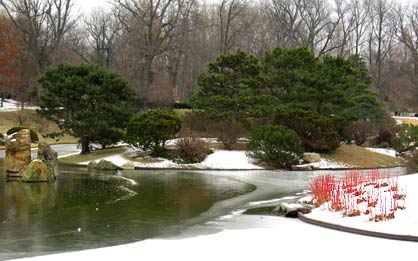 Scenic shot: I took this one in the Japanese Garden: Red Twig dogwoods planted on the point of the Sacred Island. |
||||||||||||||||||||||||||||||||||||||||||