
 clouds, then clearing: easy light breeze: 29ºF

The botanical garden’s annual orchid show opened this week. The theme this year is Madagascar. Malagasy plants, artifacts, clothing, and lemurs made of twigs and leaves are all here along with a rotating display of some 600 blooming orchids.
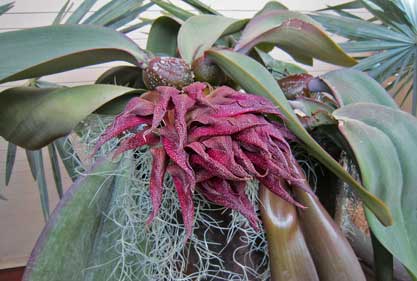
One the largest, rarest, most unusual orchids on display is this one from New Guinea called the Tongue Orchid (
Bulbophyllum fletcherianum). I’ve never seen this orchid displayed at any of the orchid shows over the years and it wasn’t mentioned in the behind the scenes tour of the orchid houses that I took last year. I suspect the keepers of the orchid houses are just as surprised and pleased to have it here and in bloom as I am to get a chance to see it. On opening night there was a docent stationed near The Tongue encouraging visitors to sniff the fleshy merlot-colored bloom cluster and then to describe its aroma. I heard words like “terrible,” “musky,” and “rotting.” A stylishly dressed woman cautiously edged forward, took a short whiff, and then when asked about the smell said, “I won’t say.”
An Australian grower who sells Tongues writes “The beautiful maroon flowers of the
Bulbophyllum fletcherianum release an overpowering aroma which attracts its pollinators – blowflies & carrion beetles.”
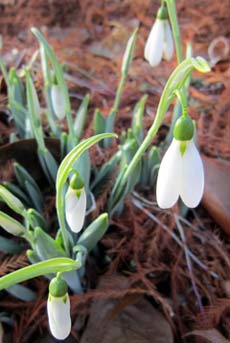
I think most of us enjoy spotting the first snowdrops of the new year. My father’s daybooks always had an entry marking the date when he saw the first robin of the year. Snowdrops sightings are a lot like that – they’re memorable days; they’re the plant robins that push us to look ahead. But apart from being important as seasonal seers, the blooms themselves don’t seem to attract much attention.
In Europe it’s different. There,
snowdrops (Gallanthus) are becoming superstars. In a
village near Devon, England, there are park and ride buses leaving for “Snowdrop Valley’ every twenty minutes. Outside a church, there’s a floral cross that’s been planted with hundreds of snowdrops. In London, the
Chelsea Physic Garden has its Snowdrop Days where visitors pay about $15 to see 10,000 snowdrops in bloom. At Anglesey Abby gardens just outside of Cambridge, visitors have to reserve a seat on their snowdrop tour busses.
For those who collect as well as admire snowdrops – the “galanthophiles” – there’s plenty of variety to keep them interested. There are 20 species and over 2000 cultivated varieties of snowdrops. As if that’s not enough, a couple in Scotland found
a unusual snowdrop with a yellow head and yellow markings on its white petals growing in their garden. Last year a bulb of the new plant (
Galanthus woronowii 'Elizabeth Harrison') sold for a record £725 ($1140) to the plant and seed company Thompson & Morgan.
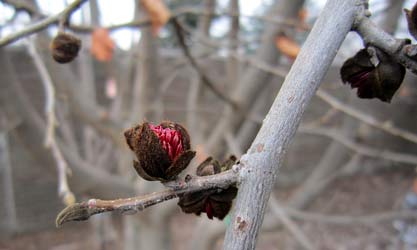
The Persian Ironwood trees (
Parrotia persica) in the English Woodland Garden and in the Kemper Home Gardens have started to bloom. The dark capsules open and form a nest protecting the tight clusters of strawberry red flowers. Each flower cluster is only about a half-inch across, but even so they stand out against the bare, leafless branches.
Reds you can get in winter as long you're satisfied with looking at twigs. Red twig dogwoods (
Cornus sericea) do the job. Last week at the
wreath laying ceremony honoring Hall of Famer Stan Musial, the St. Louis Cardinals lined a plaza in front of the stadium with a hedge of red twig dogwoods because they were as close to cardinal red as they could come in the middle of winter.
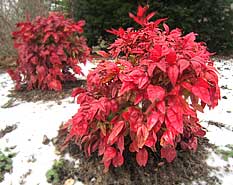
This year the red twigs have some competition for the best winter red in the Garden. Three years ago a new plant debuted --
a variety of Nandina domestica called 'AKA' Blush Pink. Unlike the red twigs, these squarish-shaped two-foot tall shrubs get their color from their soft, silky leaves. They’re brighter red than the red twigs and because they’re a solid mass of color, they attract and stop the eye especially when they’re planted in clusters. These Nadinas are so red that when I saw them for the first time I thought that someone must have bought them from the floral aisle in a Michael’s Arts and Crafts store and put them in the garden as a joke.
 high clouds: easy breeze: 28ºF
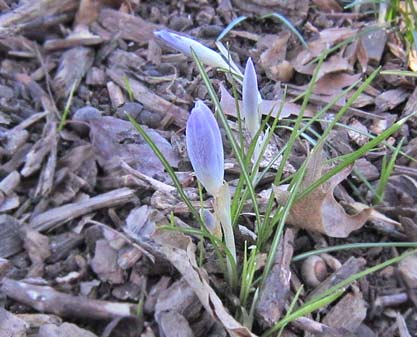
Tommys - the season’s earliest crocuses (
Crocus tomassinianus)
are beginning to bloom. I’m becoming blasé about flowers that break the rules about when they're supposed to bloom. So rules aside, Tommys that bloom in January instead of waiting until late February are just as welcome.
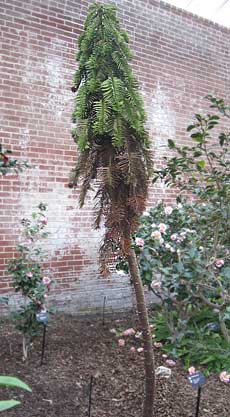
Unlike the thriving Wollemi Pine that we saw last week at the Powell Gardens, this tall Wollemi here in the Linnaean glasshouse looks as though it’s dying. The leaves are folded down close to the trunk and the lower branches have turned brown. Odd that these trees with a history that goes back a couple of hundred million years in the wild have trouble surviving in captivity.
The camellias are in full bloom in the Linnaean glasshouse. All kinds of them. I read
an article in a newspaper last week that describes why a lot of us are so attracted camellias: “Their blooms. From white or pink to deep red, some as simple as a wild rose, others as full blown as a peony, are set against glossy dark leaves. They have the same startling color as those white roses painted red for the Queen of Hearts in ‘Alice in wonderland.’ ” As an added bonus, camellias bloom in the winter. Not reluctantly either. No half-hearted blooms that have I have to put on my glasses and get on my knees to admire. Camellias have chutzpah. They aren’t at all reticent about putting on a show right at eye level.
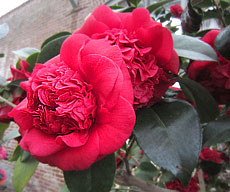 In this glasshouse, I alternate between looking for the very simplest, palest camellias I can find with trying to spot some fiery red one that’s as big as a power puff. This week, it’s the bold ones I like better. And among the boldest is this Japonica named Professor Charles E. Sargent – a strong, deep red with blooms the size of peonies. I’ve read that “some camellia aficionados consider ‘Prof. Sergeant’ to be unbearably commonplace,” but for a flower that’s been around nearly a hundred years, I think it holds it’s own among the new young guns.
 The camellia’s namesake, Charles E. Sargent was first director of Harvard’s Arnold Arboretum. He stayed there from 1872 until he died in 1927. The camellia that bears his name was named in 1925, but I don’t know whether Sargent -- the Professor -- and Sargent -- the flower -- ever crossed paths.
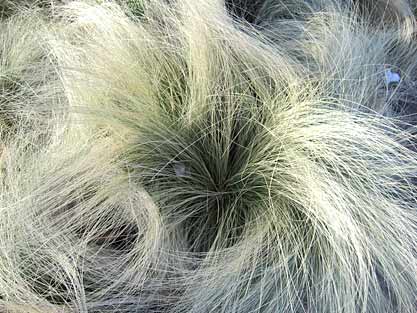
On your next visit to the Garden, have a look at this Mexican feather grass (Nassella tenuissima) planted at the base of the Soleri bell tower. When I looked at the oversized funnel clumps of the grass that move with the wind, I marveled at how good the keepers of this botanical garden are at matching plants with their settings. The Soleri cast-bronze bells often ring by themselves when the wind catches their protruding flat copper tails. So grass and bells celebrate the wind together.

This botanical garden is systematically replacing the black “tombstone” markers used to identify plants with embossed markers stuck into the ground along side each plant. Identification is not being lost; but it is being changed. And I don’t like it. No longer will it be possible to see at a glance what a particular plant is. Identification will now take more effort – knelling down, looking for the tag, brushing way the foliage, and then trying to read the embossed lettering pressed into a low contrast silvery stake. It may be more aesthetic, but it contradicts the Garden’s mission of trying to do all it can to “share knowledge about plants”
As if that weren’t enough, my walking partner in Garden, pointed out that the new signage robs her of the anticipation of things to come and pleasures she’s already experienced. In midwinters past, we used to be able to look at the tombstone markers of favorites like the Bess Ross daylily and see in our mind’s eye the towering stocks supporting the flowers with long tampered petals each dissected a yellow line. Now it’s hard to even find the place where Bess Ross once bloomed. I don’t like it.

clear: slight breeze: 28ºF
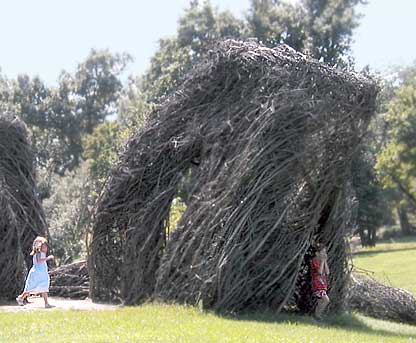
It’s been nearly seven years since we last visited the Powell Gardens near Kansas City. When we were last here, the Gardens were filled the loosely woven twig and sapling sculptures created by Patrick Dougherty. That day in late August the Gardens were also filled with blooms and fountains and lots of people. This early Sunday morning we had the 900+ acre garden to ourselves. A keeper of the gardens that we met along our walk told us that were lucky to be here at this time and in this season because we got a rare chance to see the bare bones of the Garden.
The lone staff member in the Visitor’s Center told us that the Garden was unusually quiet this morning, but that last night it was filled with revelers who had come to take part in an old English tradition of “wassailing the apple trees.” Since we were last here, Powell Gardens added an 12-acre Heartland Harvest Garden that’s filled with more than 2000 varieties of food plants that can be grown in the Midwest. The Harvest Garden includes a vineyard along with demonstration gardens of peaches, pears, and an Apple Court that’s planted with 50 varieties of apples.
Yesterday at dusk a Wassail King and Queen led a procession of well-wishers to the Garden’s Apple Court. There by torchlight, they sang, recited incantations, and beat sticks together. If their magical efforts pay off, the apple trees planted here will be disease-free, the harvest will be bountiful, and any apple-hating spirits that happen to be in area will be driven away. Even though we missed the ceremony, we did see a table filled with the racket-making sticks that were used, and we saw a piece of toast that had been put in one of the apple trees. Tradition has it that the Wassail King and Queen must place a piece of toast soaked in hard-cider wassail in the branches of an apple tree as a gift to the tree spirits and to let the trees know that they need to produce as generous a crop this year as they did last.
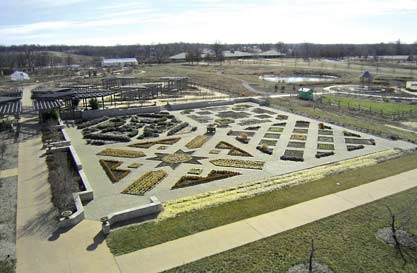
Visitors to botanical gardens always want to see what the plantings they see on the ground look like from above. Kew Gardens outside London has its 160-foot tall Pagoda that visitors in the late 1700’s could climb. The Missouri Botanical Garden, the garden where I walk, has its onion-domed shaped Piper Observatory that overlooks a maze. Powell Gardens has its Silo Overlook, a 45-foot tall observation tower lined with a spiral staircase that overlooks a four-acre garden planted to resemble four traditional quilt blocks. Seen from above, the gardens look at lot like formal knot gardens. Those gardens were also laid out using needlework designs, but instead of quilt blocks, knot gardens used embroidery patterns common in Elizabethan times.
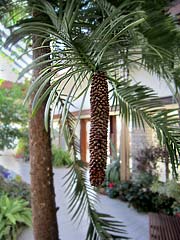 Just inside the Conservatory in the Visitors Center we spotted a tall, healthy Wollemi Pine (Wollemia nobilis). Whatever the keepers of this Garden are doing, they’ve hit on a way to keep their rare but also fussy-in-captivity specimen happy. The tree is over ten feet fall; the branches are fully extended; the needles are deep green; and the ends of the branches are filled with pollen cones like this one.
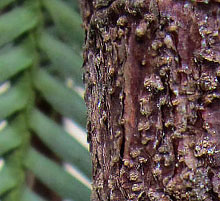 This is the first time I’ve been near enough to a Wollemi to really see what its bark looks like. Up close it looks like a Nestle Crunch bar might if had a extra helping of crackles.
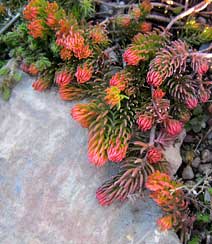 The walls on the Island Garden are draped with Angelia Sedum – my choice for one of the winter’s best plants. Proven Winners, the plant’s developer and marketer, says that Angelina thrives in heat or in cold. It’s also supposed to be drought resistance. Seems to me this one’s a nearly perfect plant for global warming. Angelina’s needles are yellow in the summer, but here in mid-winter the ends are tipped in salmon.
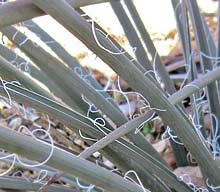 This one we would have missed if Matt, one of the keepers of this garden, had not called our attention to it. It’s a Texas native called the Red Yucca (Hesperaloe parviflora). He told us that despite the plant’s origins in Zone 7, the plants that they raised from seeds are doing just fine here in what he called a “very cold Zone 6.” The Texas Aggie website says that the Red Yucca isn’t really a yucca because it doesn’t have spiny tips and it has lots of stringy threads along the leaves. In the summer this not-a-yucca looking yucca throws up tall spikes of coral flowers.
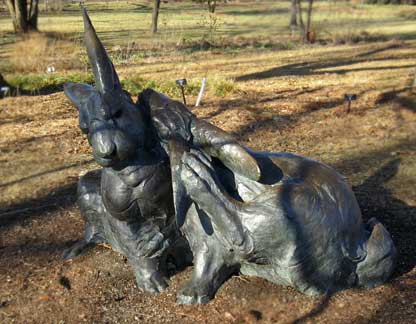
Who could visit Powell Gardens without taking a picture of the snuggling bunnies sculpture? Their ears and backs are well-worn from kids and grown-ups both who can’t resist them.
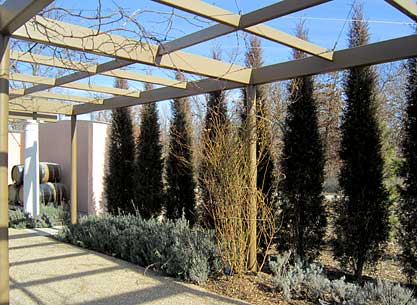 In the botanical garden where I usually walk, one of the walkways is lined with Taylor Junipers (Juniperus viginiana). They’re a perfect substitute for the tall, columnar Italian Cyrus trees that wouldn’t stand a chance in Zone 6. Powell Gardens also has a impressive wall of Taylor Junipers lining the pergola that edges the Vineyard Garden. The Garden “chose this Nebraska variety of our native Redcedar because it looks the most like the elegant tall Italian Cypresses which give a Mediterranean ‘paradise’ feel but are not hardy in our climate. . . Junipers are either male or female and Taylor is a female cultivar so does produce beautiful blue edible ‘berries’ (they are actually modified cones). The berries of Taylor are a bit sweet with a strong gin after taste -- yes true gin is flavored by Juniper berries!”
Fifty varieties of grapes are growing in fan-shaped rows just beyond the pergola. A description on Garden’s website says that “Each row ends with a hybrid tea rose, which not only adds beauty and edible flowers to the landscape but also act as the ‘canaries in the mineshaft’ to foretell any problems that may affect the grapes.” On a blog called Wine Treasures, I read that grape vines and roses are susceptible to the same fugal diseases, except that the roses are infected first. Finding a rose infected with mildew is a tip off that the grape vines are next to be hit.

 | E-Mail me