This morning I got a sneak peek at a bloom I expect to see in March. A ‘Dawn’ Viburnum (Bodnant viburnum) was in flower along the east wall of the Garden. I smelled it expecting to get a whiff of spring, but either my nose was dulled by the cold or ‘Dawn’ was keeping its sweetness to itself. Spells of warm weather must have lured it into bloom. The website of the botanical garden in New York City says that weeks of warm, wet weather there bought out early viburnums, star magnolias, and even a few daffodils. I checked every sheltered location I knew of, but found no daffodils in bloom here yet even though some leaves are up six-inches or more.
What to do when a couple of shrubs in a tall hedgerow of mature yews die? My first thought would be to pull- out the offending yews and replace them with new shrubs. That solution works and this botanical garden has done that in other places. But the new yews are just a few feet tall and I read somewhere that tall, mature yews don’t transplant well. So, what’s left? Replace the whole hedgerow – the good along with the bad – or suffer a hedge row that has its ups and downs. This morning I saw another alternative. The smart folks that run this garden decided to plant two very bushy short yews under the spreading top branches of the older yews on either side of them -- a very elegant, unobtrusive solution. As the younger yews fill the gap, who’s to notice.
We went to the botanical garden’s annual orchid show that previewed on Friday evening. With a glass of wine in hand we snaked our way through an exhibit space made to look like a Victorian conservatory . Up, down, and at eye-level were thousands of blooming orchids.
I was hoping to see one particular orchid. It’s called the ‘Comet Orchid’ (Angraecum sesquipedale) or sometimes the ‘Star of Bethlehem’ or ‘The Christmas Orchid.’ I read that a Comet Orchid was blooming at the SelbyBotanical Garden in Sarasota, Florida right now and was being treated like a botanical celebrity by the local newspaper so I wanted to see what the fuss was about.
The Comet Orchid is a native of Madagascar. It picked up the nickname “comet” because the flowers often have spurs or tails that are a foot long. When Charles Darwin saw a Comet in bloom at the Royal Botanical Gardens at Kew in 1862, he predicted that a yet to be discovered moth with a foot-long tongue would have to exist to pollinate the orchid. The Sarasota newspaper says that Darwin’s “prediction was the stuff of sexual jokes, and Darwin got the reputation for being daft.” But, forty years after he died, just such a moth was found and was aptly named the ‘predicted moth.’
I thought that even if there were a Comet at this orchid show, finding it among 800 varieties and thousands of blooms would be a long shot. I was wrong. It was the first orchid I saw. A pot of Comet Orchids was placed on a prominent pedestal just inside the door to the foyer of the exhibit hall.
On Friday, there were six flowers in bloom. They’re star-shaped and the petals are puffy, as if they’d been stuffed with cotton. The flowers look waxy, and on this night they filled the foyer with their sweet, heady aroma.
On another wall in the foyer are mural-sized reproductions of photos taken at this botanical garden’s orchid greenhouse in 1868 – less than a decade after the Garden opened and just a few years after Charles Darwin spotted his Comet in London. In that sepia-tinted photo, I saw a Comet Orchid in bloom.
filtered sun: calm: 26ºF
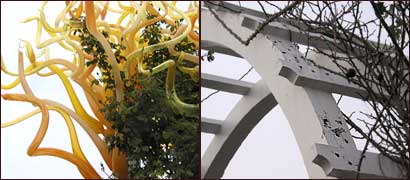
The glass is gone, well mostly. “Glass in the Garden,” the eight-month show of hand-blown, art-glass works of the Dale Chihuly studio ended on January 1st. The sinuous yellow pieces that outlined the curve of the arbors in the rose garden were gone this morning leaving just holes where the supporting stakes once were. The reflecting ponds where the “Walla Walla glass onions” floated were covered with ice now that their heating systems have been shut down. The twenty-foot long chandelier of 928 pieces of blue and white glass goosenecks and spirals will stay behind as a permanent display in the atrium entrance to the botanical garden.
A newspaper article that recapped the Chihuly show reported that 950,000 people saw the show and that overall attendance at this botanical garden jumped to 1.2 million people on 2006 – double the number of visitors in 2005. Supporting memberships to the garden also were up by 22%. Revenue figures for the sale of arts works, gift shop souvenirs, and gate receipts were not mentioned in article, but I’ll be anxious to read the botanical garden’s annual report this year to follow the money.
The director of the Garden commented that the beauty of Dale Chiluly’s work has introduced a whole new generation of visitors to the Garden. It may be too early to think that -- could be just a short-lived Chilhuly-effect, not the plants. Then too, given the success of the Chihuly show, the new thinking might be that the viability of a botanical garden depends upon a succession of block-buster attractions that dazzle and delight visitors.
To continue what may become a trend of successive really big shows, this botanical garden will host an exhibit of stone sculptures done by the Chapungu artists of Zimbabwe. The show, a reprise of exhibit shown here in 2001, opens at the end of April and will go on for most of year. Plans for 2008 haven’t been announced, but I wouldn’t be surprised to see the oversized sculptural pieces of Niki de Saint Phalle appear here. The AtlantaBotanical Garden just closed a blockbuster exhibit of her work last month. Phalle’s colorful pieces of giant animals, musicians, and Botero-like women are covered with ceramic mosaics, glass stones, and mirrors. Best of all, people can climb on them, sit in them, or crawl through them. I didn’t see the show in Atlanta, but visitors to AtlantaBotanical Garden this summer posted these pictures of the Phalle’s art work and this video of kids cavorting on a Niki skull.
The Linnean glasshouse is brimming with blooming camellias this time of year. The keepers of the garden say that they’ll be at their prime in February, but there’s plenty to see now. Besides camellias and the usual couple of sparrows that winter over in the glasshouse, there are lots of other things to see trailing up the walls or creeping on the ground. I’ve been watching a vine on the east side of the house for a while now waiting for it to bloom. This morning it did. The vine is a tropical. The sign says it’s a South American native called Pseudogynoxys cumingii or Daisy Vine. It’s a member of the daisy family, but it has the fat and toothy look of a zinnia. I look at the Daisy vine and think that if a breeder would ever come up with a zinnia that twined and climbed, it would look like this.
Pansies ought be called resurrection flowers or possum plants. It’s way below freezing this morning and a heavy frost has covered anything left out overnight, including the pansies. They’re prostrate. Their foliage and flowers are relaxed enough to be taken for dead. They're not though. I’ve seen their dance of death enough times to know that when temperature rises and the sun comes out, they’ll perk up and join the living.
Crinum lilies are used as ground cover in many of the public parks and in the botanical gardens in Madeira. Here, in winter they have a beauty of their own. Their once stiff green leaves now spread over the ground in graceful, choreographed displays. Seeing them is like looking a stop action shot of a ballet or some sea thing swimming deep underwater.
I’m still amazed by what I happen across in my walks in this botanical garden. Even after years or walking and looking, I stumble across some insignificant looking something that with the help of a web search opens some new door. This morning as I was looking at crinum lilies, I happened to see a clump of battered green lily-like leaves that shielded a stubby stock of red berries. The sign along side said they were “Omoto” (Rhodea japonica). Turned out it was a misspelling of Rohdea japonica – the Japanese Sacred Lily.
Omoto, I found means “big base” because all the lily’s strap-like waxy leaves rise from a single base. Omoto is an evergreen here and is appreciated more for its red winter flowers than for its “insignificant flowers” – which I’ve never noticed. I suppose because they’re insignificant.
Turns out Omotos were used in Japanese floral art as early as mid-13th Century -- not because of their flowers or berries, but because of the shape of their leaves. In Japan, hundreds of varieties are bred to create leaf shapes of different sizes, edging, textures, and variegated patterns. There are Omoto societies and competitions that fuel the passion for new and intriguing plant variations. Special expensive designer pots are used to show off young Omoto plants at competitions.
All this attention to the Omotos in Japan seems akin to hosta fever in America. In fact Plant Delights, a nursery in North Carolina, calls Omotos “evergreen hostas.” Plant Delights claims to have the largest selection of Rhodeas in the United States. They offer ten varieties in their 2007 catalog with prices ranging from $14 to $100, but they say that in Japan, the prize new “fancy leaf” varieties can bring from $1,000 to $10,000 per division. The price stays high because Omotos elude tissue culture methods, they are slow to divide, and demand for the latest and best is fierce. Come spring, I’m going to buy a couple of the $14 garden varieties of Omotos for my shade garden to complement the Italian arum in winter. I may even pop for a $28 Rohdea japonica ‘Suncrest’ with a creamy white, raised band that runs down the center of each leaf.
sun and clouds take turns: light breeze: 70ºF
It’s fitting: a new year and a visit to a botanical garden I’ve never been to before – the Madeira Botanical Garden on the island of Madeira, Portugal.
After years of marveling over the tiny blooms of winter honeysuckle and the odd snowdrop in January at the botanical garden where I usually walk, the lavish abundance of this subtropical botanical garden is overwhelming. At this garden the climate and plants seem to be on the same page.
The Madeira Islands are about 500 miles southwest of Lisbon and 400 miles west of Morocco. Year-round the temperatures stay between 65º and 75º during the day, and then drop to the high 50’s at night -- pretty much a Mediterranean climate moderated by warm ocean currents that dampen large temperature swings.
The botanical garden on Madeira is on the side of a mountain – only 2 miles from sea, but about 1200 feet up. We took a city bus from the marina to the garden, but had we started from the top of the mountain instead of the coast, we could have taken a cable car down. I stress “could have” because when I looked at the cable cars climbing high over a canyon-like river valley, I’m glad I took the bus. Still, I wonder how many other botanical gardens have their own stop on a cable car line.
The site where the botanical garden is located dates back to the late 19th Century. In 1881 the Reid family (best known for building the luxury Reid's Palace Hotel and gardens in Funchal), built their family villa and private gardens here. Years later, the regional government bought the Reid property land and turned it into this 12-acre botanical garden that is home to 2500 different plants. The Garden opened to the public in 1960 and hosts about 270,000 visitors a year.
This botanical garden is for the fit. Steep walks connect one level-stretch of gardens to the next higher tier. The garden rises 700 feet from its lowest level where trees and flowers mix with a large exotic bird park to top of the garden where the cable car docks. To ease the ups and downs on the steepest inclines, the walks, inlayed with patterns made from small lava rocks from the mountains or pebbles from the shore, have regularly spaced ripples instead of steps.
When we entered the Garden, we expected to be given a map of the grounds. There was none, so we checked the gift shop to see if we could buy one. T-shirts, yes, but no maps or guidebooks. There was a poster map at the entrance, and later I saw a fine map on Botanical Garden’s website, but without a map in hand as we walked, we felt like kids in a toy store moving from one dazzling overlook or wildly blooming plant to the next.
After leaving the garden, I learned that one of this botanical garden’s continuing research interests is the study of plants that are indigenous to Madeira – especially those in danger of extinction. Without a guide, I missed the out-of-way part of garden that featured these native plants and their habitats.
Every botanical garden seems to have a signature plant display or architectural feature. To find it, buy a postcard in a souvenir shop or watch other visitors to see what they photograph. The Madeira Botanical Garden’s most famous feature is its “choreographed gardens.” Uniformly trimmed foliage plants with colorful leaves are used to fill in shapes that repeat to make patterns and designs.
And at last to the plants -- what gets noticed by a novice like me to the sub-tropics in January? Two plants are impossible to miss: the Dragon Trees (Dracaena draco) because they are so odd and curious and the Pinkball Trees (Dombeya wallichii) because they seem so familiar.
I read on the Garden’s website that Dragon Trees once were common in the low lying parts of the Madeira islands, but now are rarely seen apart from places where they have been planted and cultivated. According to some accounts, naturally occurring Dragon Trees began to disappear when Dodo Birds became extinct. The seeds of Dragon Trees were favorites of the Dodos. They ate seeds, processed them though their digestive tracts, and eliminated them. It was the enzymes in the Dodo’s guts that readied the seeds to sprout. So, no Dodos; no Dragon Trees.
The Dragon Tree has a straight cylindrical trunk like a palm tree, then like a stock of broccoli, it forms a canopy of dozens of bulbous branches that end in a rosette of stiff blue-green leaves. When I see a tree like this, I stop. I look. I also take pictures from every angle and at every time of day. We had the good luck to have two Dragon Trees growing in the gardens at the inn where we stayed at in Madeira, so we got to see them at all times of the day and night.
Pinkball Trees aren’t Madeira natives. Most come from Madagascar, but they take well to Madeira’s climate. The trees I saw today were fifteen- to twenty-feet tall. The trees themselves are unremarkable – roundish-shaped trees with large, course wooly leaves. It’s their pendulous, round pink flowers clusters, some as large as cantaloupes, that hang from the under branches that cause a double-take. Because of the color and ball-like clusters, they reminded me instantly of hydrangea clusters, but with more bell-like, delicate flowers.
The most prominent tree in the garden is an extraordinarily tall Canary Island Palm (Phoenix canariensis) that stands above and apart from all else. It’s tall enough to be seen from most places in Garden and it’s likely I could spot it from sea level if I looked up to see where I’d been.
Among all that was new, some things were familiar. Camellias were ending their blooming season here. Spent blossoms covered the walks and water as they do now in the glasshouse of the botanical garden where I usually walk. In shady spots, large patches of Leopard Plants (Aureomaculata marginata) covered the ground as I’ve seen them do on August days at home. I even saw a ginkgo tree beginning to drop its yellow leaves.
I took many pictures, saw much, learned little, and left foot weary, but dazzled. I think that must be what happens on any first date with a botanical garden.
For more pictures of the Madeira Botanical Garden, click here.

 -- from "Somewhere over the Rainbow" by Harold Arlen and E.Y. Harburg

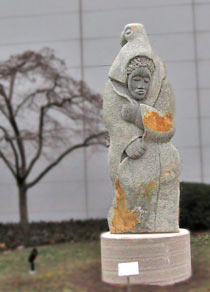 To continue what may become a trend of successive really big shows, this botanical garden will host an exhibit of stone sculptures done by the Chapungu artists of Zimbabwe. The show, a reprise of exhibit shown here in 2001, opens at the end of April and will go on for most of year. Plans for 2008 haven’t been announced, but I wouldn’t be surprised to see the oversized sculptural pieces of Niki de Saint Phalle appear here. The
 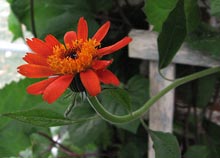 The Linnean glasshouse is brimming with blooming camellias this time of year. The keepers of the garden say that they’ll be at their prime in February, but there’s plenty to see now. Besides camellias and the usual couple of sparrows that winter over in the glasshouse, there are lots of other things to see trailing up the walls or creeping on the ground. I’ve been watching a vine on the east side of the house for a while now waiting for it to bloom. This morning it did. The vine is a tropical. The sign says it’s a South American native called Pseudogynoxys cumingii or Daisy Vine. It’s a member of the daisy family, but it has the fat and toothy look of a zinnia. I look at the Daisy vine and think that if a breeder would ever come up with a zinnia that twined and climbed, it would look like this.
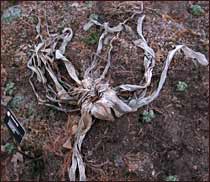 Crinum lilies are used as ground cover in many of the public parks and in the botanical gardens in
 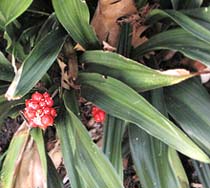 I’m still amazed by what I happen across in my walks in this botanical garden. Even after years or walking and looking, I stumble across some insignificant looking something that with the help of a web search opens some new door. This morning as I was looking at crinum lilies, I happened to see a clump of battered green lily-like leaves that shielded a stubby stock of red berries. The sign along side said they were “Omoto” (Rhodea japonica). Turned out it was a misspelling of Rohdea japonica – the Japanese Sacred Lily.
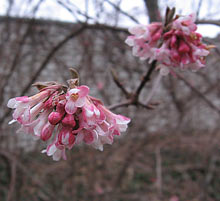 This morning I got a sneak peek at a bloom I expect to see in March. A ‘Dawn’ Viburnum (Bodnant viburnum) was in flower along the east wall of the Garden. I smelled it expecting to get a whiff of spring, but either my nose was dulled by the cold or ‘Dawn’ was keeping its sweetness to itself. Spells of warm weather must have lured it into bloom. The website of
 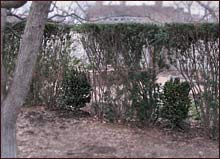 What to do when a couple of shrubs in a tall hedgerow of mature yews die? My first thought would be to pull- out the offending yews and replace them with new shrubs. That solution works and this botanical garden has done that in other places. But the new yews are just a few feet tall and I read somewhere that tall, mature yews don’t transplant well. So, what’s left? Replace the whole hedgerow – the good along with the bad – or suffer a hedge row that has its ups and downs. This morning I saw another alternative. The smart folks that run this garden decided to plant two very bushy short yews under the spreading top branches of the older yews on either side of them -- a very elegant, unobtrusive solution. As the younger yews fill the gap, who’s to notice.
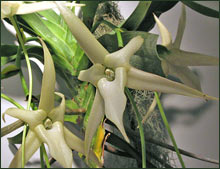 I thought that even if there were a Comet at this orchid show, finding it among 800 varieties and thousands of blooms would be a long shot. I was wrong. It was the first orchid I saw. A pot of Comet Orchids was placed on a prominent pedestal just inside the door to the foyer of the exhibit hall.
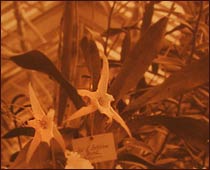 On another wall in the foyer are mural-sized reproductions of photos taken at this botanical garden’s orchid greenhouse in 1868 – less than a decade after the Garden opened and just a few years after Charles Darwin spotted his Comet in London. In that sepia-tinted photo, I saw a Comet Orchid in bloom.
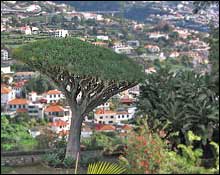 I read on the Garden’s website that Dragon Trees once were common in the low lying parts of the Madeira islands, but now are rarely seen apart from places where they have been planted and cultivated.
 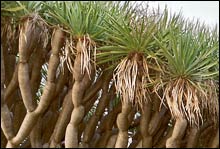 The Dragon Tree has a straight cylindrical trunk like a palm tree, then like a stock of broccoli, it forms a canopy of dozens of bulbous branches that end in a rosette of stiff blue-green leaves. When I see a tree like this, I stop. I look. I also take pictures from every angle and at every time of day. We had the good luck to have two Dragon Trees growing in the gardens at the inn where we stayed at in Madeira, so we got to see them at all times of the day and night.
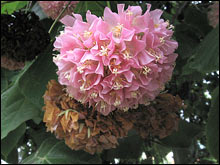 Pinkball Trees aren’t Madeira natives. Most come from Madagascar, but they take well to Madeira’s climate. The trees I saw today were fifteen- to twenty-feet tall. The trees themselves are unremarkable – roundish-shaped trees with large, course wooly leaves. It’s their pendulous, round pink flowers clusters, some as large as cantaloupes, that hang from the under branches that cause a double-take. Because of the color and ball-like clusters, they reminded me instantly of hydrangea clusters, but with more bell-like, delicate flowers.
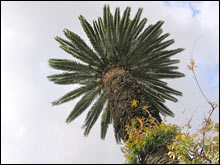 The most prominent tree in the garden is an extraordinarily tall Canary Island Palm (Phoenix canariensis) that stands above and apart from all else. It’s tall enough to be seen from most places in Garden and it’s likely I could spot it from sea level if I looked up to see where I’d been.
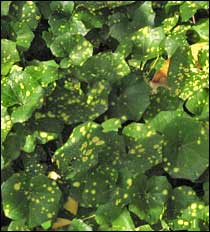 Among all that was new, some things were familiar. Camellias were ending their blooming season here. Spent blossoms covered the walks and water as they do now in the glasshouse of the botanical garden where I usually walk. In shady spots, large patches of Leopard Plants (Aureomaculata marginata) covered the ground as I’ve seen them do on August days at home. I even saw a ginkgo tree beginning to drop its yellow leaves.