 |
|||||||||||||||||||||||||||||||||||||||||||
|
“I really have not the least idea for whom I am writing.
For the flowers themselves, I suspect. For the really simple, absolutely trustworthy winter flowers that may be guaranteed to spangle the garden with blossom, whatever the weather, whatever the soil, and whatever the international situation.  -- from "Down the Garden Path" by Beverley Nichols -- from "Down the Garden Path" by Beverley Nichols |
|||||||||||||||||||||||||||||||||||||||||||
|
 rain: cold wind: 37ºF rain: cold wind: 37ºFLast year the keepers of this botanical garden scattered dozens of witch hazel shrubs among the established plantings on either side of the Garden’s long east walkway. The shrubs are just a few feet tall now, but even so, some have flowered. Ten years from now, winter visitors will stroll along this same walkway. I can hear them say to one another as they spot the row of blotches of yellows, oranges, and rusts, “I never knew that anything bloomed at this time of year.” I looked at the markers placed alongside the shrubs and found that while the varieties were all different, they were all Hamamelis intermedia, a cross between Chinese and Japanese witch hazels. Why just hybrids though? After my walk I stopped for a cup of coffee to warm up and then headed to a nearby public library. Turns out that witch hazel breeders started to create hybrids for the usual reasons: to get bigger flowers and more of them, to get flowers with more intense, glowing colors and to get shrubs that did a better job of filling in gaps on the warm side of the color wheel. They also wanted to beef-up the fragrance of the flowers. Then a second generation of breeders came along and started tinkering with the vibrancy of foliage color in the fall and with staggering the bloom times. Every breeder of course wanted to urge their creations to drop their leaves immediately after their fall color faded. The English author of the book I was reading wrote disparagingly of a hybrid witch hazel variety he saw on a winter visit to America: “I was amazed to see it hang on to high numbers of dead leaves in the USA; only occasionally is such a display seen in the UK.” To add to my store of botanical trivia, I found that the witch hazel capital of the world is the Kalmthout Arboretum in Belgium. They hold the world’s record for creating more witch hazel hybrids that anywhere else and are the official registrar for anyone staking a claim to a new variety of witch hazel. For nearly a quarter century, Kalmthout has hosted a Hamamelis Festival and bestowed the title of “Miss Hamamelis” on the most beautiful flowering witch hazel branches brought in by visitors.  In 2006 a witch hazel cross named Pallida’ was awarded the frizzy crown by both by the professional jurists and by the public. ‘Pallida’ was also singled out in the book I read as the author’s choice for “reliable explosive, showy, pale pure yellow flowers.” As if all good things come in threes, the botanical garden where I walk features just one witch hazel at the main entrance to the Garden: It’s ‘Pallida.’ And this morning ‘Pallida’ is in full flower. 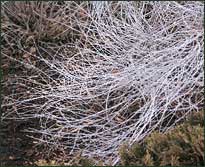 The weather sometimes guides me to certain plantings. Today’s wind and cold rain led me to a patch of Russian Sage. While there are no leaves left at this time of year, the stems light up this miserable weather with their silver-slate color. The woody stems would make a terrific illustration for that old children’s poem "Who Has Seen the Wind?" The weather sometimes guides me to certain plantings. Today’s wind and cold rain led me to a patch of Russian Sage. While there are no leaves left at this time of year, the stems light up this miserable weather with their silver-slate color. The woody stems would make a terrific illustration for that old children’s poem "Who Has Seen the Wind?"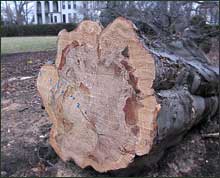 In a botanical garden, how is the decision made to fell a mature tree? Nearing the end of projected lifetime? Diseased? Damaged in a storm? All weekend visitors like me ever see is the result: a stump and sometimes a piece of trunk. The saws and workers do the deed on weekdays. This morning an old character of a tree was gone. A huge mound-shaped European beech with wine-colored branches that arched to the ground was taken. I remember its trunk best. Here and there it was dotted with large carbuncles. Its bark was cracked and in places long fissures ran up the trunk. All that was left this morning was stump and a trunk fragment tacked with blue flags, each marking a decade of its life. By my count, the tree’s beginning dates back to about 1930. In a botanical garden, how is the decision made to fell a mature tree? Nearing the end of projected lifetime? Diseased? Damaged in a storm? All weekend visitors like me ever see is the result: a stump and sometimes a piece of trunk. The saws and workers do the deed on weekdays. This morning an old character of a tree was gone. A huge mound-shaped European beech with wine-colored branches that arched to the ground was taken. I remember its trunk best. Here and there it was dotted with large carbuncles. Its bark was cracked and in places long fissures ran up the trunk. All that was left this morning was stump and a trunk fragment tacked with blue flags, each marking a decade of its life. By my count, the tree’s beginning dates back to about 1930. clear: stiff west wind shifting to the north: 19ºF clear: stiff west wind shifting to the north: 19ºFWe arrived this morning at 8:00 a.m., an hour after the botanical garden opened. Only four people were here before us. It’s a raw day for walking. We dressed in layers, so except for toes and fingers, we were snug. 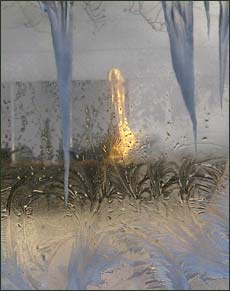 Cold weather etches ice ferns on the inside windows of the greenhouses as the warm inside air butts up against the cold outside. I took this picture of melting ice ferns inside, icicles outside, and in the distance a folded yellow umbrella waiting for warmer times. Cold weather etches ice ferns on the inside windows of the greenhouses as the warm inside air butts up against the cold outside. I took this picture of melting ice ferns inside, icicles outside, and in the distance a folded yellow umbrella waiting for warmer times.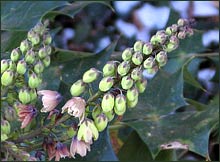 There is an Oregon Grape shrub (Mahonia aquifolium) that I’ve been looking in on for the last few weeks. It’s growing in a spot that’s sheltered from winds – west or north – and where it gets sunlight only in the morning. This shrub is thriving. The glossy leaves are deep green without a hint of bronzing and just a tad of browning. Large clusters of yellow flower buds are ready to flower, fully two months ahead of their Midwestern normal. The Mahonia buds are the only color I’ve seen this morning since the usually colorful witch hazels have rolled-up their tassels. There is an Oregon Grape shrub (Mahonia aquifolium) that I’ve been looking in on for the last few weeks. It’s growing in a spot that’s sheltered from winds – west or north – and where it gets sunlight only in the morning. This shrub is thriving. The glossy leaves are deep green without a hint of bronzing and just a tad of browning. Large clusters of yellow flower buds are ready to flower, fully two months ahead of their Midwestern normal. The Mahonia buds are the only color I’ve seen this morning since the usually colorful witch hazels have rolled-up their tassels.Yesterday 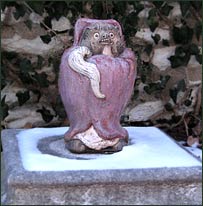 I thought of ground hogs when I spotted this statue half-hidden beside the vacant Cleveland Avenue Gatehouse. I can’t even guess at what it is or where it came from, but it reminds me of a startled groundhog peeping out of a burrow. Oddly enough, a stature a serious-looking Sir Isaac Newton used to be here. I thought of ground hogs when I spotted this statue half-hidden beside the vacant Cleveland Avenue Gatehouse. I can’t even guess at what it is or where it came from, but it reminds me of a startled groundhog peeping out of a burrow. Oddly enough, a stature a serious-looking Sir Isaac Newton used to be here.Some folks spend winter nights with their seed catalogs. Not me. I like to read books written by gardeners and writers who write about gardens (often not the same thing). My favorite reads involve successes or failures to grow things in cold weather. 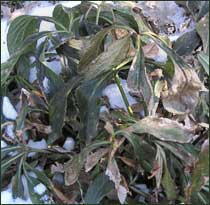 This winter I’m reading the Down the Garden Path, a book written by Beverley Nichols in 1932. It’s less a gardening book than a collection of Nichols' gardening foibles as he restores an abandoned cottage garden. As I took a picture of some hellebores this morning, I knew Beverley Nichols was right when he wrote, “The average Christmas rose is a sickly, squalid-looking thing. Half its petals are black. The stalk is only about an inch high. It looks as if it had a fearful cold in the head. Nobody could possibly go into raptures about it.” This winter I’m reading the Down the Garden Path, a book written by Beverley Nichols in 1932. It’s less a gardening book than a collection of Nichols' gardening foibles as he restores an abandoned cottage garden. As I took a picture of some hellebores this morning, I knew Beverley Nichols was right when he wrote, “The average Christmas rose is a sickly, squalid-looking thing. Half its petals are black. The stalk is only about an inch high. It looks as if it had a fearful cold in the head. Nobody could possibly go into raptures about it.” |
||||||||||||||||||||||||||||||||||||||||||