 |
|||||||||||||||||||||||||||||||||||||||||||
|
“. . . the air
is bright with breath of bloom, wise loveliness that asks nothing of the season but to be”  -- from VI, 1982 “A Timbered Choir” by Wendell Berry -- from VI, 1982 “A Timbered Choir” by Wendell Berry
|
|||||||||||||||||||||||||||||||||||||||||||
|
 rain: calm: 69ºF rain: calm: 69ºF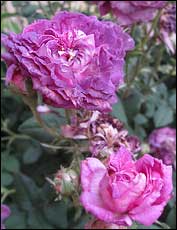 On two nights last week the temperatures fell to 40°. Not good for some the most tender plants. Especially hard hit were a few of the roses and nearly all of the newly planted Diamond Frost Euphorbia in the display beds. Because of the botanical gardens success with their Diamond Frost plantings last summer, I brought a few of them for my container gardens at home. Fortunately, I hadn’t planted them before the chilly nights arrived, so I just brought the nursery pots in until the warmer weather returned. The botanical garden wasn’t so lucky. Their hundred or so Diamond Frosts were already in the ground. According to the plant’s breeders, the plant thrives in hot weather and even drought, but is hardy to just 40°. Last week the plants were bushy, dotted with white flowers. This morning they had lost much of their foliage and shed many of their distinctive petals. By next week I’d bet the plants either will have shown signs of a quick recovery or the keepers of the garden will have put in replacements or stand-ins for the summer. On two nights last week the temperatures fell to 40°. Not good for some the most tender plants. Especially hard hit were a few of the roses and nearly all of the newly planted Diamond Frost Euphorbia in the display beds. Because of the botanical gardens success with their Diamond Frost plantings last summer, I brought a few of them for my container gardens at home. Fortunately, I hadn’t planted them before the chilly nights arrived, so I just brought the nursery pots in until the warmer weather returned. The botanical garden wasn’t so lucky. Their hundred or so Diamond Frosts were already in the ground. According to the plant’s breeders, the plant thrives in hot weather and even drought, but is hardy to just 40°. Last week the plants were bushy, dotted with white flowers. This morning they had lost much of their foliage and shed many of their distinctive petals. By next week I’d bet the plants either will have shown signs of a quick recovery or the keepers of the garden will have put in replacements or stand-ins for the summer.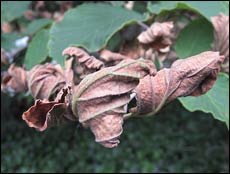 In keeping with the theme of what’s not thriving, I saw something that was more unusual and unexpected. Some the witch hazels, especially the intermedia varieties named ‘Orange Beauty,’ are showing signs of dying. Some branches are already dead. Others have large areas of brown and crinkled leaves. Lower night time temperatures wouldn’t phase any variety of witch hazel, and I’ve read that the shrubs are very disease resistant. So, I’ve got no guesses about what going on. In keeping with the theme of what’s not thriving, I saw something that was more unusual and unexpected. Some the witch hazels, especially the intermedia varieties named ‘Orange Beauty,’ are showing signs of dying. Some branches are already dead. Others have large areas of brown and crinkled leaves. Lower night time temperatures wouldn’t phase any variety of witch hazel, and I’ve read that the shrubs are very disease resistant. So, I’ve got no guesses about what going on.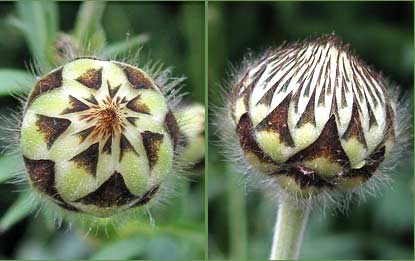 These are the remarkable, geometric buds on the yellow scabiosa (Scabiosa caucasica) growing along the west wall of the Ottoman Garden. The buds, probably no more than three-quarters of an inch across, are jutting from stems about three feet above their foliage. I’m glad I got to see the buds before these scabiosas produce their unremarkable flowers. For years I’ve wondered what tree, flower, or shrub was sending out the rank odor along the walkway in the rock garden. I’ve blamed the huge Amur Cork tree (Phellodendron amurense) near the walkway because I knew when I crushed the berries they gave off a mild petroleum odor. So I thought this other foul odor might be just a seasonal variant. 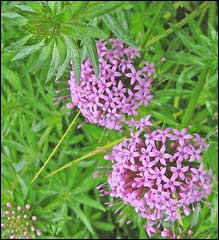 Not so. The real offender is a ground hugging creeper in the rock garden named Crosswort (Phuopsis stylosa). According to a nearby sign, the leaves give off an “odiferous, musky scent.” One of the websites I looked at described the plant plainly as “attractive, but smells like a skunk.” Another more circumspect one says, “while I agree that the plant does possess a slightly pungent odour, it is in truth far from offensive and, for the most part, largely indiscernible to all but the most sensitive of noses.” This morning, the matted patch was in full flower. I didn’t stop to smell the flowers. Not so. The real offender is a ground hugging creeper in the rock garden named Crosswort (Phuopsis stylosa). According to a nearby sign, the leaves give off an “odiferous, musky scent.” One of the websites I looked at described the plant plainly as “attractive, but smells like a skunk.” Another more circumspect one says, “while I agree that the plant does possess a slightly pungent odour, it is in truth far from offensive and, for the most part, largely indiscernible to all but the most sensitive of noses.” This morning, the matted patch was in full flower. I didn’t stop to smell the flowers.  fast moving dark clouds: breezy: 64ºF fast moving dark clouds: breezy: 64ºF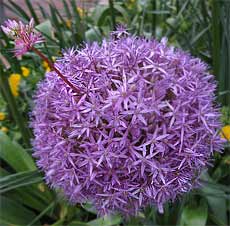 Wet. The botanical garden is drenched from two intense storms that passed through this week. Trees and shrubs are lush from the unusually heavy rains. The less studier flowers look weary and water logged. The alliums though are just fine. Even though their flower globes are a couple of feet above their foliage, they’re held up by hefty stocks built to sway but never break. The driveway to the garden entrance is lined with hundreds of flowering Globemaster Alliums. More are planted in the display beds around the entry. And on every head, except this one, every floweret is perfectly in place. Wet. The botanical garden is drenched from two intense storms that passed through this week. Trees and shrubs are lush from the unusually heavy rains. The less studier flowers look weary and water logged. The alliums though are just fine. Even though their flower globes are a couple of feet above their foliage, they’re held up by hefty stocks built to sway but never break. The driveway to the garden entrance is lined with hundreds of flowering Globemaster Alliums. More are planted in the display beds around the entry. And on every head, except this one, every floweret is perfectly in place.The display gardens just inside the botanical garden have been cleared of spent tulips and leggy yellow pansies and have been planted with plants that will be here until the mums arrive in early fall. Over the years, I’ve given up trying to predict what the keepers of the garden will choose for these beds. It’s always surprising. All that’s certain is that the plantings will be arranged like a family photograph – shorter plants in the front and taller ones in the back. For several years, the theme of the summer plantings has been tropical. Plants with hot colors and variegations dominated. Last year there were two-toned bananas and cannas, a dazzling yellow-orange lantana called ‘Firewagon,’ ‘Profusion’ orange zinnias, and an ornamental pepper called ‘Chilly Chili’ that pointed its red and golden miniature peppers straight up. This year everything has changed. Subtlety, understatement, and elegance have arrived. Deep breath: All of the display garden will be in whites and silvers. ‘Silver Falls’ Dichondra (Dichondra argenta) (which is usually found trailing out of hanging baskets) will creep along the ground. Next in height will be a white flowering plant named Angelonia ‘Serena White’ (Angelonia angustifolia), followed by Proven Winners top seller ‘Diamond Frost’ (Euphobia hypericifolia). I’ve seen all of these plants in this botanical garden before, but never together. Each is usually used as a foil for another brightly colored plant. Two flowers (neither of which I ever remember seeing) will used as the tall backdrop for the display: a canna called ‘Ermine’ and a Mandevilla named ‘White Velvet.’ ‘Ermine’ is a new canna hybrid that tops three-feet tall and forms good-sized clumps. It’s marketed as being as close to white as a cannas get. The Mandevilla vine ‘White Velvet’ already has a few buds. Each flower is purported to be 5- to 6-inches long. Just after blooming the flowers have a touch of pink, but then they turn bright white. This summer the botanical garden will be open evenings on two nights a week. I’ve got to check the calendar to find a evening when the moon is full. White flowers bathed in white light ought to be spectacular. 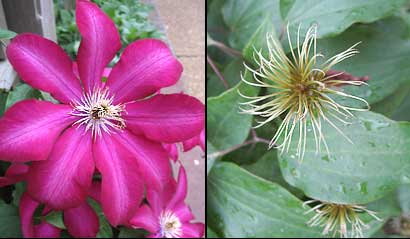 Last week I saw this orchid-colored clematis in full bloom. Here’s what it looked like this morning. An exhibition called “Earthways: Living the Green Life” has just opened in this botanical garden’s demonstration center. The display showcases “environmentally-friendly products and systems for home use.” This morning I looked at some kitchen counter tops made from recycled glass, a system for collecting and reusing rainwater, a tankless hot water heater, and a system for heating and cooling a house by tapping into geothermal energy. 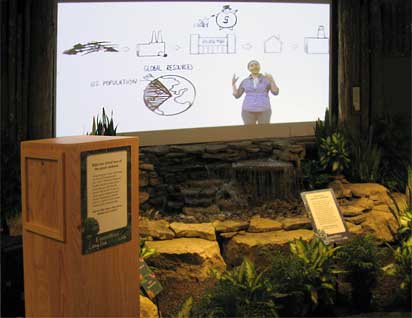 The focal point of the entire display is a 16-by-nine-foot video screen that the garden’s press release says “illustrates dozens of simple green tips for all aspects of daily life.” The titles of the videos to be shown were not listed. However, both times that I visited the exhibit, the video being shown was one I saw on YouTube and read about last week in the New York Times. It’s a twenty-minute video called “The Story of Stuff.” It was created and narrated by Annie Leonard, a long-time advocate of curbing the culture of consumption and waste that she believes destroys the environment and the health of people all over the world. The video is disarming, even charming in its use of simple, stick-figure like black-and-white drawings and animations. They illustrate in pictures what Annie Leonard says in words. In an interview with the Times, Leonard said, “the style of the animation makes it easy to watch. It is a nice counterbalance to the starkness of the facts.” “The Story of Stuff” website claims that it’s been viewed over five million times. However, not everyone who watches likes what they see. While Time magazine says that Leonard’s “passionate style transforms bleak facts into emotive stories that compel you to take action,” Fox news denounces “The Story of Stuff” as a “viral video full of misleading numbers.” They say that critics call the film “a misleading diatribe against capitalism.” This botanical garden’s Earthways exhibit will be on until the end of October. I wonder if “The Story of Stuff” will be.  clouds opening later to sun: breezy: 63ºF clouds opening later to sun: breezy: 63ºF Tulips, even the late varieties, are gone. In the display gardens the stems have been cut. Elsewhere in less tended areas, there are still remnants of shattered and fallen blossoms. All that’s left in the display gardens is a matted mass of leggy yellow pansies. By next week, they’ll probably be gone to make room for the summer plantings. Tulips, even the late varieties, are gone. In the display gardens the stems have been cut. Elsewhere in less tended areas, there are still remnants of shattered and fallen blossoms. All that’s left in the display gardens is a matted mass of leggy yellow pansies. By next week, they’ll probably be gone to make room for the summer plantings.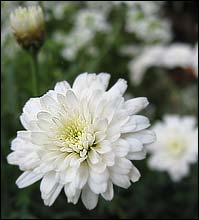 The Proven Winners logo with the letters PW in a heavily seriffed Roman typeface and a green leaf casually lounging between the letters is on all plastic pots where PW's are sold. Proven Winners plants always cost more, but they come in larger pots and they usually offer something a bit different from the run-of-the- mill. I saw this Proven Winner this morning: It’s labeled Cobbitty Daisy (Argyranthemum frutescens) Molimba mini white. The surprise: it's a diasy that has multiple petals that fluff-up to form button-sized flowers that easily could pass for mums. Even though Molimba isn’t hardy in this climate zone, it’s nice to have it here for the summer. The Proven Winners logo with the letters PW in a heavily seriffed Roman typeface and a green leaf casually lounging between the letters is on all plastic pots where PW's are sold. Proven Winners plants always cost more, but they come in larger pots and they usually offer something a bit different from the run-of-the- mill. I saw this Proven Winner this morning: It’s labeled Cobbitty Daisy (Argyranthemum frutescens) Molimba mini white. The surprise: it's a diasy that has multiple petals that fluff-up to form button-sized flowers that easily could pass for mums. Even though Molimba isn’t hardy in this climate zone, it’s nice to have it here for the summer.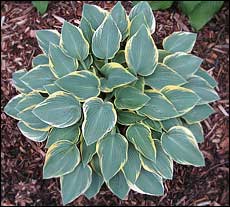 The botanical garden’s hosta collection looks as though it could model for Better Homes and Gardens. I’ve rarely seen the hostas here look so perfect: unspoiled by mud, untouched by slugs, and leaves that are perfectly mounded and richly colored. The slow, easy, moist spring has been good to them. I’ve taken lots of pictures so I’ll have something to remember them by when the sun and heat bleach their color and falling twigs poke holes in their leaves. This one is ‘First Frost.’ The botanical garden’s hosta collection looks as though it could model for Better Homes and Gardens. I’ve rarely seen the hostas here look so perfect: unspoiled by mud, untouched by slugs, and leaves that are perfectly mounded and richly colored. The slow, easy, moist spring has been good to them. I’ve taken lots of pictures so I’ll have something to remember them by when the sun and heat bleach their color and falling twigs poke holes in their leaves. This one is ‘First Frost.’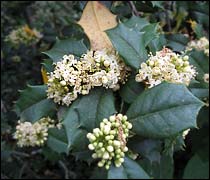 The holly trees are in full bloom this morning. The individual white flower clusters are not much to make a fuss over. But when thousands of them are blooming up and down thirty-foot trees, they saturate the air with their fragrance. The fragrance isn’t fruity, spicy, or distinctive like a lilac – maybe just calling it pleasant is as close as I can get. The holly trees are in full bloom this morning. The individual white flower clusters are not much to make a fuss over. But when thousands of them are blooming up and down thirty-foot trees, they saturate the air with their fragrance. The fragrance isn’t fruity, spicy, or distinctive like a lilac – maybe just calling it pleasant is as close as I can get.What seems to be last of the Sassafras trees that were here when this botanical garden was founded 150 years ago has died. This last tree has been pruned and propped up for the last few years, and until now the care seems to have helped. Henry Shaw, founder of this garden, described the land on which the garden now stands as “covered with tall luxuriant grass” except for a small grove of sassafras trees. He allowed those trees to stay as the garden took shape around them. Since sassafras trees spread by sending out root suckers, the descendants of those original trees are probably still thiriving. 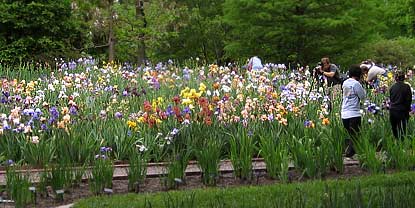 It’s that time again. Now that the tulips have are gone, the irises step in. This botanical garden’s iris beds are filled with hundred of irises of clashing colors. I’ve yet to figure out how to take a picture of this visual cacophony. The photographers that come here in droves use tripods and close-up lens. They prefer to ignore the whole and instead hone-in on the irises one at a time. 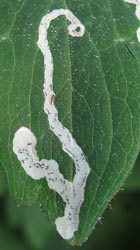 It’s also a peak time for the columbines. Most are in full flower. Almost all are untouched by leaf miners that have a habit of burrowing into their foliage. Leaf miners don’t kill the plants but they do seem to annoy many gardeners judging from the many questions on garden lines about how to get rid of them. Since for the most part, the miners begin their work after the flowering ends, I don’t think they’re so terrible. In places, their work looks no worse than a child’s imaginative scribbling. In others, where the miner population isn’t so dense, their thick, curving tracery has an artistry and delicacy about them. It’s also a peak time for the columbines. Most are in full flower. Almost all are untouched by leaf miners that have a habit of burrowing into their foliage. Leaf miners don’t kill the plants but they do seem to annoy many gardeners judging from the many questions on garden lines about how to get rid of them. Since for the most part, the miners begin their work after the flowering ends, I don’t think they’re so terrible. In places, their work looks no worse than a child’s imaginative scribbling. In others, where the miner population isn’t so dense, their thick, curving tracery has an artistry and delicacy about them. clouds and sun take turns: breezy: 52ºF clouds and sun take turns: breezy: 52ºF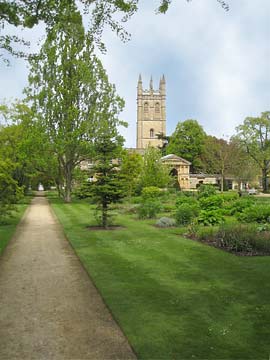 This morning we took a bus from London to Oxford to have a look at a botanical garden we’d never seen before – the University of Oxford Botanic Garden. This morning we took a bus from London to Oxford to have a look at a botanical garden we’d never seen before – the University of Oxford Botanic Garden.Take this botanic garden out of Oxford, put it down almost anywhere else and it wouldn’t be a wonder. At first look, the garden looks like a neat, but monotonous collection of rectangular beds inside straight long walkways that join at right angles. Surrounding the whole thing are high stone walls. The garden’s older glasshouses are small, their walkways are cramped, and the displays inside look as though they would benefit from more consistent care. The largest and most recently built glasshouse is almost empty. 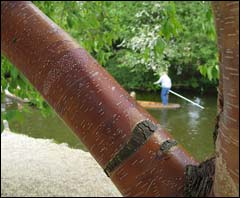 However, this is Oxford. Look beyond the walls and the gothic spires of historic Magdalen College frame the garden. Look beyond the glasshouses and there’s the meandering Cherwell River filled with visitors having a Sunday outing on one of the punts –flat bottom boats that are steered and moved using long poles pushed against the river bed. However, this is Oxford. Look beyond the walls and the gothic spires of historic Magdalen College frame the garden. Look beyond the glasshouses and there’s the meandering Cherwell River filled with visitors having a Sunday outing on one of the punts –flat bottom boats that are steered and moved using long poles pushed against the river bed.Then as Tevye would say, there’s Tradition! And there’s a lot here. This botanical garden was founded in 1621 as a physic garden to grow plants for medicinal research. The guidebook that I bought at the gift shop said the land for the garden and a sizeable amount of money to develop it came from Sir Henry Danvers, a soldier best known for murdering a neighbor in a family feud. Where the garden is now was once a Jewish cemetery that had been unused and abandoned since the Jews were expelled from Britain in 1290. Most of Danver’s gift was spent on building the garden walls (that still stand) and a grand entrance gate designed by Inigo Jones (which is here too, but no longer used as a visitor’s entrance). Tapped out by the all the construction, the garden couldn’t afford pay the salary of its first curator. Instead it agreed to let him keep the money he got from selling fruit (mostly medlars) grown in the garden. Now how many other botanic gardens have this kind of creation story? 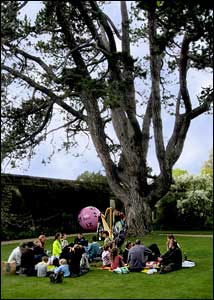 There’s still more. Oxford being Oxford, many of the world’s brightest and best made regular visits to this botanical garden. J.R.R. Tolkien was one. His favorite tree was this black pine (Pinus nigra). The sign on the tree says that it was planted here in 1800 and today, as when Tolkien’s visited, it’s a favorite gathering place. There’s still more. Oxford being Oxford, many of the world’s brightest and best made regular visits to this botanical garden. J.R.R. Tolkien was one. His favorite tree was this black pine (Pinus nigra). The sign on the tree says that it was planted here in 1800 and today, as when Tolkien’s visited, it’s a favorite gathering place.The oldest tree in this botanical is an English Yew Tree (Taxus baccata). It was planted in 1645. After being pruned, trimmed, and shaped at various points in its life, it’s now just allowed to grow as it likes. It’s planted near the black pine, but compared to the pine’s stateliness, the Yew looks unkept and would be unlikely inspire anyone. Its impact lies in its longevity and not in the tree itself. 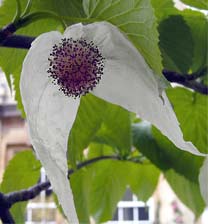 While it’s not an historical tree, the one that I spent the most time with was labeled Davidia involucrata var. vilmoriniana. As expected, no common name was given. My gardener’s encyclopedia obliges though. It offers: Dove Tree, Ghost Tree, and Handkerchief Tree. I like all three and perhaps I’d add Clapper Tree or Angel Tree. On the day I visited the garden the apple-sized tree was completely covered with these white blooms (technically, petals). The slightest breeze would cause the tree to whisper and shimmer from the flapping of so much white. My garden book says the tree is native to Southwestern China and takes at least ten years to begin flowering. While it’s not an historical tree, the one that I spent the most time with was labeled Davidia involucrata var. vilmoriniana. As expected, no common name was given. My gardener’s encyclopedia obliges though. It offers: Dove Tree, Ghost Tree, and Handkerchief Tree. I like all three and perhaps I’d add Clapper Tree or Angel Tree. On the day I visited the garden the apple-sized tree was completely covered with these white blooms (technically, petals). The slightest breeze would cause the tree to whisper and shimmer from the flapping of so much white. My garden book says the tree is native to Southwestern China and takes at least ten years to begin flowering.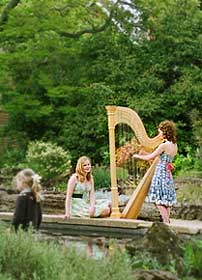 I felt a bit chilly even though I was wearing a sweater, a lined coat, and scarf while I was walking. As if to simulate a warm summer’s day, a singer and a harpist were wandering the garden in sleeveless frocks. They stopped here and there to play and sing for the Sunday visitors. We did notice though that just as soon as they finished playing at one spot and got ready to move to another, they put on sweaters and held them tightly to their shoulders. I felt a bit chilly even though I was wearing a sweater, a lined coat, and scarf while I was walking. As if to simulate a warm summer’s day, a singer and a harpist were wandering the garden in sleeveless frocks. They stopped here and there to play and sing for the Sunday visitors. We did notice though that just as soon as they finished playing at one spot and got ready to move to another, they put on sweaters and held them tightly to their shoulders.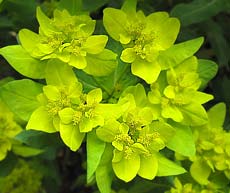 The Oxford Botanic Garden is home to “The National Collection of Hardy Euphorbia.” To be designated as a national collection a garden is expected to conserve, grow, propagate, document their specialty collections. Here there are euphorbia scattered throughout the garden and one of the large rectangular beds in the walled garden is filled dozens of varieties. My favorite from collection is one called Cushion Spurge (Euphobia polychroma). The plant forms a well-shaped clump of leaves held just a bit off the ground. The green leaves in back are set off by the yellow green leaves that surround the yellow flower heads. The Oxford Botanic Garden is home to “The National Collection of Hardy Euphorbia.” To be designated as a national collection a garden is expected to conserve, grow, propagate, document their specialty collections. Here there are euphorbia scattered throughout the garden and one of the large rectangular beds in the walled garden is filled dozens of varieties. My favorite from collection is one called Cushion Spurge (Euphobia polychroma). The plant forms a well-shaped clump of leaves held just a bit off the ground. The green leaves in back are set off by the yellow green leaves that surround the yellow flower heads.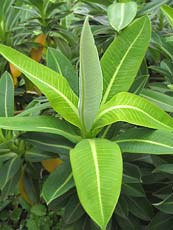 The rarest euphorbia in the garden's collection is one called Euphorbia stygiana. It’s a tall, shrubby plant with leaves that have pronounced yellowish midribs and veins. The wide, glossy leaves remind me of a tropical houseplant. I’ve read that the midribs and lower leaves turn bright red in the winter. The plants that I saw weren’t in bloom yet, but I suspect the blooms will be yellow and small and huddle together in clusters. The rarest euphorbia in the garden's collection is one called Euphorbia stygiana. It’s a tall, shrubby plant with leaves that have pronounced yellowish midribs and veins. The wide, glossy leaves remind me of a tropical houseplant. I’ve read that the midribs and lower leaves turn bright red in the winter. The plants that I saw weren’t in bloom yet, but I suspect the blooms will be yellow and small and huddle together in clusters. bright sun: easy breeze: 65ºF bright sun: easy breeze: 65ºF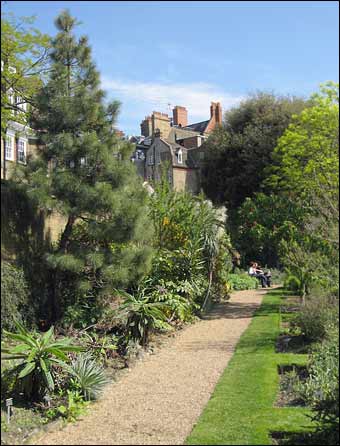 What a treat. A last I get to visit the Chelsea Physic Garden. Every other time I’ve been in London the garden – billed as “London’s oldest botanic garden” (founded in 1673, close to a hundred years before Kew) - has been closed for the winter. It’s a rectangle of just under four acres, but the Chelsea Physic Garden packs in more plants and more history than any botanical garden anywhere. It’s a low-keyed place – a kind of secret garden surrounded by tall brick walls that give no hint as to what’s inside. Even when I got here, I wasn’t sure I was here. Near the bus stop closest to the garden there is just a small green sign that reads “Chelsea Physic Garden.” It hangs over a locked, nondescript doorway. I found out later that this doorway is the exit to the garden. Only by wandering down the block did I find the nearly hidden entrance to the garden off a small side street. The private, clubby nature of this garden is in keeping with its beginnings. It was founded by the society of apothecaries in London exclusively for the use of their members and trainees. They founded the garden to study how best to identify and grow medicinal plants and then how to use them to treat and cure illness, injury, and disease. The apothecaries chose well when they decided on this spot. I was amazed to see cork, olive, Mediterranean-climate plants, and even a few bananas growing outdoors. The handouts say that the Physic Garden has a microclimate that raises the temperature a few degrees above the land outside the walls because of a south slope, nearness to the Thames, and the buildings and brick walls that surround the garden. This garden still has several beds devoted exclusively to displaying pharmaceutical plants. I looked at them briefly mainly because I felt that’s what homage to the garden’s origin called for. But I lingered more around the plants that I’ll never see growing outdoors in a Midwestern botanical garden. 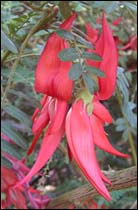 This one is named Clianthus Puniceus (“Parrot Beak” or “Lobster’s Claw” my Gardner’s Encyclopedia calls it even though I never saw a label in this garden that used anything other than a plant’s proper Latin name). The seeds of this Clianthus’ ancestor were collected by botanist Joseph Banks on his voyage with Captain Cook to New Zealand and then given to the Chelsea Physic Garden in 1770. The flower buds look like red-hot chilli peppers. Then when the buds open, the petals spread open in exotic, often erotic ways. This one is named Clianthus Puniceus (“Parrot Beak” or “Lobster’s Claw” my Gardner’s Encyclopedia calls it even though I never saw a label in this garden that used anything other than a plant’s proper Latin name). The seeds of this Clianthus’ ancestor were collected by botanist Joseph Banks on his voyage with Captain Cook to New Zealand and then given to the Chelsea Physic Garden in 1770. The flower buds look like red-hot chilli peppers. Then when the buds open, the petals spread open in exotic, often erotic ways.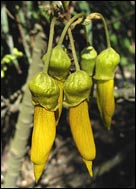 Another New Zealand native: Sophora Tetraptera. It wasn’t quite in bloom, but I can’t believe the flowers could be any more spectacular than the buds. The tubular buds are burnished gold with sepals that look like helmets or maybe even gargoyles. My garden encyclopedia says the Sophora is New Zealand’s national flower where it’s called the “Kowhai.” Another New Zealand native: Sophora Tetraptera. It wasn’t quite in bloom, but I can’t believe the flowers could be any more spectacular than the buds. The tubular buds are burnished gold with sepals that look like helmets or maybe even gargoyles. My garden encyclopedia says the Sophora is New Zealand’s national flower where it’s called the “Kowhai.”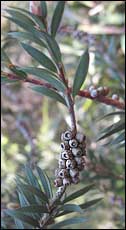 In the same New Zealand/Australian bed of the garden, I saw this cluster of seed pods from a plant labeled Callistemon. I looked it up and found that I know it better as bottlebrush. I’ve seen bottlebrushes blooming in glasshouses lots of times, but until today I’d never noticed their seeds capsules. They feel tough, wooden. Unlike most seed capsules, these cluster in tight groups around the stems of twigs instead of at their tips. In the same New Zealand/Australian bed of the garden, I saw this cluster of seed pods from a plant labeled Callistemon. I looked it up and found that I know it better as bottlebrush. I’ve seen bottlebrushes blooming in glasshouses lots of times, but until today I’d never noticed their seeds capsules. They feel tough, wooden. Unlike most seed capsules, these cluster in tight groups around the stems of twigs instead of at their tips.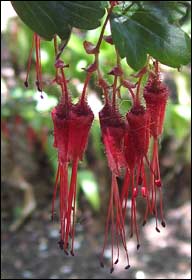 This garden makes no allowances for botanically challenged visitors. Blooming wildly with thousands of fuchsia-like flowers swinging in breeze was this shrub. I’d never seen such exotic, attention-grabbing flowers before. Yet aside from labeling the shrub as Ribes speciosum and identifying it as native to Western North America, there was nothing more. Turns out what I was looking at was an ornamental shrub called Fuchsia-Flowering Gooseberry. (My gardening reference says that if these shrubs are spiny they’re gooseberries; if smooth – they’re currents. The one planted here had spines.) The Fuchsia-Flowering Gooseberry is native to west coast of California all the way down to Baja. In San Diego I bet they’re squashed together in rows of 4-gallon pots in the big box stores right now. Fuchsia-Flowering Gooseberries are grown for their looks and for attracting hummingbirds, not for eating. This garden makes no allowances for botanically challenged visitors. Blooming wildly with thousands of fuchsia-like flowers swinging in breeze was this shrub. I’d never seen such exotic, attention-grabbing flowers before. Yet aside from labeling the shrub as Ribes speciosum and identifying it as native to Western North America, there was nothing more. Turns out what I was looking at was an ornamental shrub called Fuchsia-Flowering Gooseberry. (My gardening reference says that if these shrubs are spiny they’re gooseberries; if smooth – they’re currents. The one planted here had spines.) The Fuchsia-Flowering Gooseberry is native to west coast of California all the way down to Baja. In San Diego I bet they’re squashed together in rows of 4-gallon pots in the big box stores right now. Fuchsia-Flowering Gooseberries are grown for their looks and for attracting hummingbirds, not for eating.My most surprising find was this 6-foot tall Wollemi Pine, a tree the National Geographic News called “the botanical equivalent of finding a dinosaur alive today.” Wollemi Pines were know only from fossil records until 1994 when a park service officer stumbled upon a stand of then while hiking in the Wollemi National Park, a rugged wilderness area about 90 miles west of Sydney. The trees are remnants of the Jurassic forests that blanketed the area about 150 million years ago. The trees were thought to have been wiped out two million years ago when the world’s climate changed. 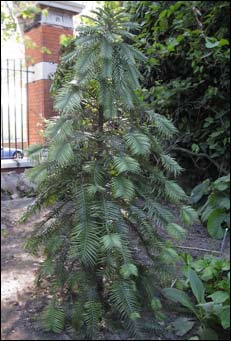 To keep the tree from becoming extinct, the Australian government propagated millions of specimens to sell. The idea here is that the best way to protect rare and endangered species in the wild is to make them common and widely available commercially. To keep the tree from becoming extinct, the Australian government propagated millions of specimens to sell. The idea here is that the best way to protect rare and endangered species in the wild is to make them common and widely available commercially.Until today the only Wollemi Pines I’d seen were the ones two-foot tall ones growing in a glasshouse and outdoors in the botanical garden when I usually walk. In both the protected spots and outdoors, all of the trees died. The Wollemi here at the Chelsea Physic Garden is tucked away in a corner of the garden along a sheltered path. I’m glad to see it thriving here. 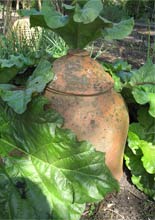 One more thing I’d never seen. A wildly healthy patch of rhubarb, some of which were covered with over-sized terra-cotta pots topped with teapot-like lids. The sign alongside explained that the pots are placed over the rhubarb plants just as the crowns come up to force the plant to mature earlier and to produce stocks that are more tender. The garden claims credit for discovering the technique around 1817. One more thing I’d never seen. A wildly healthy patch of rhubarb, some of which were covered with over-sized terra-cotta pots topped with teapot-like lids. The sign alongside explained that the pots are placed over the rhubarb plants just as the crowns come up to force the plant to mature earlier and to produce stocks that are more tender. The garden claims credit for discovering the technique around 1817.To end the visit: we found some chairs on the patio that looked out into the garden and rested with a generously poured glass of wine and slice of pear-almond tart with a dollop of crème fraîche on the side. A perfect prescription for this healing garden.  mostly clouds: light breeze: 58ºF mostly clouds: light breeze: 58ºF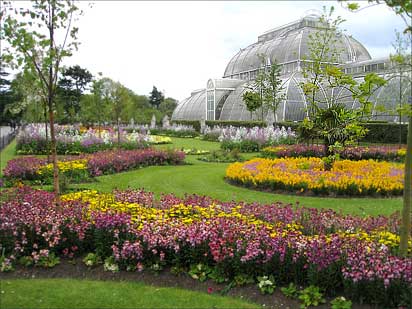 After two years, I’m back for another visit to the Royal Botanic Gardens, Kew. Thinking of royalty, I missed the Queen’s visit to Kew by a few days. Dressed in pale pink with black trim, she and Prince Phillip visited the botanic garden at Kew to help celebrate its 250th anniversary. To mark the royal visit, the couple planted trees that date back to the dinosaurs. The Queen planted a gingko tree. Prince Phillip planted a Wollemi pine, an ancient tree thought to be extinct until stand of them was found growing in Australia a few years ago. 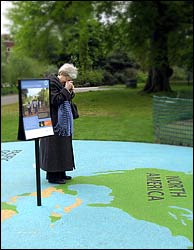 The most prominent display marking Kew’s anniversary year is a colorful walk-on map of the world. Poster stands near each of the continents tick off the conservation work that Kew is doing or fostering. In the United States, Kew is working with the Bureau of Land Management to collect seeds of native plants for study and long-term storage. In the U.K., the garden is collecting stories. They’ve setup an “Ethnomedica Project” to collect stories from people who know how certain plants were used to treat diseases like cancer, Alzheimer’s, and diabetes. The most prominent display marking Kew’s anniversary year is a colorful walk-on map of the world. Poster stands near each of the continents tick off the conservation work that Kew is doing or fostering. In the United States, Kew is working with the Bureau of Land Management to collect seeds of native plants for study and long-term storage. In the U.K., the garden is collecting stories. They’ve setup an “Ethnomedica Project” to collect stories from people who know how certain plants were used to treat diseases like cancer, Alzheimer’s, and diabetes.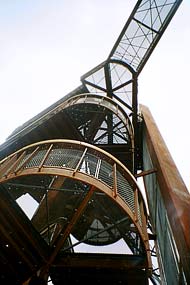 I read that a tree top walkway had been added to Kew since I was last here. I can’t even climb a ladder without getting light-headed, so I knew I’d never be able to climb up a long flight of stairs to see Kew from the top, but I wanted to see the walkway anyway. I was right about the height. The walkway is as high as a six-story building and forms a pentagon in the sky about the size of city block. At each of the corners there’s a circular observation platform. I read that a tree top walkway had been added to Kew since I was last here. I can’t even climb a ladder without getting light-headed, so I knew I’d never be able to climb up a long flight of stairs to see Kew from the top, but I wanted to see the walkway anyway. I was right about the height. The walkway is as high as a six-story building and forms a pentagon in the sky about the size of city block. At each of the corners there’s a circular observation platform.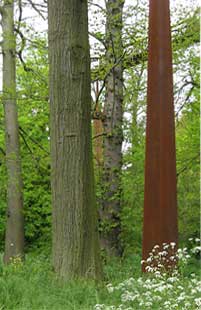 The pylons supporting the walkway were the first thing I saw as I got closer. They’re triangular and they taper as they rise. As the steel they’re rusts, they start to look right at home among the tree trunks on all sides of them. To prevent the pylons from killing the nearby trees, the planners mapped the major underground root systems with radar and then very neatly positioned the pylons between the roots. The pylons supporting the walkway were the first thing I saw as I got closer. They’re triangular and they taper as they rise. As the steel they’re rusts, they start to look right at home among the tree trunks on all sides of them. To prevent the pylons from killing the nearby trees, the planners mapped the major underground root systems with radar and then very neatly positioned the pylons between the roots.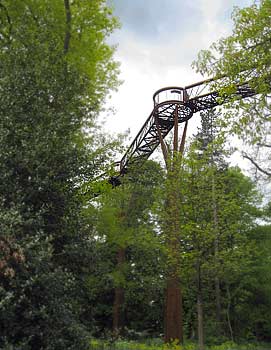 Here's a picture of the walkway (from the ground, of course). To see I might have seen had I made it to the top, have to look at someone else’s video. Here's a picture of the walkway (from the ground, of course). To see I might have seen had I made it to the top, have to look at someone else’s video.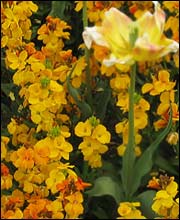 This is the first time I’ve visited Kew in late spring. Other times it’s been in winter or in early spring. By now the much photographed crocus field is just a mass of green spikes that blends with the grass. The daffodils have all flowered and the tulip blooms are shattering. Now though the display beds are filled English Wallflowers (Erysimum cheri) – huge numbers of them in luminous yellows and oranges. These are the colors in those paintings of English cottage gardens that are staples at starving artist sales. In one of his books, tongue-in-cheek English garden writer Beverly Nichols wrote that wallflowers are by nature country flowers and don’t like being planted in London gardens: “Starved wallflowers, trying vainly to shake the grime from their faces . . . gleaming a sickly gold after the city’s rain, as though the breath of the fields had touched their faces.” This is the first time I’ve visited Kew in late spring. Other times it’s been in winter or in early spring. By now the much photographed crocus field is just a mass of green spikes that blends with the grass. The daffodils have all flowered and the tulip blooms are shattering. Now though the display beds are filled English Wallflowers (Erysimum cheri) – huge numbers of them in luminous yellows and oranges. These are the colors in those paintings of English cottage gardens that are staples at starving artist sales. In one of his books, tongue-in-cheek English garden writer Beverly Nichols wrote that wallflowers are by nature country flowers and don’t like being planted in London gardens: “Starved wallflowers, trying vainly to shake the grime from their faces . . . gleaming a sickly gold after the city’s rain, as though the breath of the fields had touched their faces.”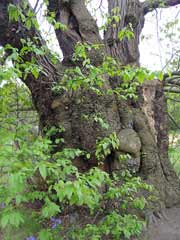 In any botanical garden I visit I like to look for the oldest or the biggest or the rarest. At Kew it was this Sweet Chestnut tree (Castanea sativa). The sign says that this tree has been in this spot since the early 1700’s. Visitors are asked to treat the tree with respect and not walk on its roots – “It has, after all, been here for 300 years.” The tree looks pudgy, winkled, and battered, but for yet another spring, it’s put out a full canopy of leaves. I wonder after all time it still bothers to flower and raise another crop of chestnuts. In any botanical garden I visit I like to look for the oldest or the biggest or the rarest. At Kew it was this Sweet Chestnut tree (Castanea sativa). The sign says that this tree has been in this spot since the early 1700’s. Visitors are asked to treat the tree with respect and not walk on its roots – “It has, after all, been here for 300 years.” The tree looks pudgy, winkled, and battered, but for yet another spring, it’s put out a full canopy of leaves. I wonder after all time it still bothers to flower and raise another crop of chestnuts.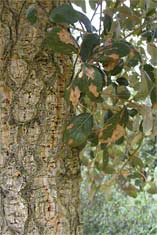 At the botanical garden in the Midwest where I usually walk, olive trees and cork trees are only grown under glass. By contrast, Kew’s has a Mediterranean garden that's outdoors. Olive trees and several corks (Quercus suber) grow along the walkway threading through the garden. The youngest of the corks looks as though it had been touched by the winter cold, but still looks strong and healthy. At the botanical garden in the Midwest where I usually walk, olive trees and cork trees are only grown under glass. By contrast, Kew’s has a Mediterranean garden that's outdoors. Olive trees and several corks (Quercus suber) grow along the walkway threading through the garden. The youngest of the corks looks as though it had been touched by the winter cold, but still looks strong and healthy.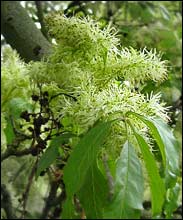 While not in the Mediterranean garden, the Manna Ash (Fraxinus ornus), another warm weather tree that my garden books tell me thrives in Southern Europe, was in full flower this morning. I was drawn to the tree by the sweet smell and the dense panicles of fuzzy yellow-green flowers that draped from all of the branches. Calls to mind the fringe tree that likely will be in bloom in the midwest when return. While not in the Mediterranean garden, the Manna Ash (Fraxinus ornus), another warm weather tree that my garden books tell me thrives in Southern Europe, was in full flower this morning. I was drawn to the tree by the sweet smell and the dense panicles of fuzzy yellow-green flowers that draped from all of the branches. Calls to mind the fringe tree that likely will be in bloom in the midwest when return.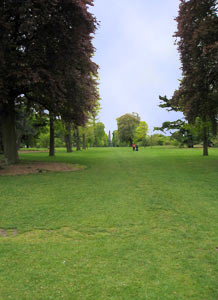 Two things I most enjoy about coming to Kew: the tall pines and cedars that have long grown just as they’ve wanted – unpruned and unshaped. Their lower branches droop making domed canopies around their trunks. Two things I most enjoy about coming to Kew: the tall pines and cedars that have long grown just as they’ve wanted – unpruned and unshaped. Their lower branches droop making domed canopies around their trunks.Then there are the long grassy vistas – open, clear, wide pathways along which there is nothing to see or do except to walk. Vistas like these are luxuries that few botanical gardens have. |
||||||||||||||||||||||||||||||||||||||||||