 |
|
|
“I do have the inner conviction that when the grass has turned green,
something really important has happened and that I might be a good deal less well employed than in taking note of the fact.”  -- From 'The Twelve Seasons' by Joseph Wood Krutch -- From 'The Twelve Seasons' by Joseph Wood Krutch |
|
|
|
 fast moving clouds; stiff wind: 64º fast moving clouds; stiff wind: 64ºThat sliver of a season between spring and summer is here. The exuberance of spring has passed and the plants of summer have just been upended from the cramped pots where they were born and moved to new, more spacious homes. A few late irises still are flowering and a few early daylilies and Asiatic lilies have begun to bloom, but the crowd-pleasing spring sweeps have ended. This temporary blooming lull in the Garden brings to mind some of the paintings of cut flowers I've been looking at in a book called The Paintings and Drawings of Jan "Flower" Bruegel by Gertraude Winklemann-Rhein. Jan Bruegel was a late-Renaissance Flemish painter who late in life developed a passion for painting flowers arranged in vases, buckets, baskets, and bowls. Aside from whatever artistic interests the flower arrangements have, the paintings are remarkable because of the flowers he chose to include. Bruegel's vessels house impossible combinations of flowers: late winter snowdrops bloom side-by-side with hot summer cornflowers. Tulips and Asian lilies; cherry blossoms and roses; iris and daffodils: all in their prime and all in the same vases. The author of the book says the flowers combine to weave a fairylike magic . . . No doubt the child in the painter saw a dream of Paradise here." Writers about botanical gardens favor words like "Garden of Eden" or "paradise" to describe what they see in the gardens. But what if these gardens were really the paradise of Bruegel's flower paintings? What if every flower, every shrub, and every tree from every season that I see in this Garden were all blooming at the same time? I looked this morning at a fringe tree that only a couple of weeks ago turned heads and caused excited pointing. Now it is green; nothing more. What if I pick a corner of the Garden packed with flowering shrubs, bulbs, and perennials, and take a picture of it each week of the year? Then after a year with the help of Photoshop, I create a composite, fantastical photo of that small corner of paradise. Not a Bruegel--but a personal flirt with paradise. Next week I will choose the spot and begin. 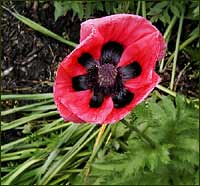 Poppies have always been popular with artists. I remember years ago the Garden hosted an exhibition of botanical prints by Henry Evans that featured some prints of his trademark California poppies. I couldn't afford to buy a print, but I did buy the catalog. Pat says artists like poppies because they are inherently graphical which makes them compliant subjects. Whatever the reason, I know I can't resist looking at poppies and taking their picture whenever the wind stops moving their silky petals.
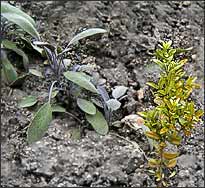 The new herb garden behind Henry Shaw's mansion is finished. All the plants have been planted and the remnants of the extensive renovation are gone. Boxwoods called 'Pride of Rochester' (Deutzia scabra) are being used extensively in the garden plots to trace Victorian curly-cues. Now the boxwoods are small, hardly larger than a new-growth tri-colored sage is. But, a web search on this variety says that it's destined to grow to eight feet and spread to six. If that happens--no more herbs. I think 'Pride of Rochester' is destined for sculpturing by a bonsai artist.
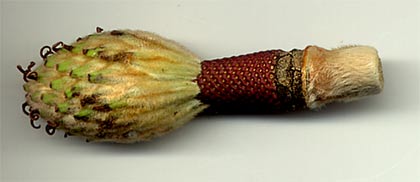
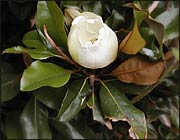 There is a huge Southern Magnolia (Magnolia grandiflora) tree just west of the Rose Garden. This morning it reminds me an extended family living in the same house. On it are buds, flowers just opening full of their warm citrus scent, mature flowers with flaccid petals, aged browning flowers, and upright seed pods. Of all the stages of life, the maturing seedpod is my favorite. Just below the artichoke-like pod is a neckband of burgundy weaving that serves whatever purpose nature intended it to serve with beauty, flare, and grace.
   overcast to some sun: calm: 58º overcast to some sun: calm: 58ºNobody but us people and plants here this morning. Just the usual suspects. Yet for the first time since I've been making my weekly visits, there were two police cars parked at the gates to the Garden and several uniformed security people on the concrete apron leading to the entrance. Four armed police officers were standing outside their cars watching cars as they pulled into the parking lot. They stopped no one. No one was questioned. I didn't ask anyone why the police were here though I suspect a recent headline in the local newspaper: "U.S. Sets Terrorism Alert At High, Fearing Al-Qaida Attack At Home" brought them. 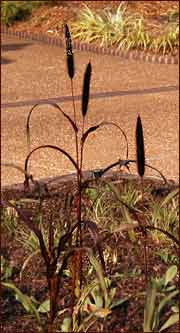 All of the plantings for summer are in. The major display gardens now are filled with small bedding plants still settling in to their new surroundings. As usual, the plants have arrived before their identifying markers have been put in place. Keeping with the lush tropical theme selected by the Garden planners, I was able to identify kalanchoe, coleus, penta, and some canna with variegated leaves. The centerpiece of this season's whole display is a collection of tall spindly plants with burgundy leaves arranged like those on field corn. Topping the whole unwieldy tower is a weedy-looking, dark foxtail spike. This plant could be a poster child for gangling adolescence. This odd collection has been in for a couple of weeks, so while I've been shopping the nurseries for bedding plants, I've been hoping to find one - not to buy; just to identify. On Thursday, I found one at Garden Heights Nursery. The label named it. It is called Ornamental Millet 'Purple Majesty' (Pennisetum glaucum). The label went on to say it was an All-America Selections award winner for 2003. Go on! Gaining new respect for the plant, I checked the web and found that not only was it a winner, but it won a gold metal. According to an article about the millet written for the New York News: "The All-America committee, which has been testing seeds and making selections of exceptional plants for home gardeners to grow since 1932, is very stingy with its awards in general and its gold medals in particular. Some 625 awards have been issued since the committee was formed, according to Nona Wolfram-Koivula, executive director of the group. Since 1989, only Coreopsis 'Early Sunrise' and the Zinnia Profusion series in 1999 and in 2001 have won gold medals." Now 'Purple Majesty.' All of the plantings for summer are in. The major display gardens now are filled with small bedding plants still settling in to their new surroundings. As usual, the plants have arrived before their identifying markers have been put in place. Keeping with the lush tropical theme selected by the Garden planners, I was able to identify kalanchoe, coleus, penta, and some canna with variegated leaves. The centerpiece of this season's whole display is a collection of tall spindly plants with burgundy leaves arranged like those on field corn. Topping the whole unwieldy tower is a weedy-looking, dark foxtail spike. This plant could be a poster child for gangling adolescence. This odd collection has been in for a couple of weeks, so while I've been shopping the nurseries for bedding plants, I've been hoping to find one - not to buy; just to identify. On Thursday, I found one at Garden Heights Nursery. The label named it. It is called Ornamental Millet 'Purple Majesty' (Pennisetum glaucum). The label went on to say it was an All-America Selections award winner for 2003. Go on! Gaining new respect for the plant, I checked the web and found that not only was it a winner, but it won a gold metal. According to an article about the millet written for the New York News: "The All-America committee, which has been testing seeds and making selections of exceptional plants for home gardeners to grow since 1932, is very stingy with its awards in general and its gold medals in particular. Some 625 awards have been issued since the committee was formed, according to Nona Wolfram-Koivula, executive director of the group. Since 1989, only Coreopsis 'Early Sunrise' and the Zinnia Profusion series in 1999 and in 2001 have won gold medals." Now 'Purple Majesty.'According to those who have seen 'Purple Majesty' at maturity, I can expect to see each plant spread to two feet around and grow nearly as tall as I am. Each will be topped with meaty flower spikes of nearly a foot. High school yearbook pictures are poor predictors of what those of us at our prime will look like. 'Purple Majesty' has two months to maturity. I'll be watching. I've been thinking about roses. They are all in bloom and to celebrate the rose, the Garden just hosted its annual "Rose Evening" with cocktails, dinner, a Q&A with the Garden's rosarian, complementary roses, and an chance to stroll though the rose gardens at twilight. I don't grow roses and know little about them, so I listened a lot. One of Rosarian's helpers told me that to qualify as a fanatic, a rose lover must grow at least 150 varieties. Those obsessed he said, have 300 or more. I overhead another visitor say that she knows precisely where to find all of the roses with sweet scents. Each morning on her way to work she says she stops by the rose garden to refresh her spirit by smelling each of her favorites. 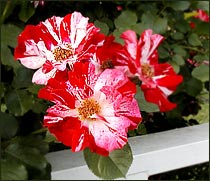 Not knowing roses, I stay away from subtleties, preferring instead roses that smell like roses used to smell and roses that put on flashy displays. For flashy I've always liked a bush rose called 'Rio Samba' because it goes from a youthful gold to mature pink as it ages. Then there's a climber called 'Fourth of July.' Vivid reds and clear whites swirl like a painting by Rembrant. My pick for utter elegance though goes to a bush rose called 'Distant Drums.' It's pink with a trace of purple in its family tree. The Garden's Rosarian must be partial to them too. I counted 51 'Distant Drums' in one of the rose gardens and at least 20 more specimens in the other. Not knowing roses, I stay away from subtleties, preferring instead roses that smell like roses used to smell and roses that put on flashy displays. For flashy I've always liked a bush rose called 'Rio Samba' because it goes from a youthful gold to mature pink as it ages. Then there's a climber called 'Fourth of July.' Vivid reds and clear whites swirl like a painting by Rembrant. My pick for utter elegance though goes to a bush rose called 'Distant Drums.' It's pink with a trace of purple in its family tree. The Garden's Rosarian must be partial to them too. I counted 51 'Distant Drums' in one of the rose gardens and at least 20 more specimens in the other.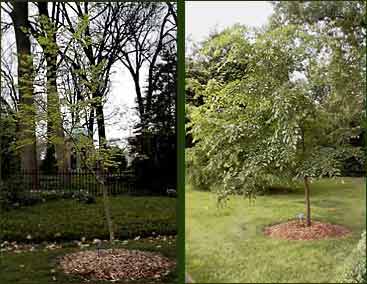 It's been more than a year since I last looked at the 'Accolade' Elm tree planted just north of the grove where Henry Shaw rests. The Morton Arboretum near Chicago developed 'Accolade' as tree that will grow fast, look fabulous, and withstand attacks of Dutch elm disease. It's done all that. Here are side-by-side pictures of the elm taken a year apart. The sapling is becoming a young, vigorous tree since last I visited.
 None of the tell-tail signs of Dutch Elm disease here. However, some of the leaves do have unusual red, finger-like spikes that erupt a quarter inch or more from their top-sides. From web sources, I would guess the Garden's 'Accolade' has a touch of the colorfully named Elm Cockscomb Galls. Authority says that "galls are abnormal growths of plant tissue induced by insects and other organisms" and that "cockscomb gall aphids cause elongated galls resembling a rooster's comb to form on elm leaves." The galls are said to mar the aesthetics of plants (although in this case I don't think so), but unlike what tumors do to people, the galls won't harm the tree. As I looked at the red eruptions on the green, glossy leaves, I thought of that tumultuous scene in My Big Fat Greek Wedding when Toulah, the bride, finds a zit on her face an hour before the wedding begins. Her father Gus advises spraying it with Windex. I wonder if Windex would work on Cockscomb Galls? None of the tell-tail signs of Dutch Elm disease here. However, some of the leaves do have unusual red, finger-like spikes that erupt a quarter inch or more from their top-sides. From web sources, I would guess the Garden's 'Accolade' has a touch of the colorfully named Elm Cockscomb Galls. Authority says that "galls are abnormal growths of plant tissue induced by insects and other organisms" and that "cockscomb gall aphids cause elongated galls resembling a rooster's comb to form on elm leaves." The galls are said to mar the aesthetics of plants (although in this case I don't think so), but unlike what tumors do to people, the galls won't harm the tree. As I looked at the red eruptions on the green, glossy leaves, I thought of that tumultuous scene in My Big Fat Greek Wedding when Toulah, the bride, finds a zit on her face an hour before the wedding begins. Her father Gus advises spraying it with Windex. I wonder if Windex would work on Cockscomb Galls?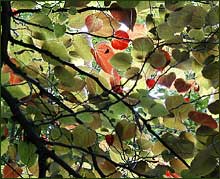 At the entrance to the English Woodland Garden grows a Red Bud tree called 'Forest Pansy.' Like other red buds, it has magenta flowers in early spring and then it covers itself with heart-shaped leaves. Unlike other red buds though, 'Forest Pansy' has a mix of green-, red-, and burgundy-hued leaves. Stand under the tree, add a bright morning light and here's what you will see. At the entrance to the English Woodland Garden grows a Red Bud tree called 'Forest Pansy.' Like other red buds, it has magenta flowers in early spring and then it covers itself with heart-shaped leaves. Unlike other red buds though, 'Forest Pansy' has a mix of green-, red-, and burgundy-hued leaves. Stand under the tree, add a bright morning light and here's what you will see. ominous: breeze: 75º before the storm ominous: breeze: 75º before the stormUnsettled weather. We decided to cut our walk short about halfway into the Garden. The color of the sky and the sound of tornado warning sirens figured in. The rain started just after we bought a cup of coffee and settled in to watch the storm from a place of shelter. Workers at the Garden have already begun the seasonal shift of spring to summer. The annual spring rip-out has begun. Beds of tulips and pansies gone leggy have begun to be removed to make way for the beds of summer. It is still too early to guess what the specifics of the summer plantings will be, but the theme is apparent. Again, the summer display beds will have a lush tropical look with the reds of hibiscus and the chocolate of taro as anchors. 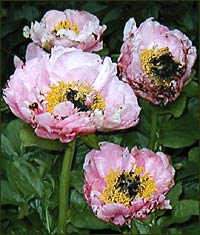 It is rare to see anything but perfect plants in the Garden's featured display beds. Even rarer to see are two peony plants with their flowers marred by what looks to be dark smudges of grease covering their bright yellows centers. Too bad this Garden is particularly uninformative about these kinds of attention-grabbing, sort-lived oddities. I'll have to wait until I get home to see what the web has to say. [Later: Apparently what I saw was botrytis, a fungus aptly nicknamed "gray mold." It usually kills off peony buds, but has been known to cover the flowers with a gray mold. It needs the kind of damp, rainy weather we've been having to thrive.] It is rare to see anything but perfect plants in the Garden's featured display beds. Even rarer to see are two peony plants with their flowers marred by what looks to be dark smudges of grease covering their bright yellows centers. Too bad this Garden is particularly uninformative about these kinds of attention-grabbing, sort-lived oddities. I'll have to wait until I get home to see what the web has to say. [Later: Apparently what I saw was botrytis, a fungus aptly nicknamed "gray mold." It usually kills off peony buds, but has been known to cover the flowers with a gray mold. It needs the kind of damp, rainy weather we've been having to thrive.]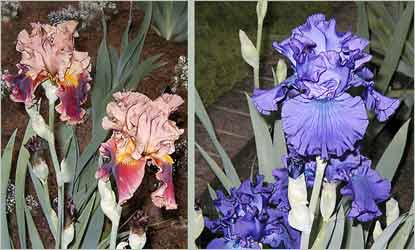 I thought of an ancient spiritual labyrinth as I watched a trail of visitors snaking their way through the narrow grass paths that separate the beds of wildly blooming iris. The travelers pause from time-to-time to point to or to photograph some especially attractive bloom. I hadn't intended to do the iris dance this year, but I couldn't resist walking the labyrinth. I even took a couple of photos of two flowers that agreed to pose--a cinnamon-colored bearded one called 'Adobe Camp Fire' and a striking iridescent blue one that has a name that I didn't care to know. Are the contorted Henry Lauder's Walking Stick trees dying? Pat thinks so. Within the last three weeks she spotted three of them that failed to put on their cover of wrinkled leaves that look diseased even when they are healthy. Walking Sticks are shrubs so ugly that polite people give them a quick glance, then look away lest they be accused of offensive staring. 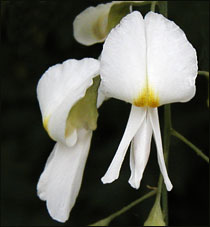 The old yellow wood tree (Cladrastis kentuckea) at the Garden's wall was rotted with age. Its branches were so crippled they needed crutches for support. It's gone now, but anticipating the death of the historic tree, the keepers of the Garden planted two young ones nearby. This morning these new trees with their supple limbs and smooth unblemished barks are blooming. Cascades of pendulous clusters of white flowers drip from their branches. Each flower in the cluster looks like a tentacled sea creature or a tiny windsock. I remember reading somewhere that yellow wood trees flower just once every two or three years. If that's so, this is a special year--all four yellow trees that I know about in the Garden are in flower. The old yellow wood tree (Cladrastis kentuckea) at the Garden's wall was rotted with age. Its branches were so crippled they needed crutches for support. It's gone now, but anticipating the death of the historic tree, the keepers of the Garden planted two young ones nearby. This morning these new trees with their supple limbs and smooth unblemished barks are blooming. Cascades of pendulous clusters of white flowers drip from their branches. Each flower in the cluster looks like a tentacled sea creature or a tiny windsock. I remember reading somewhere that yellow wood trees flower just once every two or three years. If that's so, this is a special year--all four yellow trees that I know about in the Garden are in flower.It's easy to miss--a little patch of flowers shielded by a rectangular hedge of boxwood planed near the old museum. I had to walk up and look over the hedge. Inside is a shimmering field of 'Solstice Burgundy' Snapdragons and dots of 'Crown-Jewel' toadflax punctuated with the watery oranges and reds of Artic poppies. If I were in charge of designing the set for the path to Oz or for planting the Elysian Fields, these are the plants and the color combinations I would choose. 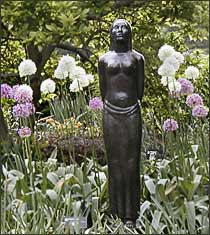 An untitled statue flanked with untitled purple and white giant allium globes seem meant for each other. An untitled statue flanked with untitled purple and white giant allium globes seem meant for each other.Last week the hosta and wildflower enthusiasts were selling and showing at the Garden. This week groups with passions for miniature roses, dahlias, and bonsai were on hand. I enjoy seeing their displays and exhibits. I like being tempted to buy the plants raised by their members. Mostly though, I like talking with people who know and have grown to care about some particular plant. The object of their passion differs, but not the passion. I'm reading Pete Hamill's latest book Forever. In it he talks about usefulness of reading everything an author wrote, being able to distinguish "between one composer and another while hearing a mere eight bars," or "by knowing without thinking the difference between an accent or an umlaut." Long acquaintance and observation with the object of one's passion is a way of "smashing into the sludge" that gathers in the brain, he says. In the brains of these plant groupies who share their hard-acquired understandings of hostas, dahlias, or tiny roses, sludge doesn't clot.  cloudy to rain: light breeze: 75º to 63º as a storm begins cloudy to rain: light breeze: 75º to 63º as a storm beginsAs the automatic doors opened into the Garden, the first thing I saw was a small truck that a worker had left parked outside the entrance. Its bin was half-filled with spent, faded tulip heads headed for the compost heap. It reminded me of what I had missed while I was away for a few weeks. I hated to miss the Garden's main event, but there will still be plenty of spring's leftovers to savor. I'm certain that even among those who see the Garden every day in spring, no one takes in all the Garden offers. The Garden's weekly listing of "Plants in Bloom" now has expanded from two pages to nine pages of small print. The repetitive winter listing of pansies and more pansies has swollen with the abundance of April. Many of the daffodils and tulips featured on the list, while technically still in bloom, are today in tatters. Dafodill heads have bent to the ground. Nearly all of the tulip petals are marked with dark specks and streaks of decay. Some of them have a toothy look where a petal or two has fallen. Even so, when I move back from the blemishes of individual flowers, I still see the grand swaths of vibrant color that say spring. 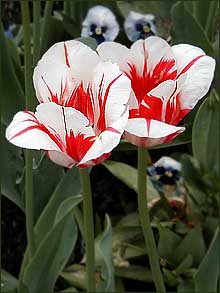 This morning I take notes. Neither tulips nor daffodils bloomed around our homeplace this year. Next spring I am determined things will be different. So, like a shopper at a remainder sale, I look at the dowdy remains of the late spring flowers and try to image what they would have been like had they been still new. To help me imagine, I brought along a bulb catalog from McClure & Zimmerman, my favorite "flowerbulb broker." By matching the words of their talented copywriters with the last of the Garden's blooming flowers, I try to imagine what I might have seen had I been at the Garden a week or two ago. I settle on a couple of tulips for my 2004 landscape: one is Rembrant-kind of tulip called "Sorbet"-- pure white with a fire of red in the center edged with red flames licking at the petals. The McClure & Zimmerman description This morning I take notes. Neither tulips nor daffodils bloomed around our homeplace this year. Next spring I am determined things will be different. So, like a shopper at a remainder sale, I look at the dowdy remains of the late spring flowers and try to image what they would have been like had they been still new. To help me imagine, I brought along a bulb catalog from McClure & Zimmerman, my favorite "flowerbulb broker." By matching the words of their talented copywriters with the last of the Garden's blooming flowers, I try to imagine what I might have seen had I been at the Garden a week or two ago. I settle on a couple of tulips for my 2004 landscape: one is Rembrant-kind of tulip called "Sorbet"-- pure white with a fire of red in the center edged with red flames licking at the petals. The McClure & Zimmerman description 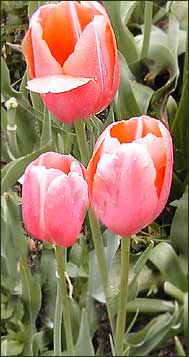 clinches the choice: "White blooms lightly swirled with luscious red-raspberry. Simply put--it's gorgeous!" At just under $1.00 a bulb, it ought to be. Still, for less than a bagel and cream cheese, I get luscious and gorgeous. clinches the choice: "White blooms lightly swirled with luscious red-raspberry. Simply put--it's gorgeous!" At just under $1.00 a bulb, it ought to be. Still, for less than a bagel and cream cheese, I get luscious and gorgeous.The other tulip I picked is called "Menton." Like "Sorbet," it's a single late tulip. The rose-colored petals have a satiny look that invites dew to stay. The inside glows with a gradient of fireplace oranges. Better said by McClure & Zimmerman writers: "Soft and muted rose-pink with light tangerine. Reminds us of ripe peaches." Yum. Hostas are fashionable plants, rightly so. Thousands of varieties exist. The authoritative Hosta Handbook that a friend gave me last year lists 1300 varieties and apologizes for omitting "mention of many fine plants." For many years now, the Garden has had a Hosta Garden just across the walk from the bulb gardens. This morning though I was wanted to look at other hostas -- older hostas-- hostas that were thriving before the formal hosta garden was planted. 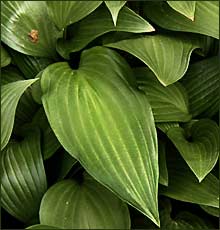 Two weeks ago in an over-grown, long-neglected part of the yard around my 1960's house, I found a clump of hostas that with the help of the Hosta Handbook I identified as Hosta lancifolia. No fancy hosta this: plain, shiny, dark green, somewhat flimsy leaves, shaped like a squashed oval. No variegation; no giant flower scapes, no delicate white edging or streaks of chartreuse. Nothing to make it stand out, except, again according to the Hosta Handbook, this hosta hiding among my weeds, was the most planted landscape hosta ever. It was introduced into the United States from China in the 1800's. It grew well in shade; it was inexpensive; and it multiplied rapidly. And up until the 1980's, when people thought hosta, they imaged Hosta lancifolia. Then as newer, flashier varieties of hosta began to appear, Hosta lancifolia became a landscaping outcast shunned as "common and ordinary." So finding that patch of Hosta lancifolia in a neglected corner of my yard was like finding a piece of garden history. Two weeks ago in an over-grown, long-neglected part of the yard around my 1960's house, I found a clump of hostas that with the help of the Hosta Handbook I identified as Hosta lancifolia. No fancy hosta this: plain, shiny, dark green, somewhat flimsy leaves, shaped like a squashed oval. No variegation; no giant flower scapes, no delicate white edging or streaks of chartreuse. Nothing to make it stand out, except, again according to the Hosta Handbook, this hosta hiding among my weeds, was the most planted landscape hosta ever. It was introduced into the United States from China in the 1800's. It grew well in shade; it was inexpensive; and it multiplied rapidly. And up until the 1980's, when people thought hosta, they imaged Hosta lancifolia. Then as newer, flashier varieties of hosta began to appear, Hosta lancifolia became a landscaping outcast shunned as "common and ordinary." So finding that patch of Hosta lancifolia in a neglected corner of my yard was like finding a piece of garden history.I also found a huge patch of Hosta lancifolia (also called Hosta cathayana) thriving under an out-of-the-way crabapple tree in the Garden. There are no Hosta lancifolia growing among the newer, trendier hostas in the Hosta Garden, but it's good to know that common and ordinary still has a place at the Garden. 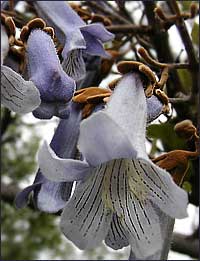 The Paulownia trees are in bloom. The tubes of orchid flowers burst from tan sepals, soft as kid gloves. Stems of them cluster at the end of branches beyond the point where giant leaves will eventually appear. I was lucky not to have missed this spectacle. The tree itself is also lucky, as I learned from the web. According to Chinese legend, the Paulownia tree is the only tree that the mythical phoenix bird will perch upon. As a symbol of God's favor, virtue and grace, luck and happiness, the phoenix is a good bird to have around. So to attract the phoenix with its gift of luck and good fortune, the web source says many Paulownia trees are planted around Chinese homes. We all need a Paulownia tree. The Paulownia trees are in bloom. The tubes of orchid flowers burst from tan sepals, soft as kid gloves. Stems of them cluster at the end of branches beyond the point where giant leaves will eventually appear. I was lucky not to have missed this spectacle. The tree itself is also lucky, as I learned from the web. According to Chinese legend, the Paulownia tree is the only tree that the mythical phoenix bird will perch upon. As a symbol of God's favor, virtue and grace, luck and happiness, the phoenix is a good bird to have around. So to attract the phoenix with its gift of luck and good fortune, the web source says many Paulownia trees are planted around Chinese homes. We all need a Paulownia tree. |