 |
|||||||||||||||||||||||||||||||||||||||||||
|
“I wonder whether
 in Rutherford, New Jersey,
the trees this morning areas full as these outsidemy window.” -- from “Dieback” by Elizabeth Dodd
in Rutherford, New Jersey,
the trees this morning areas full as these outsidemy window.” -- from “Dieback” by Elizabeth Dodd |
|||||||||||||||||||||||||||||||||||||||||||
|
 sun, then clouds: light breeze: 48ºF sun, then clouds: light breeze: 48ºF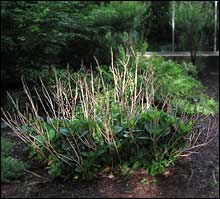 Summer’s not summer without Big Leaf Hydrangeas (Hydrangea macrophylla). They’re the ones covered with oversized globes of flower clusters that turn either pink or blue depending on whether they are cared for by men or women or some such thing. The keepers of this botanical garden have planted dozens of varieties of Big Leaf Hydrangeas throughout the grounds. Most years they put on a long, spectacular show. This year may be different. Last winter sub-zero temperatures pushed this part of the country into Zone 5 for a few days. That was enough to do in a lot of the Big Leafs growing in unsheltered places. Last season’s growth along with this season’s flower buds were killed. The big leaf hydrangeas damaged by the cold are now starting over with new foliage that is growing up and around the dead twigs that would have been loaded with flowers next month. Summer’s not summer without Big Leaf Hydrangeas (Hydrangea macrophylla). They’re the ones covered with oversized globes of flower clusters that turn either pink or blue depending on whether they are cared for by men or women or some such thing. The keepers of this botanical garden have planted dozens of varieties of Big Leaf Hydrangeas throughout the grounds. Most years they put on a long, spectacular show. This year may be different. Last winter sub-zero temperatures pushed this part of the country into Zone 5 for a few days. That was enough to do in a lot of the Big Leafs growing in unsheltered places. Last season’s growth along with this season’s flower buds were killed. The big leaf hydrangeas damaged by the cold are now starting over with new foliage that is growing up and around the dead twigs that would have been loaded with flowers next month.Now that I see what an uncooperative winter can do to hydrangeas that flower on last year’s branches, I can see why nurseries and garden centers around here are steering their customers to a newer Big Leaf Hydrangea named ‘Endless Summer.’ Unlike other more finicky macrophylla hydrangeas that collapse in the cold, ‘Endless Summer’ is supposed to survive temperatures to 40 below. Then even, if the buds on the old wood do die, the shrub is supposed to go ahead and bloom anyway on the new shoots that it puts out in spring. This botanical garden has a few ‘Endless Summer’ plants. I’m anxious to have a look at them to see how they survived the winter and whether they will perform as advertised this summer. 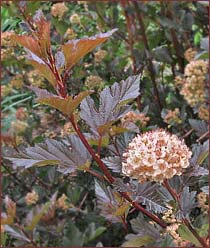 While thinking of things new, I couldn’t help but notice some burgundy-colored shrubs loaded with pink quarter-sized blossom clusters that remind me of spirea blooms. A couple are blooming in the display gardens paralleling the Linnean greenhouse. Nearly three dozen have been planted along the borders of the recently opened George Washington Carver Garden. The shrubs are labeled Common Ninebark (Physocarpus opulifolius). Nothing about them is common though. They are a top selling variety marketed by Proven Winners, an international marketing cooperative of breeders, growers, and marketers. Proven Winners finds breeders who have developed a shrub that is a notch or two away from run-of-the mill varieties. Then they test it to find out how quickly and easily their network of growers can bring it to market and how well the shrub will perform for buyers like us. Shrubs that pass muster are then given coming-out parties with ads in the national media, appearances at prestigious garden shows, and prominent placements at retail nurseries.
The Proven Winner shrub growing here is called ‘Summer Wine.’ That's a name that can’t miss. Who cares that burgundy is better drunk on winter nights? Maybe ‘Summer Wine’ is meant to emphasize the white zinfandel-like colors of the flower clusters. The old-fashioned ninebarks also have fall and winter interest. In fall, many of them light up with oranges, yellows, and reds. In winter, their peeling bark adds interest. I’ll have to wait and see what ‘Summer Wine’ does as the seasons change. For now though, who cares? It’s a stand-out. I’ve yet to see it other than in magazines and on the web, but Proven Winners has introduced a new ninebark just this spring that they call ‘Coppertina.’ This one crosses a gold leafed-ninebark with one that has dark purple leaves to get a shrub with burnished orange leaves and pure white flowers. 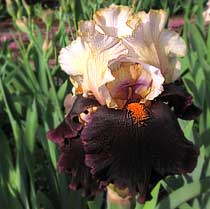 The iris garden is at its peak this morning. To prepare for the American Iris Society’s national conference last year, the iris beds were renewed and planted with the best (or maybe the trendiest) of the up and comers. All of the older varieties were banished to the far wing of the iris garden. I am not an avid iris person so I don’t know enough to take sides on the merits of new comers versus the ones that grandma grew. I’m just attracted to color, size, and names: usual or striking color combinations, big blooms and names that make me smile or scratch my head are my favorites. This year, my pick is a tall bearded variety introduced by Keith Keppel in 2002 that he named ‘Secret Service.’ The iris garden is at its peak this morning. To prepare for the American Iris Society’s national conference last year, the iris beds were renewed and planted with the best (or maybe the trendiest) of the up and comers. All of the older varieties were banished to the far wing of the iris garden. I am not an avid iris person so I don’t know enough to take sides on the merits of new comers versus the ones that grandma grew. I’m just attracted to color, size, and names: usual or striking color combinations, big blooms and names that make me smile or scratch my head are my favorites. This year, my pick is a tall bearded variety introduced by Keith Keppel in 2002 that he named ‘Secret Service.’ |
||||||||||||||||||||||||||||||||||||||||||