 |
|
|
“Green, that is what my world is,
bright, brassy, green, the kind that hurts your eyes when the sun shines.”  -- from "Appalachian Spring" by Marcia Bonta -- from "Appalachian Spring" by Marcia Bonta |
|
|
|  sunny, calm, 71ºF sunny, calm, 71ºF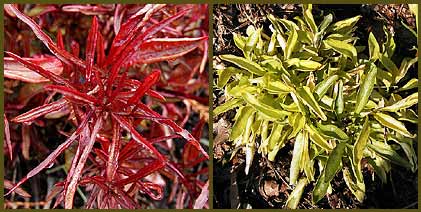 For years, the botanical garden has relied on the foliage of a low, compact plant called "Joseph's Coat" or "Joyweed" (Alternanthera) to add brash tropical colors to summer beds and to define the edges or fill the innards of ground patterns. "Joseph's Coat" is an apt name for these plants that come in colors that range from burnished copper through chartreuse to some unlikely variegations. Leaf size varies too. All are narrow; some are pinched and wiggley; others are thin and unruly. According to a web source, Joseph's Coat is an heirloom plant that was popular in the Victorian era when formal gardens were in vogue. Today there is new interest in it, thanks to exciting new cultivars from Mexico and South America . . . It's a choice plant for today's part-time gardener because it provides season-long color with little routine care." With all of this going for the little plants, they have yet to be widely used outside the botanical garden. The garden centers in the big-box stores don't have them, nor have I seen them in any of the nurseries near me. The earliest of the daylilies (not counting Stella d'Oros which are already blooming energetically here and everywhere else) have begun to bloom. Late year I picked my favorite dozen from among the hundreds that flower each June. This week I've picked two varieties to start my top-twelve list. 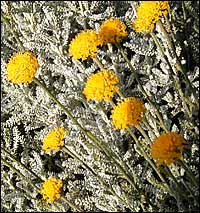 Lavender cotton (Santolina) is used as an edging for several of the beds in the herb garden. Most times the ground-hugging plant looks like a jumble of silver-white crawling things that could be dished-up to serve contestants on "Fear Factor." Never though do I remember seeing the Cotton in bloom. This morning all of the patches had sent up stocks of frothy lemon-pie filling colored balls of flowers. The combination of gold against a backdrop of silver lit by an early sun was dazzling.
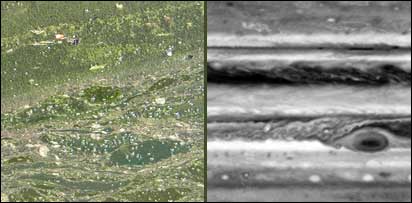 The four-acre lake in the Japanese Garden named for "pure, clear harmony and peace" is neither pure nor clear this morning. A layer of algae rings the lake from the shoreline to about twenty-five feet out. Where the turbid currents of this green scum flowing in opposite direction meet, they form turbulent eddies. The conflicting currents bring to mind pictures of the cloud movements on Jupiter taken several years ago by the NASA's Galileo spacecraft. Visitors to the Japanese Garden from tour buses look, point, make mouth clicks, and say to their fellow travelers, "You would think they would do something about that." Having seen this great murkiness happen before -- late spring and fall are the worst times-- we know that it will pass. The wizards who manage this lake soon will turn the waters pure and clear again. 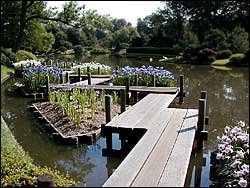 Three weeks after the bearded iris finish blooming, the blunt-nosed Japanese Water Irises (Iris enstata) bloom. Beds of them line the zig-zag bridge that juts into the lake in the Japanese Garden. We crossed the bridge that jogs eight times before returning to shore to get a closer look at these once-a-year wonders and to evade the evil spirits that legend says can travel only in straight lines. Three weeks after the bearded iris finish blooming, the blunt-nosed Japanese Water Irises (Iris enstata) bloom. Beds of them line the zig-zag bridge that juts into the lake in the Japanese Garden. We crossed the bridge that jogs eight times before returning to shore to get a closer look at these once-a-year wonders and to evade the evil spirits that legend says can travel only in straight lines. |