 |
|
|
"We cannot remember too often that when we observe
nature, and especially the ordering of nature, it is always ourselves alone we are observing.  -- "From 'Aphorisms' by R.J. Hollingdale -- "From 'Aphorisms' by R.J. Hollingdale |
|
|
|
 hazy: calm: a clammy 82º hazy: calm: a clammy 82ºSometime during the past week, the display gardens outside the Linnean House were "revised." The ragged leafed, sparse blooming Mexican sunflowers and the pentas that never seemed to catch on were removed. In their place is a ragtag assortment of grasses, bananas, crotons, globe amaranth, papyrus, and as they say at the bottom of the flyers that are used to advertise up-coming auctions, "other items too numerous to mention." Rather than working from a plan, the idea seems to have been to fill these spaces with choice leftovers from the greenhouse. This kind of radical change of planting in high summer is extremely unusual. I can never remember it happening. To the credit of the garden keepers, they gave up their adventurous experiment with the untamed look of a tropical garden before the plants gave up. 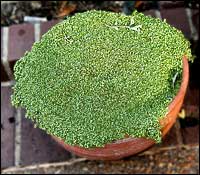 Most container pots in the garden are planted in three tiers of contrasting colors-a tall center piece is surrounded by puffy shorter plants and then the whole thing is edged with vines that drape over the lips. The pot of 'Crème de menth' mint in the fragrance garden always makes me pause because it's different. It's a single colored, tiny-leafed ground hugger that obediently fills the pot and then stops. Rubbing a sprig of leaves between my thumb and forefinger released some of the most concentrated scent I've even smelled in a mint. I haven't ordered a grasshopper in a lot of years, but I think 'crème de menthe' is apt for this little one.
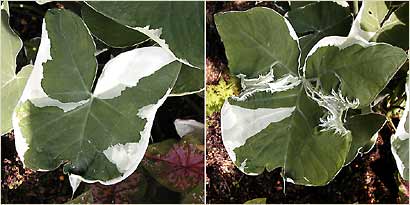 Another odd plant I keep returning to is a mouse-cupped taro called 'Variegatum Monstrosum.' It's planted in several places in the bulb gardens. When the leaves of the plant are new and young, they are yellow-green with continents of cream that sweep in from the edges. Then as the leaves mature, the cream color crinkles-folds in upon itself, puckers up until the mature leaves look like the skin of a burn victim.  I've looked through the windows of the mausoleum at the sarcophagus of Henry Shaw dozens of times. I knew that the bronze plaques on the base memorialized the dates of his birth and death. What I noticed today was that on these plaques, his first name is spelled as Henrÿ - with two dots over the y. Curious. Umlauts I associate with German. Shaw was an Englishman. Why the dots?
 I saw the Henry Moore sculpture near the east entrance to the English Woodland Garden in a new way this morning. There was an article about Moore's lifelong fascination with the monoliths at Stonehenge in this week's Christian Science Monitor. He saw them first by moonlight when he was a 23 year-old art student. "ever since," he said, "I've wanted to do work that could be walked through and around." From a distance, the Moore piece of a two-piece reclining figure seemed to have none of the scale, thrust, or mystery of Stonehenge that fascinated Moore. But as I walked up to the sculpture, I could see that the separate pieces were penetrated with shadowy tunnels where I could imagine walking and experiencing what Moore did on that moonlit night 80 years ago.
 clear: calm: 68º clear: calm: 68º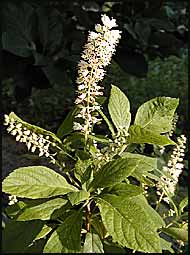 Sweet pepperbushes (Clethra alnifolia) have begun to bloom. Their compact shrubs are about four feet tall--just tall enough to make their spire-like white flowers easy to sniff. I've learned not to inhale too deeply when taking in their scent. The peppery tinge behind their sweet fragrance makes me sneeze. Thinking back to last winter, I think it was the shrub's dried seed capsules hanging like pendants that were used to add a feathery look to some of the holiday wreaths displayed at the Garden. The blooming pepperbush shrubs are scattered throughout the garden, but are featured prominently on the West Side of the Japanese Garden and under a Paulownia tree in the Dry Creek Garden. Sweet pepperbushes (Clethra alnifolia) have begun to bloom. Their compact shrubs are about four feet tall--just tall enough to make their spire-like white flowers easy to sniff. I've learned not to inhale too deeply when taking in their scent. The peppery tinge behind their sweet fragrance makes me sneeze. Thinking back to last winter, I think it was the shrub's dried seed capsules hanging like pendants that were used to add a feathery look to some of the holiday wreaths displayed at the Garden. The blooming pepperbush shrubs are scattered throughout the garden, but are featured prominently on the West Side of the Japanese Garden and under a Paulownia tree in the Dry Creek Garden.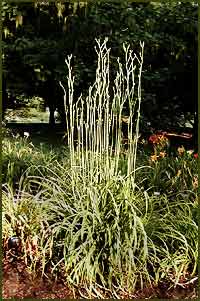 It's not even blooming, but I wanted to get a picture of the scapes of the 'Altissima' daylily. The scapes without blooms look like one of those fountains of dancing waters rising from a smaller splays. I wish I had thought of posing beside this giant. Or better still, visualize the center of a basketball team standing next to the scapes looking up at the buds. These giants would have been perfect additions to a strip of garden I have in my far back yard. Why did I put in so many invisible-from-a-distance 'Stella d'Oros' instead? It's not even blooming, but I wanted to get a picture of the scapes of the 'Altissima' daylily. The scapes without blooms look like one of those fountains of dancing waters rising from a smaller splays. I wish I had thought of posing beside this giant. Or better still, visualize the center of a basketball team standing next to the scapes looking up at the buds. These giants would have been perfect additions to a strip of garden I have in my far back yard. Why did I put in so many invisible-from-a-distance 'Stella d'Oros' instead?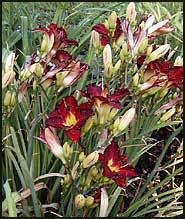 The daylily ideal--more scapes, more buds per scapes, and bigger flowers -- has gotten out of hand with a cultivar called 'Siloam Paul Watts.' In moderation, it's a shapely plant with a flower of a rich, unusual color. But bloated and super-sized as it was bred to be, it loses its charm. The daylily ideal--more scapes, more buds per scapes, and bigger flowers -- has gotten out of hand with a cultivar called 'Siloam Paul Watts.' In moderation, it's a shapely plant with a flower of a rich, unusual color. But bloated and super-sized as it was bred to be, it loses its charm.After looking at 'Siloam Paul Watts,' I began to notice that many daylilies of all colors and sizes bear the name Siloam. Without even trying I spotted at least a dozen such cultivars. Going to the internet I found that one person--Pauline Henry--was responsible for all of these and more. She is credited with introducing 476 varieties of daylilies. Siloam always was the first name of all of her varieties: 'Siloam Tom Howard,' or 'Siloam Virginia Henson.' Siloam is for Siloam Springs, Arkansas, a town of about 10,000 in the Northwest part of the state just this side of the Oklahoma border where Ms. Henry lived and bred daylilies for more than thirty years. Ms. Henry was 92 when she died nearly two years ago. I think of her and her garden now. What was she like? Who were the people she named her flowers for? Did she have a family? Did she continue with her work to the end? Why was the daylily her passion? Is her garden still there? Is anyone carrying on her work? Perhaps I should travel to Siloam Springs. Here is a site that features the best of Pauline Henry's Siloam series. I remember someone at the Garden saying to me that acquisitive people, not hungry animals were the biggest threat to Garden specimens. To combat such folks, I remembering hearing that the Garden intentionally does not label commercially valuable or medicinally useful plants such as Golden Seal or Ginsing. Until today though, I had never seen anyone take a living plant from the Garden. This morning near the English Garden, I saw a middle-aged woman carrying a plastic bag filled partway with soil and some live green specimens that she must have picked up earlier. Her husband was winding his way through the beds occasionally calling out to his wife to come and see a prize he had found. We passed her on the walk. She was looking to the ground; her head moving quickly side-to-side as if trying to spot the next treasure in what for her was a shopping center where everything was free for the taking. The pair reminded me of that tv show where shoppers wheel their carts down the aisles of a supermarket trying to scoop up as much as they can in the shortest time. I felt disgusted. But I didn't act. I neither challenged the pair or used my cell phone to call the front desk to alert them of the impending loss. Looking back, I know I should have done one or the other. Next time, I will. Complementary colors. Colors that invoke harmony and belonging. Reds and greens. The pairing is abundant in the Japanese Garden just now. Red maples and pines, green shrubs paired with red Japanese barberry shrubs. And at the North Entrance to the mausoleum grounds, the angel wing-shaped leaves of a variety of rex begonia called 'Maui Mist' combine the two colors on each leaf adding accents of black, cream, and gold. 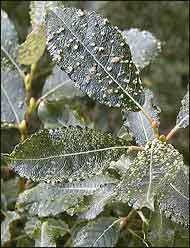 In late winter as I look for signs of spring, I always promise myself that this will be the year I plant a pussy willow. I like the sensuousness of the gray cushions tucked into every stem node. Later as the shrub matures, it sports wooly worm-like catkins that swing to the slightest breeze. In winter, I didn't believe the garden books that knock pussy willows as weak-wooded, with shallow, greedy roots, and a proneness to catching all manner of plant illnesses. About this time though, reality sets in. The pussy willow patch at the far curve of the Japanese Garden, has picked up what according to a fact sheet from the Ohio State University Extension, seems to be a case of willow blister gall. It is caused by a microscopic carrot-shaped mites. They don't kill the plant so OSU suggests just leaving them alone to continue feeding and multiplying I guess. All the pussy willows now look like they have a bad case of the hives. I suppose pussy willows aren't meant to seen in July. In late winter as I look for signs of spring, I always promise myself that this will be the year I plant a pussy willow. I like the sensuousness of the gray cushions tucked into every stem node. Later as the shrub matures, it sports wooly worm-like catkins that swing to the slightest breeze. In winter, I didn't believe the garden books that knock pussy willows as weak-wooded, with shallow, greedy roots, and a proneness to catching all manner of plant illnesses. About this time though, reality sets in. The pussy willow patch at the far curve of the Japanese Garden, has picked up what according to a fact sheet from the Ohio State University Extension, seems to be a case of willow blister gall. It is caused by a microscopic carrot-shaped mites. They don't kill the plant so OSU suggests just leaving them alone to continue feeding and multiplying I guess. All the pussy willows now look like they have a bad case of the hives. I suppose pussy willows aren't meant to seen in July. hazy: calm: 82º hazy: calm: 82ºVery often we've heard the sounds of the "bell tree" as walkers use their arms like kids dragging a stick across a picket fence to ring the brass Swiss bells dangling on chains from the "branches" of the tree. Tradition has it that those who sound the bells bring good fortune to themselves and their families. Some bells are large; others very tiny. Ringing them usually makes a potpourri of sound. Today though I heard something different. I was in another part of the garden where I could hear, but not see the bell tree. Instead of the usual clatter of sound, I heard a clear four-note melody, played just once. The bell tree had become a musical instrument. I wish I had been closer to see who and how. 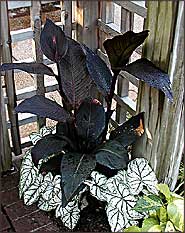 Deep burgundy, white, and green is a color combination that can't miss. Softening an inside corner of the pergola near the Linnean House I found a medium-sized merlot-colored canna edged at the base with a 'White Christmas,' a white, green-veined caladium. Because the canna is planted in partial shade it is unlikely to flower, but then why add red to a combination that works fine just as it is? Deep burgundy, white, and green is a color combination that can't miss. Softening an inside corner of the pergola near the Linnean House I found a medium-sized merlot-colored canna edged at the base with a 'White Christmas,' a white, green-veined caladium. Because the canna is planted in partial shade it is unlikely to flower, but then why add red to a combination that works fine just as it is?Two girls about eight and ten stooped down to gently pinch the cheeks of some yellow snap dragon flowers hanging over a walk in the bulb garden. As their touch squeezed and relaxed, the "jaws" of the flower opened and closed. The girls nodded "yes" when their mom walked up to them and asked, "Making the flowers talk?" 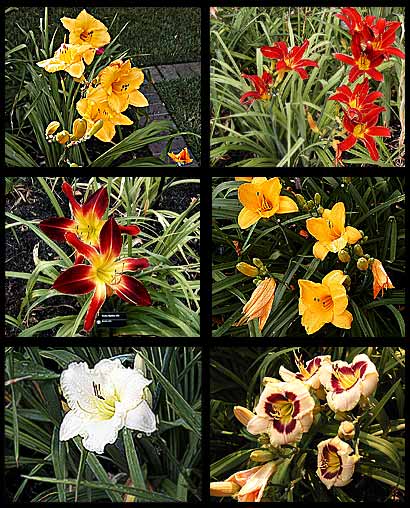 I don't count number of scapes of buds or anything else that the daylily aficionados use to confer greatness on a cultivar. I picked my five favorites just because I liked them best on this one morning in early July. I may have picked the "pet quality" of the breed, but then they are my pets. From left to right, with no particular ranking, my choices are 'Gateway Gold,' 'Bess Ross,' 'Ruby Spider,' 'Golden Prize,' 'Alpine Snow,' and 'Custard Candy.' That makes six on my top five list. Hey, it's my list. 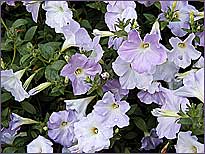 In planters and in all the beds leading up to the front door of Shaw's country home, the dominant plant is a petunia called 'Misty Lilac Wave.' It's one of the newer spreading petunias as evidenced by the tiny "TM" superscript on the label behind the name. New though it is, the petunia is instantly familiar. It has the same shape and faded violet color as the old-fashioned leggy petunias that spread their color over the backyards and flower beds of other times. As I looked as the masses of color, I remembered the huge petunia bed my mother-in-law cultivated just outside the front door of her farmhouse. At this time of year the bed was alive with bees, butterflies, hummingbirds, and the occasional blacksnake looking for shade or shelter. The sweet smell of the thousands of blooms welcomed visitors to her door. Once established, the petunias reseeded themselves, each year becoming thicker and more lush. Seeing the familiar shape and color of 'Misty Lilac Wave' returned my thoughts to a that garden that sadly is no more. In planters and in all the beds leading up to the front door of Shaw's country home, the dominant plant is a petunia called 'Misty Lilac Wave.' It's one of the newer spreading petunias as evidenced by the tiny "TM" superscript on the label behind the name. New though it is, the petunia is instantly familiar. It has the same shape and faded violet color as the old-fashioned leggy petunias that spread their color over the backyards and flower beds of other times. As I looked as the masses of color, I remembered the huge petunia bed my mother-in-law cultivated just outside the front door of her farmhouse. At this time of year the bed was alive with bees, butterflies, hummingbirds, and the occasional blacksnake looking for shade or shelter. The sweet smell of the thousands of blooms welcomed visitors to her door. Once established, the petunias reseeded themselves, each year becoming thicker and more lush. Seeing the familiar shape and color of 'Misty Lilac Wave' returned my thoughts to a that garden that sadly is no more. hazy: calm: 84º hazy: calm: 84ºThe display gardens outside the Linnean House are much as they were last week: adolescent uncertainty hoping for confident maturity. One new addition: Japanese beetles have begun making lace of the canna leaves at the back of the beds. It surprises me that they have been given free rein to make inroads into these carefully monitored signature beds. Years ago I bought a reprint of a book published 1870 for homeowners who wanted to use flowers and trees to beautify their "home grounds." The home grounds of the Victorian homes of the well-to-do were expansive. So if flowers were to be admired from distant verandas, they had to be tall and colorful. Castor-bean plants, canna, hollyhocks, and cleome all were recommended to the 19th Century homeowner who aimed for a "grand display." My seed catalogs pay scant attention to cleome. They are described as throwbacks to grandmother's flower garden or, more kindly, as heritage flowers. Still, until a pin oak in my neighbor's lot shaded my garden, cleome (I call them spider plants) were always a part of my summer garden. I even grew to like them close-up: their prickly stems, the gluey feel of their leaves, and their distinctive scent that has been likened to that of a "wood kitty." Like a Victorian homeowner, I enjoyed watching them from my porch, 200 feet away. Their clusters of pink, purple, cherry, and white flowers moved with the slightest breeze like exploding fireworks shot high above everything else in my garden. 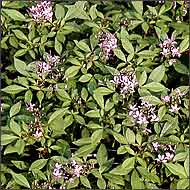 The cleome I saw this morning in the plot opposite the scented garden was nothing like anything I had ever grown. Full grown and sporting blossom heads of rosey-purple flowers, these plants were no more than knee high. When I reached out to touch one, another surprise: no prickly stems; the leaves were just slightly tacky; and the skunkiness was gone. A label nearly hidden under the foliage calls them 'Linde Armstrong.' When I typed "Linde Armstrong" into Google, I found I wasn't the first to discover this odd cleome. Chris Kelly, owner of a nearby nursery, wrote with exuberance, "I proclaim this to be one of the best new annuals, that once seen, will instill instant plant lust. I left the Missouri Botanical Garden in a daze after having seen it . . . I was lucky to make it home --in rush hour traffic, no less." The cleome I saw this morning in the plot opposite the scented garden was nothing like anything I had ever grown. Full grown and sporting blossom heads of rosey-purple flowers, these plants were no more than knee high. When I reached out to touch one, another surprise: no prickly stems; the leaves were just slightly tacky; and the skunkiness was gone. A label nearly hidden under the foliage calls them 'Linde Armstrong.' When I typed "Linde Armstrong" into Google, I found I wasn't the first to discover this odd cleome. Chris Kelly, owner of a nearby nursery, wrote with exuberance, "I proclaim this to be one of the best new annuals, that once seen, will instill instant plant lust. I left the Missouri Botanical Garden in a daze after having seen it . . . I was lucky to make it home --in rush hour traffic, no less."Looking further, I learned that 'Linde Armstrong' was named for a gardener in Charlotte, North Carolina, and that it was developed by the Athens Select Program, a University of Georgia trial garden that specializes in plants that stand-up to high heat and humidity. Hear! Hear! 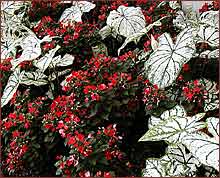 I saw another dwarf variety that was new to me: the 'Pixie' family of impatiens. The flowers are about half the size of the bread-and- butter varieties, and are being used extensively in container plantings throughout the garden. As container flowers, they look skimpy and undernourished. As companion plants through, they are stunning. I took this picture near the back entrance to the Temperate House. 'Pixie Red Bicolor' is companion planted with 'White Christmas' caladiums. I saw another dwarf variety that was new to me: the 'Pixie' family of impatiens. The flowers are about half the size of the bread-and- butter varieties, and are being used extensively in container plantings throughout the garden. As container flowers, they look skimpy and undernourished. As companion plants through, they are stunning. I took this picture near the back entrance to the Temperate House. 'Pixie Red Bicolor' is companion planted with 'White Christmas' caladiums.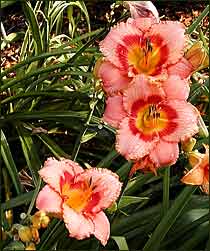 I like this line about lists written by the outspoken comedic playwright David Ives: "Lists are anti-democratic, discriminatory, elitist, and sometimes the print is too small." Adding to all the other lists we love to hate, the American Hemerocallis Society (AHS), the daylily people, have come up with their list of the five most popular daylilies in my region of the country. Armed with only the list, no pictures or description, I smugly found four of the five winners among the hundreds of cultivars blooming in the Jenkins Daylily Garden, one of the designated demonstration gardens of the AHS. Tops on big five list was 'Strawberry Candy,' (photo above) followed by 'Siloam Double Classic,' 'Barbara Mitchell,' 'Janice Brown,' and trailing the pack, 'Cherokee Pass' (which I had no luck in finding). Of the top five, four had received the AHS's prestigious Stout Silver Medal (poor, unloved 'Cherokee' Pass had not). The Stout Metal, was named to honor Dr. Arlow Burdette Stout, developer of modern daylily breeding in North America. 'Strawberry Candy' was the most recent winner of the list taking the medal in 1998. So much for the lists of others. Next week I will boldly pick my top five daylilies. I like this line about lists written by the outspoken comedic playwright David Ives: "Lists are anti-democratic, discriminatory, elitist, and sometimes the print is too small." Adding to all the other lists we love to hate, the American Hemerocallis Society (AHS), the daylily people, have come up with their list of the five most popular daylilies in my region of the country. Armed with only the list, no pictures or description, I smugly found four of the five winners among the hundreds of cultivars blooming in the Jenkins Daylily Garden, one of the designated demonstration gardens of the AHS. Tops on big five list was 'Strawberry Candy,' (photo above) followed by 'Siloam Double Classic,' 'Barbara Mitchell,' 'Janice Brown,' and trailing the pack, 'Cherokee Pass' (which I had no luck in finding). Of the top five, four had received the AHS's prestigious Stout Silver Medal (poor, unloved 'Cherokee' Pass had not). The Stout Metal, was named to honor Dr. Arlow Burdette Stout, developer of modern daylily breeding in North America. 'Strawberry Candy' was the most recent winner of the list taking the medal in 1998. So much for the lists of others. Next week I will boldly pick my top five daylilies.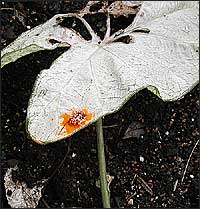 The Green Hawthorn (Crataegus viridis) in the Samuels Bulb Garden has turned sickly. The fruits are covered with spores that shake off a powdery, orange rust. From a distance an infected fruit that landed on a nearby caladium leaf looked like a ladybug that had an accident. The Green Hawthorn (Crataegus viridis) in the Samuels Bulb Garden has turned sickly. The fruits are covered with spores that shake off a powdery, orange rust. From a distance an infected fruit that landed on a nearby caladium leaf looked like a ladybug that had an accident. hazy: calm: 78º hazy: calm: 78ºThe affairs of family took me away during the month when spring yielded to summer. I thought I would feel anticipation and excitement as I returned to the Garden this morning. Instead I had other feelings. Change between these two great seasons had so altered the Garden that I felt like a stranger or an out-of-town visitor alighting from a tour bus. Mingled with that awkwardness was a felling of guilt for having left suddenly, without permission. Now audaciously I was expecting to be welcomed back. Watching visitors have their pictures taken in front of the Latzer Fountain at the Garden entrance is an endless source of fascination for me. For an instant the people on the receiving end stand, stand linked arm-in-arm, dressed in their best smiles. Then an instant later they separate and the upturned lines on their faces ripple back into place. I used to be judgemental about the choice of plantings the keepers made for the prime display gardens outside the Linnean House. Their selections always seemed quirky--like those recipes in chic magazines that add broccoli to fruit salads. I've changed my mind. Taking risks, being unpredictable is exactly what botanical gardens ought to do. Without a doubt, the keepers could succeed brilliantly by putting in vinca, impatiens, marigold, petunias, or begonia. But then this place of wonder would be indistinguishable from the plantings around the corporate campuses in West County. The display plantings this year are indeed risky. At the front of the beds are ornamental peppers ('Treasure Red'), white penta are in the middle, followed by Mexican Sunflowers (Tithonia rotundifolia 'Festa Del Sol'). Today the peppers are lush and full; the penta are still tiny; and the Mexican Sunflowers are tall, deep green, but nearly flowerless. Overall, the tiny pentas sandwiched between taller peppers and still taller sunflowers give the beds a toothless look. The pentas will likely catch-up and grow up and out. It's the Mexican Sunflowers that might prove to be the most troublesome as the summer wears on. I have tried to grow Mexican Sunflowers 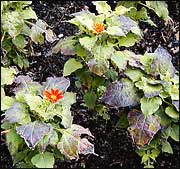 several times. No more. I've given up. For my best efforts I got a few small flowers supported by mildewed brown-singed leaves. The overall effect was like a patch of heat-stressed black-eyed Susans growing along a Texas highway. Sadly, in other less prominent parts of the Garden where Mexican Sunflowers have been planted, they are already beginning to look browbeaten. I wish for a kinder fate for the ones planted in areas where visitors come to be dazzled. several times. No more. I've given up. For my best efforts I got a few small flowers supported by mildewed brown-singed leaves. The overall effect was like a patch of heat-stressed black-eyed Susans growing along a Texas highway. Sadly, in other less prominent parts of the Garden where Mexican Sunflowers have been planted, they are already beginning to look browbeaten. I wish for a kinder fate for the ones planted in areas where visitors come to be dazzled.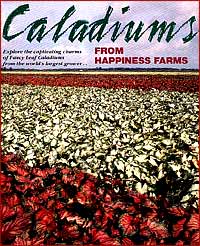 Affirmation was what I looking for as I closely examined how much sun falls on the cladiums planted in the bulb garden. I have had great success with many varieties and colors that I planted in beds starved of sun. This year though, my bulbs ended up being planted in a plot that gets full sun until midafternoon. While most of the caladiums I saw in the Garden were planted in partial or full shade (as God intended them to be), there were some, the ones with white leaves in particular, that were thriving in mostly sunny locations. Admittedly, I'm growing 'Blaze,' a red-heart edged with green, but Happiness Farms, the Florida grower that reared them, says that they will "grow well in full sun or shade." As if to proof it, in their sales catalog, they picture acres of red and white caladiums growing happily in full Florida sunshine. So, I'll mulch, water often and hope that God and Happiness Farms reward my efforts. Affirmation was what I looking for as I closely examined how much sun falls on the cladiums planted in the bulb garden. I have had great success with many varieties and colors that I planted in beds starved of sun. This year though, my bulbs ended up being planted in a plot that gets full sun until midafternoon. While most of the caladiums I saw in the Garden were planted in partial or full shade (as God intended them to be), there were some, the ones with white leaves in particular, that were thriving in mostly sunny locations. Admittedly, I'm growing 'Blaze,' a red-heart edged with green, but Happiness Farms, the Florida grower that reared them, says that they will "grow well in full sun or shade." As if to proof it, in their sales catalog, they picture acres of red and white caladiums growing happily in full Florida sunshine. So, I'll mulch, water often and hope that God and Happiness Farms reward my efforts.Pat told me that the tall trumpet lilies were prettier last week. Maybe so, but there's still plenty of pretty to go around. I've always been dazzled by the flowers, but the Horatio Alger in me resents the plants because so few of them can stand on their own stalks and look me in the eye without being supported by a bamboo cane. Still give credit where it's due: there are very few flowers tall enough to look me in the eye or even make me look up to them. 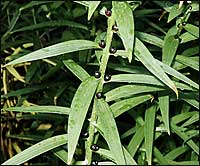 I saw a Tiger Lily, yet to bloom, in the English Garden. Nestled in each of the leaf axils was a dark round pellet about half the size of a pea. A book on lilies that I scanned in the Garden shop calls the pellets "bulbils." They harden after the flower has bloomed and then drop off to form new lilies at the foot of their parents. As soon as I saw them, I thought back to the many Tiger Lilies in my grandmother's garden. My cousin and I used to harvest the bulbils (ripe or not, it didn't matter) and shoot them at one other through pea shooters that we had fashioned from hollowed-out elderberry stems. Ah, such nature lovers we were! I saw a Tiger Lily, yet to bloom, in the English Garden. Nestled in each of the leaf axils was a dark round pellet about half the size of a pea. A book on lilies that I scanned in the Garden shop calls the pellets "bulbils." They harden after the flower has bloomed and then drop off to form new lilies at the foot of their parents. As soon as I saw them, I thought back to the many Tiger Lilies in my grandmother's garden. My cousin and I used to harvest the bulbils (ripe or not, it didn't matter) and shoot them at one other through pea shooters that we had fashioned from hollowed-out elderberry stems. Ah, such nature lovers we were! |