 |
|||||||||||||||||||||||||||||||||||||||||||
|
“From damp strings morning glories hang their ancient faces.
The dry and exalted noise of the locusts from all the air at once enchants my eardrums.”
|
|||||||||||||||||||||||||||||||||||||||||||

|
 clear: light breeze: 85ºF clear: light breeze: 85ºF Ten days of temperatures in the 100s have thinned out the summer crowds at this botanical garden. We’ve noticed too that more people are getting here when the Garden opens at 7 a.m. and then leaving before the heat takes over the day. Since the Linnaean glasshouse has been remodeled, the space inside has been reallocated – half of the house goes to the camellia trees; a quarter to the citrus and arums and the remainder to plants that grow in arid parts of Southern Africa and Madagascar. The keepers of this small glasshouse have their hands full trying to keep all these plants satisfied, but for visitors the diversity means there’s always something new to see. 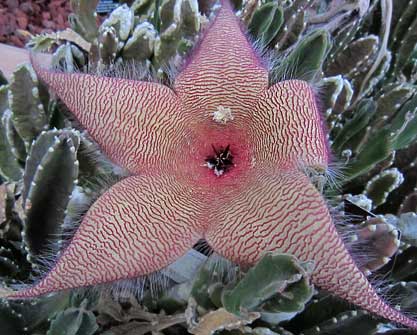 This morning there’s this: the star-shaped bloom of the Giant Stapelia (Stapelia gigantean), native to the dry lands of Southern Africa. The flat blooms seem to lounge coomfortably on the towers of the spineless stocks. The flowers are pale yellow, but their background color is hardly noticed because it’s the reddish-purple stichery-like lines that attract the attention. The edge of the bloom is fringed with long hairs that trick my eyes into thinking there’s a purple iridescent halo around each flower. Web sources say the Stapelia gigantean goes by the names ‘Star Fish Flower’ or ‘Carrion Flower.’ The flowers are meant to smell enough like a dead animal to attract the flies they need to collect and carry their pollen from plant to plant. 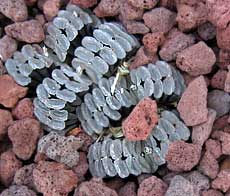 Near the Star Fish Flower is another plant from South Africa: the Haworthia truncata also called ‘Horse’s Teeth.’ They look like a stacked display of tiny gray bi-focals. Because they’re so unusual looking, they’ve become a favorite among collectors especially in Japan where they’ve been hybridized to look like gem stones. In their native South Africa they’re also a favorite of ostriches grazing on ostrich farms. Near the Star Fish Flower is another plant from South Africa: the Haworthia truncata also called ‘Horse’s Teeth.’ They look like a stacked display of tiny gray bi-focals. Because they’re so unusual looking, they’ve become a favorite among collectors especially in Japan where they’ve been hybridized to look like gem stones. In their native South Africa they’re also a favorite of ostriches grazing on ostrich farms.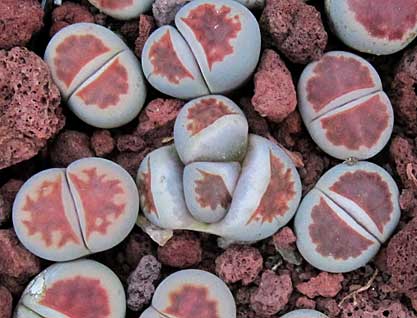 And near the Harworthia, some of the Living Stones (Lithops) are begetting new living stones. Their fissures have split and two new stones are popping out at right angles to their parents. Those who know about Lithops say that the new stones will take their moisture from their parents who will gradually shrivel and die. 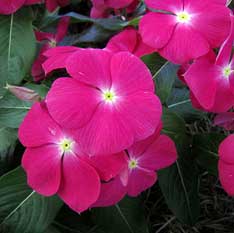 I usually don’t look at vincas too closely. I think of them much as I do impatiens, except that vincas like the sun. Like impatiens though, vincas are everywhere. They make lots of color. And, they do a good job of filling in large open spaces. A new series of vinca named Titan did make me stop and look. It was the flowers. Nothing fancy: no ruffles; no odd colors; no double blossoms. Just big. The flowers measuring two to two and half inches across are hard to miss. I saw the Titan series vincas growing around the potted figs in the atrium of the Garden and also in the spaces between the boxwoods in the Boxwood Garden. The seeds are being sold by PanAmerican Seed Company. They’re marketing them as the vincas with the biggest flowers, the ones earliest to flower, and the best choice for places with places that have hot summers and not enough rain (Isn’t that just about everywhere?)
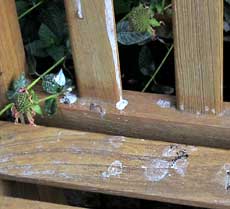 I wondered why this bench that’s ordinarily free of bird droppings is now covered with them. The bench is not under a tree. It’s far from anything that birds would eat. And in other years birds have never used it as a stopping off point. What’s different this summer? Lack of rain. Plenty of heat. Ten feet away from the bench is a small fountain – a millstone with a stream of slow gurgling weather. For the birds, a perfect place to drink and bathe. For the bench, a perfect stop for takeoffs and landings.
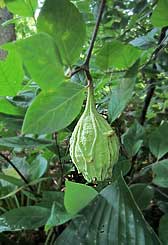 I often look at the Carolina Allspice (Calycanthus florida) shrubs in the English Woodland Garden when they are in bloom. After that, not at all. Out of bloom, the shrub is just green like everything else this time of year. This morning though I happened to see these urn-shaped seed capsules hanging from the ends of some branches. They seemed larger and heavier than the shrub’s small branches should have to support.
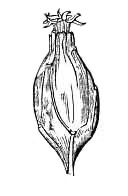 Asa Gray, the botanist who advised Henry Shaw when establish this botanical garden in the mid-1800’s, made this sketch of a ripe Allspice hip in the fall after it matured and turned brown, but didn’t write much more about it. Neither could I find anything on the web. The book Mind-Altering and Poisonous Plants of the World had plenty to say though. The seeds inside these intriguing hips are loaded with alkaloids that “show strychnine-like properties.” Highly toxic, they cause violent convulsions, paralysis, and cardiac arrest. Asa Gray, the botanist who advised Henry Shaw when establish this botanical garden in the mid-1800’s, made this sketch of a ripe Allspice hip in the fall after it matured and turned brown, but didn’t write much more about it. Neither could I find anything on the web. The book Mind-Altering and Poisonous Plants of the World had plenty to say though. The seeds inside these intriguing hips are loaded with alkaloids that “show strychnine-like properties.” Highly toxic, they cause violent convulsions, paralysis, and cardiac arrest. high clouds: light breeze: 78ºF high clouds: light breeze: 78ºF  This summer’s Lantern Festival is drawing large crowds to the botanical garden. So to avoid both the crowds and the daytime heat, we’ve started arriving at the Garden just after it opens at seven in the morning. 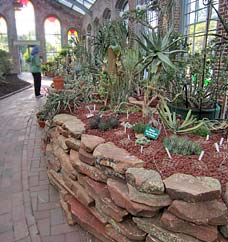 A week ago they weren’t here: brick-colored flat rocks stacked up to make them look like desert outcroppings and used as planters for arid plants. They’ve been built in the Linnaean glasshouse opposite the Garden’s collection of camellias. Along with some taller succulents, the planters are filled with an assortment of odd-looking, ground-hugging plants. They’re named Lithops, but usually are called Living Stones or Flowering Stones. A week ago they weren’t here: brick-colored flat rocks stacked up to make them look like desert outcroppings and used as planters for arid plants. They’ve been built in the Linnaean glasshouse opposite the Garden’s collection of camellias. Along with some taller succulents, the planters are filled with an assortment of odd-looking, ground-hugging plants. They’re named Lithops, but usually are called Living Stones or Flowering Stones.The English botanist William Burchell who wrote about them two centuries ago said that he found the plants by accident. They were growing on some stony ground in a South African scrubland and he happened to pick one up because he thought it was just a “curiously shaped pebble.” He said “it proved to be a plant . . . but in colour and appearance bore the closest resemblance to the stones between which it was growing." 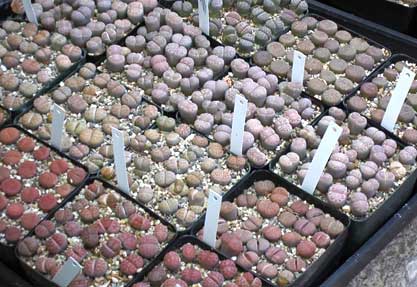 Here too the Lithops are planted among stones, but there’s no mistaking the Living Stones from the real ones. The keepers of this garden decided not to actually plant the Living Stones, but instead to bury little boxes of them among the stones. The effect is a checkered pattern of truffle-like delicacies poking up from the rocks. 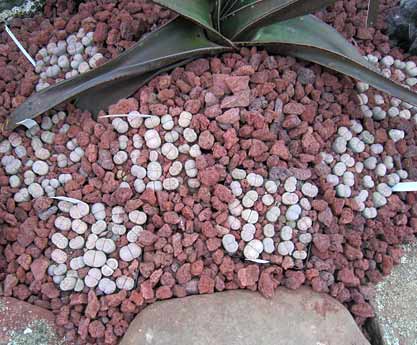 It’s very different from what could have been a random naturalized look. The ordered look makes me think of those boxes of Godiva chocolates that come with a sheet of paper that helps people find the ones with raspberry fillings. None of the Stones here are in bloom, but they do flower -- yellow, pink, white, and orange daisy-like flowers pop up between the plant’s lobes. Since the Living Stones are planted so close together, they’ll look like square tussie-mussies growing out of the rocks when they do flower. A not to be missed event. It’s very different from what could have been a random naturalized look. The ordered look makes me think of those boxes of Godiva chocolates that come with a sheet of paper that helps people find the ones with raspberry fillings. None of the Stones here are in bloom, but they do flower -- yellow, pink, white, and orange daisy-like flowers pop up between the plant’s lobes. Since the Living Stones are planted so close together, they’ll look like square tussie-mussies growing out of the rocks when they do flower. A not to be missed event.On red stemmed hostas: Love ‘em or leave ‘em. To some, the petioles can’t be red enough. And while the breeders are at it, the reds want the scapes to be red, and maybe the flowers too. For the traditionalists, red as an adjective for hostas just won’t do. Here’s a telling comment I came across on the American Hosta Society Forum: “On the topic of RED....it clashes with my hair. I doubt that I'll ever buy a red car or motorcycle. I'd buy a red dog.”  A new very red-stemmed hosta was added to the Garden’s hosta collection this week. I like its name: ‘Beet Salad,’ although ‘Swiss Chard’ might have worked too. The petioles are rhubarb red and they’re tall enough so that the leaves don’t get in the way of admiring the red. Nurseries that sell ‘Beet Salad’ say that the leaves have very narrow red margins, but could be they’re more apt to see what they wish their customers could. To complement the leaf stems ‘Beet Salad’ is supposed to sprout tall red stocks topped with purple flowers sometime next month. Bob Solberg, the breeder who developed ‘Beet Salad’ calls it “the first wave of the future of red hostas.” He said he named the hosta for a wonderful meal he once had in Minnesota. A new very red-stemmed hosta was added to the Garden’s hosta collection this week. I like its name: ‘Beet Salad,’ although ‘Swiss Chard’ might have worked too. The petioles are rhubarb red and they’re tall enough so that the leaves don’t get in the way of admiring the red. Nurseries that sell ‘Beet Salad’ say that the leaves have very narrow red margins, but could be they’re more apt to see what they wish their customers could. To complement the leaf stems ‘Beet Salad’ is supposed to sprout tall red stocks topped with purple flowers sometime next month. Bob Solberg, the breeder who developed ‘Beet Salad’ calls it “the first wave of the future of red hostas.” He said he named the hosta for a wonderful meal he once had in Minnesota.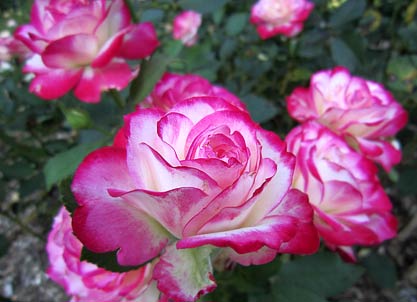 Another shade of red: a rose with white petals and pronounced red margins. This rose was named ‘Cherry Parfait’ by its breeder, the French rose company Meilland who introduced the famous ‘Peace Rose’ back in the 30s. I like ‘Cherry Parfait’ just because it’s pretty – the two colors seem perfectly matched. Others must have agreed because ‘Cherry Parfait’ was the All-American Rose Selection winner in 2003. Recently I read that the rose resists attacks from spider mites and stands up well to summer heat spells. Only knock I can find on the roses: I leaned over smelled them. They gave me nothing.  Finally, an even deeper shade of red that’s clearly the most spectacular of all the reds I saw this morning. Blooming just inside the entrance to the Climatron tropical glasshouse is this impressive-sized flower called variously Torch Ginger, Philippine Wax Flower, or my favorite, Porcelain Rose (Etlingera elatior). My garden encyclopedia Flora, says the deep red flaring structures that circle the dome are bracts (like poinsettias), not petals and that if I had been able to touch them, they’d feel stiff and waxy. In Malaysia, Thailand, and Indonesia where the Torch Ginger is staple of the landscape instead of being the precious exotic it is here, the buds are picked and used as vegetables or added to fish stews and curries for flavoring. Finally, an even deeper shade of red that’s clearly the most spectacular of all the reds I saw this morning. Blooming just inside the entrance to the Climatron tropical glasshouse is this impressive-sized flower called variously Torch Ginger, Philippine Wax Flower, or my favorite, Porcelain Rose (Etlingera elatior). My garden encyclopedia Flora, says the deep red flaring structures that circle the dome are bracts (like poinsettias), not petals and that if I had been able to touch them, they’d feel stiff and waxy. In Malaysia, Thailand, and Indonesia where the Torch Ginger is staple of the landscape instead of being the precious exotic it is here, the buds are picked and used as vegetables or added to fish stews and curries for flavoring. |
||||||||||||||||||||||||||||||||||||||||||
|
+ Click to Subscribe
 | E-Mail me | E-Mail me |
|||||||||||||||||||||||||||||||||||||||||||