 |
|||||||||||||||||||||||||||||||||||||||||||
|
“Green in nature is one thing, green in literature another.
Nature and letters seem to have a natural antipathy; bring them together and they tear each other to pieces.”
|
|||||||||||||||||||||||||||||||||||||||||||

|
 rain: mostly still : 65ºF rain: mostly still : 65ºF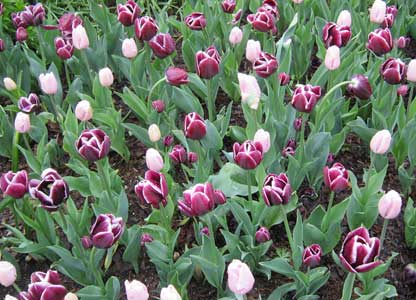 The tulips in the botanical garden are long gone – bloomed and uprooted to make room for the displays of summer. My pictures of the flowers are left though, as are my catalogs from bulb sellers telling me it’s not too soon to order for spring 2014. I always use the pictures I take at the garden to help me decide what to buy. Next year it will be this combo of a triumph tulips named ‘Jackpot’ paired with some single late ones named ‘Pink Diamond.’ 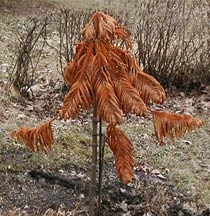 My first encounter with any plant native to the Norfolk Islands was this Norfolk Island Pine. My father either thought it could survive a northern winter or forgot to bring in when the seasons changed. Whatever the reason, the brown outline remained in his yard because I think he liked looking at it – alive or dead. My first encounter with any plant native to the Norfolk Islands was this Norfolk Island Pine. My father either thought it could survive a northern winter or forgot to bring in when the seasons changed. Whatever the reason, the brown outline remained in his yard because I think he liked looking at it – alive or dead.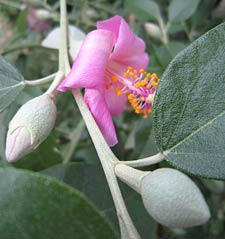 After this morning I know one more plant endemic to the island -- the Norfolk Island Hybiscus (Lagunaria patersonia). It’s in bloom in the Temperate glass house. The tall tree/shrub is filled with blooms that mate delicate rosy-pink petals with an exuberant protruding column bristling with pollen sacs. After the blooms close, I read that they form tough seed pods that ripen and release tiny fibers that give the tree its other name – the “Cow Itch Tree.” Breathe them in or get down wind of them and your nose, eyes, and skin can itch for weeks.
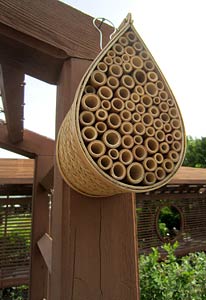 Just arrived -- some very fancy digs hoping to attract some mason bees. The south-facing apartment complex is hanging near the top of an arbor leading to this botanical garden’s soon to be completed vineyard. The vineyard will be a testing ground for finding varieties of grapes that will be able to withstand the hotter, drier climate predicted and still be able to produce good quality wines. The mason bees (if they come) are here to help pollinate the grapes. A nearby sign says that mason bees carry more pollen than honey bees do and they don’t make a habit of stinging or chasing people. The bees don’t made honey either, but instead gather pollen to put in the tubes where the females lay eggs and then seal off the chambers with a dabs of mud. If the bees do decide to come here, they should be easy to recognize. They’re a little smaller than honey bees and they have a metallic blue-black sheen. Just arrived -- some very fancy digs hoping to attract some mason bees. The south-facing apartment complex is hanging near the top of an arbor leading to this botanical garden’s soon to be completed vineyard. The vineyard will be a testing ground for finding varieties of grapes that will be able to withstand the hotter, drier climate predicted and still be able to produce good quality wines. The mason bees (if they come) are here to help pollinate the grapes. A nearby sign says that mason bees carry more pollen than honey bees do and they don’t make a habit of stinging or chasing people. The bees don’t made honey either, but instead gather pollen to put in the tubes where the females lay eggs and then seal off the chambers with a dabs of mud. If the bees do decide to come here, they should be easy to recognize. They’re a little smaller than honey bees and they have a metallic blue-black sheen.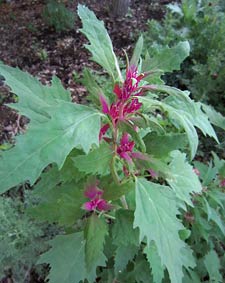 I knew a plant that looked much like this one when I was a kid. It was a pest back then. Who knows how many of them I uprooted when I weeded my father’s garden? Now I find it has a name and it’s edible. The plant growing here and there around the Linnean glasshouse is called Magenta Spreen (Chenopodium gigantium). Wikipedia says the leaves “taste very much like chard or spinach with a hint of asparagus when cooked.” The prized parts of the plants are the tender growing tips, which can be added to salads for taste and color. Thinking back, I believe the plant I knew as a kid that looked like spreen was called pigweed (Amaranthus). I’m comforted to know that pigweeds are still considered weeds, even though they’re edible too.
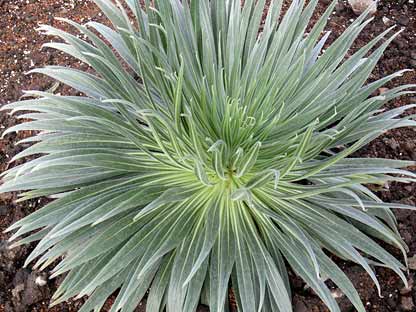 I predict that in a month or so, the area around the reflecting ponds near the Climatron glasshouse will be this botanical garden’s major attraction. As usual. the colorful Chihuly glass onions will be there floating on the water. But this year lining the plots around the ponds, visitors will get to see dozens of specimens of a flower named Tower of Jewels (Echium wildpretii). It’s a flower that will cause visitors to stop and do a double take before reaching for their cameras. 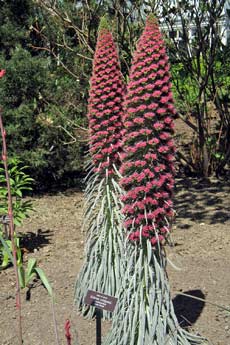 Tower of Jewels is a perfect name for them. When the plant is two years old, a giant stock begins to grow from a rosette of leaves. The stock, that can grow from five to seven feet, is shaped like a bullet or a better still a ballistic missile. Coiling around the tower in ever-tighter loops are strands of luminescent magenta flowers. The whole tower of flowers is held high above a skirting of blue-green leaves. Here’s a picture of a some of them in bloom that I took a couple of years ago at the New York Botanical Garden. When we saw them from a distance they looked so bizarre that we thought they were sculptures of flower-inspired art that someone had tucked in among the real flowers. I look forward to the summer here – a combo of Towers of Jewels and Chihuly onions enjoying each others company. Tower of Jewels is a perfect name for them. When the plant is two years old, a giant stock begins to grow from a rosette of leaves. The stock, that can grow from five to seven feet, is shaped like a bullet or a better still a ballistic missile. Coiling around the tower in ever-tighter loops are strands of luminescent magenta flowers. The whole tower of flowers is held high above a skirting of blue-green leaves. Here’s a picture of a some of them in bloom that I took a couple of years ago at the New York Botanical Garden. When we saw them from a distance they looked so bizarre that we thought they were sculptures of flower-inspired art that someone had tucked in among the real flowers. I look forward to the summer here – a combo of Towers of Jewels and Chihuly onions enjoying each others company.As an aside: The Ecimum wildpretii is not the result of hybridization. They do grow wild on the rocky slopes of Tenerife in the Canary Islands where they're called 'Tajinaste'. Here’s a picture of a group of them taken by a hiker on the island. 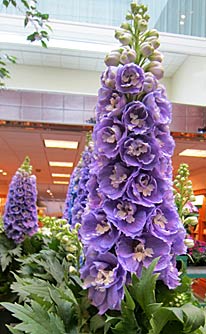 With my mind still on plant towers, I saw this tower of delphiniums for sale in the garden shop. How far the breeders of these flowers have come from the toothy stocks of blue flowers that self-seeded themselves in my mother’s garden.
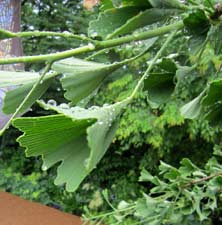 Roll the fan-shaped leaves of an ordinary ginkgo into a tube and tilt them upwards – that describes how the leaves looked on a small ginkgo tree (Ginkgo biloba 'Tubiformis') that we passed this morning. We must have passed the tree dozens of times before without noticing because it’s planted inside a circle of bricks in the middle of a walkway. I think we saw it today because its raining, making the small, upward facing trumpet-shaped leaves are more noticeable as they attract and keep the rain drops. Roll the fan-shaped leaves of an ordinary ginkgo into a tube and tilt them upwards – that describes how the leaves looked on a small ginkgo tree (Ginkgo biloba 'Tubiformis') that we passed this morning. We must have passed the tree dozens of times before without noticing because it’s planted inside a circle of bricks in the middle of a walkway. I think we saw it today because its raining, making the small, upward facing trumpet-shaped leaves are more noticeable as they attract and keep the rain drops. |
||||||||||||||||||||||||||||||||||||||||||