 |
|
|
“What dreadful hot weather we have.
It keeps me in a continual state of inelegance.”  -- Jane Austen (1775-1817) -- Jane Austen (1775-1817) |
|
|
|  clear: calm: 57ºF clear: calm: 57ºFIt never occurred to me. I've heard of using supermarkets, bars, gyms, and continuing education courses. But botanical gardens? The Atlanta Constitution has a column that they call "Second Chances." In it they publish notes from people who missed a chance to connect with someone they encountered, but were too shy or hesitant to approach. Here's a recent note from Second Chances: "To the woman with the beauty mark and wearing a red/white/blue-striped top and jeans last night at the Chihuly exhibit at the Botanical Gardens: not sure if you noticed me - you were taking lots of pix (well, so was I), but I sure noticed you. I kept coming across you several times during the evening, but I didn't have the nerve to bump into you. 5' 8" guy wearing a green plaid shirt and navy shorts. While waiting in the line for the shuttle, I wanted to walk back to you to say hi, but I was with a friend (platonic), and didn't want to be impolite. Hoping for a chance to finally say hi." 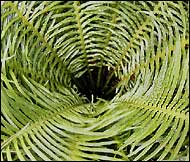 I like dewy mornings. Without dew, spider webs are barely visible. With dew, they frost the tops of all the hedges. I thought of a spider web as I looked into the basket-weave vortex of a palm that I saw growing inside the Linnean greenhouse. I like dewy mornings. Without dew, spider webs are barely visible. With dew, they frost the tops of all the hedges. I thought of a spider web as I looked into the basket-weave vortex of a palm that I saw growing inside the Linnean greenhouse.Except for an arbor that my grandfather used to grow grapes that he turned into wine, the rest of his sizable yard was used to grow barberry. He grew both the green and red varieties, but preferred the reds because his customers were willing to pay a premium price for them. Once his plots were established, he never bought seeds. As kids, it was our job to pick the seeds from the prickly plants, and then, when my grandfather felt the pods had aged enough, we would all gather around a card table to pry the seeds from their shells. Remembering those earlier days, I knew barberrys were never stingy about setting seeds. But until I read a note in Horticulture, I didn't know the seeds were causing trouble. The magazine piece is titled "Beware the Barberry." It says all varieties of the barberry set far too many seeds that birds then eat and spread willy-nilly. 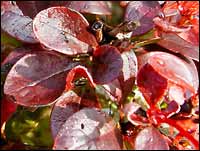 This morning I looked at two separate plantings of barberry (Berberis thunburgii) in the Garden. I expected to see gobs of reddening seed pods. I saw none. Either the Garden keepers have stripped them or the plants planted here are sterile. Since the piece in Horticulture says that sterile varieties are "in the distant future," I guess the plants that grow here have been fixed. This morning I looked at two separate plantings of barberry (Berberis thunburgii) in the Garden. I expected to see gobs of reddening seed pods. I saw none. Either the Garden keepers have stripped them or the plants planted here are sterile. Since the piece in Horticulture says that sterile varieties are "in the distant future," I guess the plants that grow here have been fixed.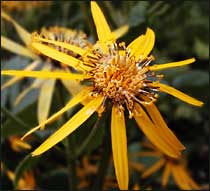 For most of the year the clump of Liglaria (Ligularia dentata) growing in the deep shade of the English Woodland Garden goes unnoticed. Despite its unusual leaves that remind me of a kid's first stab at making a paper airplane, the plant looks frowzy. This morning though the Ligularia has bloomed. Now it sports elegant flowers with slender golden petals that radiate from a coffee-colored pincushion centers. Maybe if the flowers bloomed along a highway in bright sun with sunflowers and black-eyed susans, they might go unnoticed. But here, such blooms in these deep shadows turns frowzy into high-spirited exuberance. I'm glad I got to see Cinderella at the ball. For most of the year the clump of Liglaria (Ligularia dentata) growing in the deep shade of the English Woodland Garden goes unnoticed. Despite its unusual leaves that remind me of a kid's first stab at making a paper airplane, the plant looks frowzy. This morning though the Ligularia has bloomed. Now it sports elegant flowers with slender golden petals that radiate from a coffee-colored pincushion centers. Maybe if the flowers bloomed along a highway in bright sun with sunflowers and black-eyed susans, they might go unnoticed. But here, such blooms in these deep shadows turns frowzy into high-spirited exuberance. I'm glad I got to see Cinderella at the ball.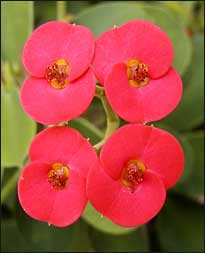 The colors of certain flowers are arresting. The colors seem fresh and new. They haven't been co-opted by Land's End or Old Navy to be made into t-shirts. They exist only to add color to the petals of one specie of flower. One such color is the color of four bracts of the Crown of Thorns (Euphorbia milli) that was blooming today in the temperate greenhouse. Books describe the color as "pinkish-red."or "soft salmon-pink." I would rather not give it a name. The colors of certain flowers are arresting. The colors seem fresh and new. They haven't been co-opted by Land's End or Old Navy to be made into t-shirts. They exist only to add color to the petals of one specie of flower. One such color is the color of four bracts of the Crown of Thorns (Euphorbia milli) that was blooming today in the temperate greenhouse. Books describe the color as "pinkish-red."or "soft salmon-pink." I would rather not give it a name.
|