 |
|||||||||||||||||||||||||||||||||||||||||||
|
“I appreciate the foods of August.
The only time of year for big tomatoes is now, when they are luscious, fresh and flavorful. . . Those are the best, for one slice covers any chunk of bread.”  -- "fieldnotes" journal by Lisa, August 14, 2003 -- "fieldnotes" journal by Lisa, August 14, 2003 |
|||||||||||||||||||||||||||||||||||||||||||
|
 overcast: easy breeze: 72ºF overcast: easy breeze: 72ºFThis morning I found out why the fans of the irises had been cut. A member of the local iris society who was here for the iris sale today told me. He said that a dozen members of the society along with some interns at the botanical garden dug up, divided, and replanted the whole iris bed. He said that they started about 5:30 in the morning and worked though the heat of a day that topped 102ºF to get the job done. I asked him why the iris fans had been cut. He said the fans are routinely cut whenever irises are divided and replanted. Continuing, he railed against those who would trim or cut the fans of their irises about this time of year just to make them look tidier. “They shouldn’t do it!,” he said. I could hear the exclamation point in his voice. Cutting the fans cuts down on vigor, the size of the blossoms, and the number of blooms. The thinnings from that day of work were being sold today. The offerings were extensive and the sale was well-organized, but the crowd was thin – especially when compared to the frenzied scene at the daylily sale last Saturday. I left with two varieties: ‘Beverly Sills’ and ‘Belvi Queen.’ ‘Beverly Sills’ came from a long table filled with Dykes Winners. The Dykes Medal is the highest award any iris can get. Only one iris gets a Dykes each year. It’s given to the best of the best from all of categories of irises that top breeders compete in. ‘Beverly Sills’ won the Dykes in 1985. It has a frilly satiny, soft pink color with a touch of electric gold on its beard. ‘Belvi Queen’ is a rebloomer. I like strawberries in December, so I thought I’d enjoy seeing an iris flower in October. I also liked its fall-like colors of mottled brown, wine, and gold. 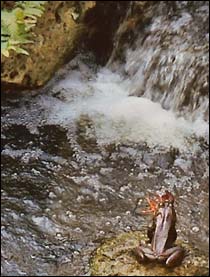 I looked down as I was crossing the bridge in the Chinese Garden. On a rock in the middle of the stream I saw what I took to be a new statue of a bullfrog with a crayfish in its mouth. As I looked for a sign that identified the piece and the artist, I remarked how life-like the piece looked and how well the artist had bent the toes of its feet to conform to the curvature of the stone. Then the frog moved, just slightly, and the crayfish folded its segmented tail. I watched the pair for a long time thinking I’d see the end of a bullfrog breakfast. This frog out-waited me. When I left, the tableau was pretty much as I had found it.
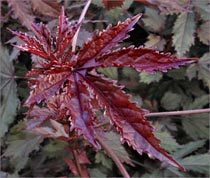 Very prominent among the plantings around the observation tower are clumps of a hibiscus named ‘Maple Sugar.’ I’m glad there was a label nearby because I never would have guessed the shrubs could be any kind of hibiscus. Guessing, I would have said the shrubs were a thread-leaf Japanese maple. The leaves are right – deeply lobed and serrated. So is the color – a rich, dark burgundy. And, the shrubs had no flowers or even buds. Turns out the ‘Maple Sugar’ is an introduction of Proven Winners, a brand name that over the years has also introduced such surprises as the whirlwind scaevolas, the hybrid nemesias of every hue, and the new ‘Limelight’ hydrangeas.
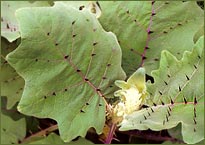 The maple-leaf hibiscus may be out-of-the ordinary, but hardly strange or exotic. For strange, exotic, even gothic, it's a plant named Solanum quitoense - also known as 'Naranjilla' (na-ran-hee' ya or little orange), 'lulo' and 'bed of nails' -- growing just west of the Climatron among such benign company as some Oakleaf hydrangeas. The leaves of Solanum quitoense are filled with thorns – much bigger ones than the ones on roses – that sprout from along the purple veins of its leaves. As fierce as this relative of the potato looks, I learned that it is an important commercial crop in South America where it is highly prized for its fruit. The fruits are globe-shaped and grow to about the size of a golf ball. When they are ripe, they turn bright orange and are covered with bristly fuzz. They look like a tomato inside, but the prize is their juice. It's green-colored and is described as tasting like a blend of pineapple and strawberries, with a bit of citrus or kiwi thrown-in. It's also rich in vitamins C and A. Next week I plan to stop at an international market near the botanical garden to pick up some lulo juice or maybe even a jar of naranjilla jelly. The maple-leaf hibiscus may be out-of-the ordinary, but hardly strange or exotic. For strange, exotic, even gothic, it's a plant named Solanum quitoense - also known as 'Naranjilla' (na-ran-hee' ya or little orange), 'lulo' and 'bed of nails' -- growing just west of the Climatron among such benign company as some Oakleaf hydrangeas. The leaves of Solanum quitoense are filled with thorns – much bigger ones than the ones on roses – that sprout from along the purple veins of its leaves. As fierce as this relative of the potato looks, I learned that it is an important commercial crop in South America where it is highly prized for its fruit. The fruits are globe-shaped and grow to about the size of a golf ball. When they are ripe, they turn bright orange and are covered with bristly fuzz. They look like a tomato inside, but the prize is their juice. It's green-colored and is described as tasting like a blend of pineapple and strawberries, with a bit of citrus or kiwi thrown-in. It's also rich in vitamins C and A. Next week I plan to stop at an international market near the botanical garden to pick up some lulo juice or maybe even a jar of naranjilla jelly.Spotted yet another hardy camellia growing in the English Garden. This one: ‘Polar Ice.’ It's another late fall bloomer with white flowers.  brilliant blue sky: calm: 74ºF brilliant blue sky: calm: 74ºF Today is the day. This botanical garden’s big daylily sale began today at 9 a.m. When I joined the line to the exhibition hall at a quarter to nine, there were already about seventy-five people ahead of me. As I waited, I looked over the list of varieties that would be offered for sale when the doors opened. This year there would be 475 different varieties arranged on the tables inside the doors. Exactly at nine a bagpiper walked down the steps into the foyer and led us in. Today is the day. This botanical garden’s big daylily sale began today at 9 a.m. When I joined the line to the exhibition hall at a quarter to nine, there were already about seventy-five people ahead of me. As I waited, I looked over the list of varieties that would be offered for sale when the doors opened. This year there would be 475 different varieties arranged on the tables inside the doors. Exactly at nine a bagpiper walked down the steps into the foyer and led us in.I wasn’t planning to buy any daylilies this year because I have few sunny places to plant them and because a vole wintered over on the fat, spindle-shaped tubers of the few plants I did have. Still, I do like the excitement of watching real daylily fans search for that one perfect variety they must have to round-out their collection. And I do like checking the list of varieties offered for sale to find the most expensive and the cheapest. The priciest three: ‘Addis Ababa,’ described as a rose violet, red blend / cream watermark and edge / green to yellow throat will be offered for $50; next at $48 comes ‘Uri Geller,’ a cinnamon gold blend with chartreuse throat; then at $45 comes ‘Harem House,’ a lavender rose and cream rose bi-tone / yellow and green throat. The cheapest varieties were on a back table. They are called ‘Mystery’ dayliles and sell for $2. They are named ‘Mystery’ because somewhere between the digging and the bagging, the actual name of the variety was lost or misplaced. “They are all good varieties,” I was assured when I asked, “but we just don’t know what they are.” I passed on the mysteries and bought an old-fashioned variety named ‘Kwanzo variegata’ – the only daylily I know of whose strapping leaves have white stripes. I’m through taking pictures of daylilies. Most of the blooming is finished now and the dead scapes and most fans have been cut. Left though are the photos that I took from mid-June through late July. From those, I’ve picked my Top Ten Daylilies of 2006. I don’t limit my picks to award winners, blossom counts, or things that judges of quality hone in on. I pick what I happen to find appealing on the Saturday mornings when I visit. My list is unordered, and usually I say that I like all ten all equally well. However, if pressed I’d have to say that I thought ‘Vatican City’ and ‘Kyoto Swan’ were the standouts of 2006 daylily season. 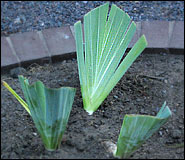 All of the irises have been trimmed. The leaves have been cut down to about six inches and have been shaped into perfect fans. Why a fan, not a straight cut? Don’t know if it makes a difference, but a field of fans sure does look nice. I’m wondering how the fall rebloomers will take to this early August trimming. All of the irises have been trimmed. The leaves have been cut down to about six inches and have been shaped into perfect fans. Why a fan, not a straight cut? Don’t know if it makes a difference, but a field of fans sure does look nice. I’m wondering how the fall rebloomers will take to this early August trimming.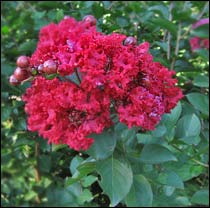 As uncomfortable as the weather may be for me, it couldn’t be better for the Crape Myrtles. A month of sunny days with temperatures touching 90 and above seems just right for them. If I could pick just one to take home with me, it would be the cherry-red one flowering wildly on the north side of the Kemper Center. The variety is named Dynamite®, ‘Whit II.’ It’s a patented creation of Carl Whitcomb, a patient, persistent hybridizer of crape mytle at Lacebark, Inc., a horticultural research company outside Stillwater, Oklahoma. ‘Whit II’ is the first-ever crape myrtle with true red flowers. When Whitcomb saw what he had developed, he wrote, “It was so distinct that I noted in my record book that this is Dynamite and the name stuck.” I’d second that. As uncomfortable as the weather may be for me, it couldn’t be better for the Crape Myrtles. A month of sunny days with temperatures touching 90 and above seems just right for them. If I could pick just one to take home with me, it would be the cherry-red one flowering wildly on the north side of the Kemper Center. The variety is named Dynamite®, ‘Whit II.’ It’s a patented creation of Carl Whitcomb, a patient, persistent hybridizer of crape mytle at Lacebark, Inc., a horticultural research company outside Stillwater, Oklahoma. ‘Whit II’ is the first-ever crape myrtle with true red flowers. When Whitcomb saw what he had developed, he wrote, “It was so distinct that I noted in my record book that this is Dynamite and the name stuck.” I’d second that.
|
||||||||||||||||||||||||||||||||||||||||||