 |
|||||||||||||||||||||||||||||||||||||||||||
|
“Fruit cannot drop
through this thick air-- fruit cannot fall into heat that presses up and blunts the points of pears and rounds the grapes.”  -- from 'Heat' by H. D. (Hilda Doolittle) (1886–1961) -- from 'Heat' by H. D. (Hilda Doolittle) (1886–1961) |
|||||||||||||||||||||||||||||||||||||||||||
|
 cloudy: cooling breeze: 74ºF cloudy: cooling breeze: 74ºFThe roses in the botanical garden never recovered from the hard freeze in early April. Most new canes were destroyed by the cold. The ones that made it seem to lack the strength to grow sideshoots. Rather than the bushy coffee table book-like shrubs that are par for the course here, nearly every rose bush looks spiky and bare. Most have just one anemic rose dangling from the tip of a lone cane. The winners of the All-American Rose Selections for 2008 – ‘Dream Come True’ and ‘Mardi Gras’ are here, but since they didn’t fare any better than the others, I thought I’d wait until the winners were feeling better before I took their pictures. 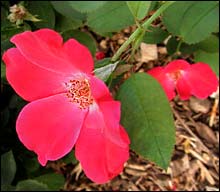 The only rose that has come through the cold completely unscathed is an intensely red one named ‘Home Run.’ It’s an off-spring of the ubiquitous ‘Knock-Out’ family of roses. All of the ‘Home Run’ shrubs are full. Their deep green leaves are so plentiful that the canes are completely hidden. Roses – fully formed, fully developed with deeply saturated red colors – cover the plants. New buds are constantly forming even through this prolonged heat. The developers tout Home Run’s resistance to powdery mildew and black spot, but for beating a late freeze, this one bests them all. The only rose that has come through the cold completely unscathed is an intensely red one named ‘Home Run.’ It’s an off-spring of the ubiquitous ‘Knock-Out’ family of roses. All of the ‘Home Run’ shrubs are full. Their deep green leaves are so plentiful that the canes are completely hidden. Roses – fully formed, fully developed with deeply saturated red colors – cover the plants. New buds are constantly forming even through this prolonged heat. The developers tout Home Run’s resistance to powdery mildew and black spot, but for beating a late freeze, this one bests them all.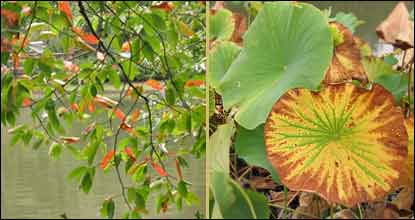 Every year, there is a day that divides one season from the next. This is that day. Summer has crossed into fall. Last week all I saw was lushness. This week, summer’s mascara has begun to run. Trees have a smattering of leaves with color; plants that will eventually die have leaves that have started to brown and shrivel. Renewal of the hedge maze in the Victorian garden started a week ago. The maze had been planted with six-foot tall yews along it’s inside walkways and arborvitae around it’s perimeter. Last week the shrubs were being cut to the ground. This week most have been dug out and hauled off. 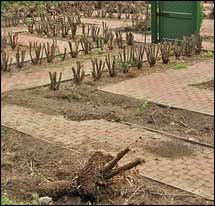 The maze was just over twenty years old. It looked good from the outside, but inside the paths had developed toothy gaps where shrubs had been bent and trampled by visitors looking for an easy way out. Before the renewed maze gets its new plantings, I’d bet some kind of barrier will be installed to discourage new shortcuts from being made. Still, people are ingenious in finding a way to do what they have a mind to do. The maze was just over twenty years old. It looked good from the outside, but inside the paths had developed toothy gaps where shrubs had been bent and trampled by visitors looking for an easy way out. Before the renewed maze gets its new plantings, I’d bet some kind of barrier will be installed to discourage new shortcuts from being made. Still, people are ingenious in finding a way to do what they have a mind to do.I read that the historic 17th century maze at Hampton Court Palace in England also got an update a couple of summers ago. The tall shrubs stayed though. Just as they do in this botanical garden, frustrated visitors there also look for shortcuts. But instead of cutting down all the shrubs as they did here, the keepers of Hampton Court maze just fill in the gaps. Originally the maze was made of hornbeams. Now it is a hodgepodge of hornbeam, privet, yew, holly, hawthorn and sycamore. The update to the maze at Hampton Court was the addition of sounds to the inside of the maze. The sounds are trigged by hidden sensors in the walkway, and they change as people get deeper into maze. A group of London artists who call themselves Greyworld created the sound work. Called ‘Trace,’ the piece is based “on the idea of the maze as a place of furtive conversation and flirtation.” As visitors move through the maze “they are tempted to follow tantalizing sounds - a fragment of music, a snatch of laughter, the seductive rustle of fine silks or the whispers of an illicit conversation as it disappears around a corner and into a dead-end. Slowly the sounds weave together in the visitors mind to create a rich tapestry of the other people who have passed through the maze over the centuries.” What a terrific idea to encourage visitors to keep moving through a maze instead of looking for a way out of it. Beats barriers. I wonder if the need to patch the maze has lessened since ‘Trace’ was installed. 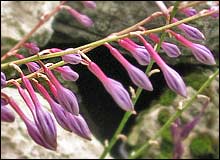 Ordinarily I don’t pay much attention to hosta flowers unless they’re extraordinarily large or unusually fragrant. Most are small, white or lavender. This one though, growing at the edge of a stream in the Chinese garden, made me stop and to get a closer look. The buds were of usual size. Not the colors of the buds though. Their funnels were a bright fuchsia; their fluted buds a dark lavender. Too bad the hostas were unlabelled, but I have a friend who’s a close friend of all hostas. Maybe he’ll know what these were. Ordinarily I don’t pay much attention to hosta flowers unless they’re extraordinarily large or unusually fragrant. Most are small, white or lavender. This one though, growing at the edge of a stream in the Chinese garden, made me stop and to get a closer look. The buds were of usual size. Not the colors of the buds though. Their funnels were a bright fuchsia; their fluted buds a dark lavender. Too bad the hostas were unlabelled, but I have a friend who’s a close friend of all hostas. Maybe he’ll know what these were. haze: still: 78ºF haze: still: 78ºF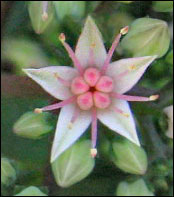 A tiny perfection: a single sedum flower about a half inch across. A tiny perfection: a single sedum flower about a half inch across.The big leaf hydrangeas ought to be at their peak. This botanical garden has a row of them planted in a sheltered courtyard near the lower entrance to the garden center. Each shrub is a different variety, but all are Hydrangea macrophyllas. But even though they are sheltered from the wind on three sides, none of the shrubs has any flowers. The hard freeze in early April ended their season before it began. But, even though the spring freeze quashed any hope of blooms this season, it didn’t seem to affect the shrubs’ vitality. The hydrangeas here are as green, lush, and full as ever. 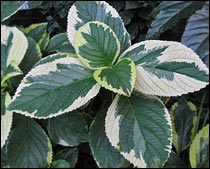 Without the distraction of flowers, I noticed a hydrangea I’d not seen before. It 's tucked in among the hellebores and hosta in the most protected part of the courtyard, away from the other larger shrubs. This hydrangea was just a couple of feet tall and the same across. Like the others it’s a macrophylla too. Unlike the others though, this one, named ‘Lemon Wave,’ has variegated leaves. Its young leaves have a jagged outline of yellow on the perimeter. On more mature leaves the lemon-yellow fades to cream. Butting up against the light colors are dark greens and sometimes even gray-greens in places. Color shifts and patterns on the leaves are irregular and unpredictable. I saw no flowers on this big leaf hydrangea, but with foliage like this, flowers would be beside the point anyway. Without the distraction of flowers, I noticed a hydrangea I’d not seen before. It 's tucked in among the hellebores and hosta in the most protected part of the courtyard, away from the other larger shrubs. This hydrangea was just a couple of feet tall and the same across. Like the others it’s a macrophylla too. Unlike the others though, this one, named ‘Lemon Wave,’ has variegated leaves. Its young leaves have a jagged outline of yellow on the perimeter. On more mature leaves the lemon-yellow fades to cream. Butting up against the light colors are dark greens and sometimes even gray-greens in places. Color shifts and patterns on the leaves are irregular and unpredictable. I saw no flowers on this big leaf hydrangea, but with foliage like this, flowers would be beside the point anyway.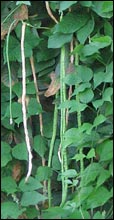 An ‘Asparagus Bean’ vine (Vigna sesquipedalis) has climbed to the top of its trellis along the wall in the scented garden. I found the vine has lots of aliases: Chinese long bean, yard-long bean, long-horn bean, snake bean, and orient wonder yard long bean. Whether it tastes like asparagus I’ll never know because the beans and the vines are here just for show – no touching, no pulling, no tasting. According to a company that sells the seeds, the long bean is widely gown in Japan, the Philippines, China, and Southeast Asia. Picked young, before the pods begin to show their ribs, the beans are supposed to be crisp and tender. Nothing I’ve read says anything about how they taste. An ‘Asparagus Bean’ vine (Vigna sesquipedalis) has climbed to the top of its trellis along the wall in the scented garden. I found the vine has lots of aliases: Chinese long bean, yard-long bean, long-horn bean, snake bean, and orient wonder yard long bean. Whether it tastes like asparagus I’ll never know because the beans and the vines are here just for show – no touching, no pulling, no tasting. According to a company that sells the seeds, the long bean is widely gown in Japan, the Philippines, China, and Southeast Asia. Picked young, before the pods begin to show their ribs, the beans are supposed to be crisp and tender. Nothing I’ve read says anything about how they taste.

|
||||||||||||||||||||||||||||||||||||||||||
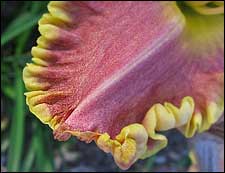 The botanical garden’s annual daylily sale last weekend marked the official end of the daylily season. I’ve been taking pictures of this year’s daylily crop since early June. Of the hundreds of varieties that bloomed here, and the dozens of pictures I’ve taken over the season, I’ve settled on my personal Top 10. There’s no rhyme or reason to my selections except that each of the daylilies I picked was a standout in the early morning on the one day a week I visited the botanical garden. Conspicuously absent from my list are doubles with their dangling confetti-like centers. I know these fluffy flowers have their admirers, but I’m not among them. I don’t care for Persian cats either.
 The Ottoman Garden is filled with daisies – all are a Shasta variety named “Becky.” These daisies have remarkable flowers – pure white petals with yellow hearts, many of them three inches across, borne on sturdy stems three feet tall. What a cut flower “Becky” would make. But why here? What’s the link between the Ottoman Empire and a Shasta daisy that was
 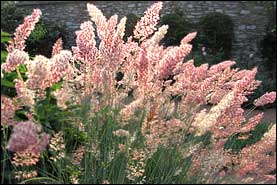 The sensory garden was lit by beams of early sun on a patch of short grass named ‘Pink Crystals’ (Melinus nerviglumis). The sun’s backlighting gave the grass' arching pink tassels a deeper color and made them look sharper than I knew they were. After just looking and taking a few pictures, I couldn’t resist touching. The tassels are cat’s-fur soft and have just as much need to be stroked.
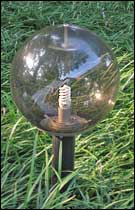 Still thinking about energy conservation, I noticed that the incandescent bulbs in the globes along the garden walkways have been replaced with energy saving fluorescent bulbs. In the coffee shop too, paper cups have replaced the Styrofoam ones.
 This morning the botanical garden sold off its surplus daylilies. A line began to form long before the doors opened at 9:00 a.m. By nine a line of about 100 daylily aficionados snaked across the entry lobby. Then exactly at nine a bagpiper walked down the stairs to the lobby to lead the line into the exhibit hall. Inside there were about 350 named varieties alphabetically arranged on long tables that spread the length of the room.
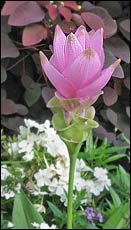 Look at this. I saw this peony-sized flower blooming outside the south door to the Climatron glasshouse. A marker identified it as a “Siam Tulip” (Curcuma altismatifilia). As eye-catching and unusual as it is right here, it’s not hard to imagine it as the focal piece in some prizewinning flower arrangement. Not surprising that Thailand exports about two million of these rhizomes every year to Japan.