 |
|||||||||||||||||||||||||||||||||||||||||||
|
“Such still air. Soon
the mid-morning breeze will float
|
|||||||||||||||||||||||||||||||||||||||||||

|
 clear: calm: 75ºF clear: calm: 75ºFWe got to the botanical garden a few minutes before 7:00 a.m. We hoped to be leaving before visitors to the garden’s annual Japanese Festival began arriving. About 40,000 people are expected at the garden over this Labor Day weekend. This botanical garden is among the first to show off the winning roses selected by the rose growers and breeders of the All American Rose Selections. The winners have to survive a two-year trial at 27 sites in all parts of the country where dozens of competing roses are judged on things like disease resistance, flower production, color and fragrance. For the winners the pay-off is big. They are touted though marketing promotions. They are sure to be mentioned in garden magazines, newspaper articles, and websites. And they will be given rack-space in countless nurseries and garden centers next spring. For 2009 the AARS winners are ‘Pink Promise,’ ‘Cinco de Mayo,’ and ‘Carefree Spirit.’  ‘Pink Promise,” is described by its developer as a rose with a “cool pink color center that blends out to a soft white.” Its fragrance “will bring thoughts of honey and berries.” The rose was adopted as the official rose of the National Breast Cancer Foundation with a cut of the royalties going to support its work. When I arrived at the botanical garden shortly after sunrise, the rose garden had just been watered so all the roses had more than a touch of that dew-drop look that makes anything look luscious. The half-dozen or so shrubs of ‘Pink Promise’' looked like winners. ‘Pink Promise,” is described by its developer as a rose with a “cool pink color center that blends out to a soft white.” Its fragrance “will bring thoughts of honey and berries.” The rose was adopted as the official rose of the National Breast Cancer Foundation with a cut of the royalties going to support its work. When I arrived at the botanical garden shortly after sunrise, the rose garden had just been watered so all the roses had more than a touch of that dew-drop look that makes anything look luscious. The half-dozen or so shrubs of ‘Pink Promise’' looked like winners. ‘Cinco de Mayo’ is a maverick. It has none of the orderliness of a typical rose that spreads gracefully around a nub in the center. ‘Cinco de Mayo’ hardly has a center. The petals flail in all directions. Image the swirl of a flamenco dancer and you’ve got it. Weeks Roses, the roses’ developer, calls “this bushy rounded flower factory mysteriously colored & deliriously novel.” They describe its color as “smoked lavender & rusty red-orange.” I see fewer of the “mysterious colors” and more of just a dusky red in the shrubs growing here.
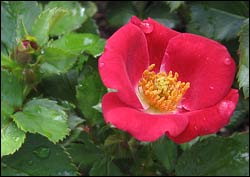 Of the three winners, ‘Carefree Spirit’ is the most ordinary. It’s a pretty little red shrub rose that its developer says has “a great non-fading bright red color,” good disease resistance and “plant habit.” It’s nice, but I think it will have a hard time competing with the reliably and heavily promoted ‘Knock-Out’ family of roses.
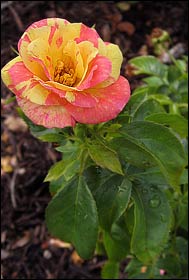 This botanical garden is one of the 27 trial sites for evaluating the roses that will get the AARS title. I look more closely at the plot where roses are in their second-year trials because one of them some of them will be chosen as winners in 2010. My pick for winner is this one. As yet it has a number so that judges can’t be influenced by its pedigree. Traditionally roses aren’t christened until they’re set for marketing. Still, I think any rose would be hard-pressed to beat this one for marketability. Now for a name? This botanical garden is one of the 27 trial sites for evaluating the roses that will get the AARS title. I look more closely at the plot where roses are in their second-year trials because one of them some of them will be chosen as winners in 2010. My pick for winner is this one. As yet it has a number so that judges can’t be influenced by its pedigree. Traditionally roses aren’t christened until they’re set for marketing. Still, I think any rose would be hard-pressed to beat this one for marketability. Now for a name?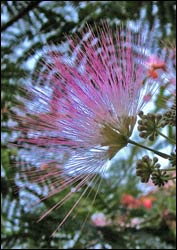 Of all the flowering plants that grow in this part of the mid-west, I think most exotic are the magnolias trees in the spring and the mimosas in summer. Both have flowers that look as though they’ve escaped from the sub-tropics. A young mimosa in the Ottoman garden has been vigorously flowering for about a month now. It keeps on flowering, budding, and growing long green seed pods all at the same time. I was told the tree was rescued from a site slated for development and then planted here because the tree’s silky flowers and feathery leaves fit well with the ornate surroundings of this garden. Pretty as minosas are though, they got the US Forest Service’s “Weed of the Week” award in 2004 because of their invasive habits in the eastern coastal states. Of all the flowering plants that grow in this part of the mid-west, I think most exotic are the magnolias trees in the spring and the mimosas in summer. Both have flowers that look as though they’ve escaped from the sub-tropics. A young mimosa in the Ottoman garden has been vigorously flowering for about a month now. It keeps on flowering, budding, and growing long green seed pods all at the same time. I was told the tree was rescued from a site slated for development and then planted here because the tree’s silky flowers and feathery leaves fit well with the ornate surroundings of this garden. Pretty as minosas are though, they got the US Forest Service’s “Weed of the Week” award in 2004 because of their invasive habits in the eastern coastal states.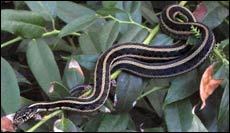 Snakes have begun to come to the tops of shrubs with dense, supportive foliage to sun themselves. This morning we saw this garter snake on top of a leucothoe shrub. Also saw a night heron on the lake and what looked to be a coyote passing through the Ottoman Garden. Snakes have begun to come to the tops of shrubs with dense, supportive foliage to sun themselves. This morning we saw this garter snake on top of a leucothoe shrub. Also saw a night heron on the lake and what looked to be a coyote passing through the Ottoman Garden.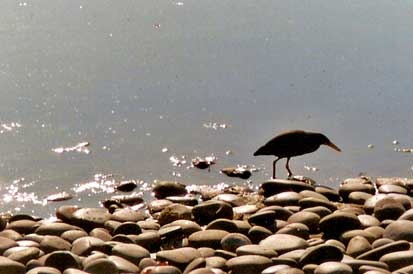
 high haze: calm: a muggy 74ºF high haze: calm: a muggy 74ºFThe keepers of this botanical garden’s Ottoman Garden have redesigned it to include a dozen rectangular beds set around a courtyard fountain. When the newly designed garden was dedicated earlier this summer, the beds were planted with intensely fragrant red and white dwarf carnations. At the opening the flowers were all in bloom. A few weeks later when most of the blooms had faded, a weed whacker was used to lop off the spent heads. The carnations responded by setting new buds and blooming again, but this time not as vigorously. Still even though only a quarter of plants are now in bloom, the humid air and the walled-in courtyard make this garden smell like the inside of a potpourri pot. 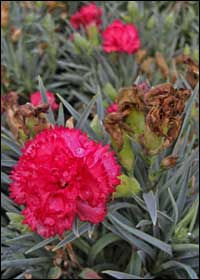 I spotted a plastic sign at the edge of one of the beds that identifies the carnations growing here as patented dwarf varieties from the California Florida Plant Company in Salinas, California. The tag says the carnations planted here are two varieties from CFPC’s twenty-five plant ‘Adorable Series.’ They’re touted as “Natural Dwarf Carnations.” The CFPC website says that the carnations in its Adorable Series can be traced back to a single dwarf hybrid mutation that was spotted by chance. The maverick was then cross bred and back bred until this “natural” flower appeared. Apparently in the flower propagation business, a dwarf plant is considered natural unless chemicals were used to stunt its growth. I spotted a plastic sign at the edge of one of the beds that identifies the carnations growing here as patented dwarf varieties from the California Florida Plant Company in Salinas, California. The tag says the carnations planted here are two varieties from CFPC’s twenty-five plant ‘Adorable Series.’ They’re touted as “Natural Dwarf Carnations.” The CFPC website says that the carnations in its Adorable Series can be traced back to a single dwarf hybrid mutation that was spotted by chance. The maverick was then cross bred and back bred until this “natural” flower appeared. Apparently in the flower propagation business, a dwarf plant is considered natural unless chemicals were used to stunt its growth.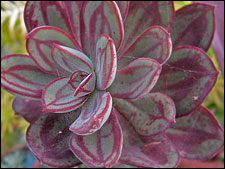 I can’t pass some plants without taking their picture. I don’t plan to buy the plants or to raise them, but I do want to look at them often and try to remember them. As I look back at the pictures I took this summer I saw that I took far, far too many pictures of a fleshy sedum named Echeveria nodulosa. I have pictures taken above the plant, under it, and from its side. In some the characteristic rosette shows; in others the focus is on the maroon etched leaves. I hope this sedum never blooms. That would be distracting. I can’t pass some plants without taking their picture. I don’t plan to buy the plants or to raise them, but I do want to look at them often and try to remember them. As I look back at the pictures I took this summer I saw that I took far, far too many pictures of a fleshy sedum named Echeveria nodulosa. I have pictures taken above the plant, under it, and from its side. In some the characteristic rosette shows; in others the focus is on the maroon etched leaves. I hope this sedum never blooms. That would be distracting.This botanical garden leaves much unsaid. There are unwritten messages here meant only for people who work in botanical gardens. For others who come here to walk, look, point, and admire, this hidden botanical garden stays unseen. I’m no insider – just a regular visitor – but I couldn’t help but notice a magnolia sprig not more than a yard tall that was planted this spring in a grassy area where the crocuses stage their annual display. The planting was odd. Why there? -- in an open field claimed for another purpose and why such a small specimen. Surely if it wanted to, a botanical garden of this size could afford to put in a tree large enough to flower next spring. 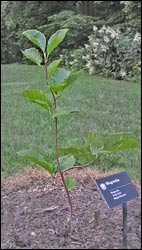 This morning I decided to have a closer look. The magnolia is named ‘Judy Zuk.’ Again I checked the web. ‘Judy Zuk’ is a magnolia with yellow flowers that some say has a fragrance like Fruit Loops. It was developed at the Brooklyn Botanic Garden and named to honor Judy Zuk who retired as president of the Brooklyn Garden in 2005. During her tenure she raised money needed to revitalize the garden and helped green Brooklyn neighborhoods outside the garden walls. Judy Zuk died last September of breast cancer. She was 55. Magnolias were her favorite flower. Now I understand. This morning I decided to have a closer look. The magnolia is named ‘Judy Zuk.’ Again I checked the web. ‘Judy Zuk’ is a magnolia with yellow flowers that some say has a fragrance like Fruit Loops. It was developed at the Brooklyn Botanic Garden and named to honor Judy Zuk who retired as president of the Brooklyn Garden in 2005. During her tenure she raised money needed to revitalize the garden and helped green Brooklyn neighborhoods outside the garden walls. Judy Zuk died last September of breast cancer. She was 55. Magnolias were her favorite flower. Now I understand.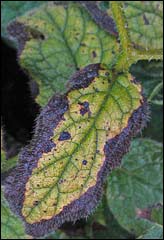 By the time the leaves on the trees start to show fall color, the subtle beginnings of fall have past. I noticed that the leaves on plants, not trees, are among the first to change. Plant leaves already have begun to show tinges of brown or yellow along their edges or veins. Some of the giant lotus leaves at the edge of the Japanese Garden now have yellow fan-like fingers along their veins. In the Ottoman Garden some of the green leaves on this Prickly Comfrey (Symphytum asperum) plant have turned yellow and have an edging of crusty brown. By the time the leaves on the trees start to show fall color, the subtle beginnings of fall have past. I noticed that the leaves on plants, not trees, are among the first to change. Plant leaves already have begun to show tinges of brown or yellow along their edges or veins. Some of the giant lotus leaves at the edge of the Japanese Garden now have yellow fan-like fingers along their veins. In the Ottoman Garden some of the green leaves on this Prickly Comfrey (Symphytum asperum) plant have turned yellow and have an edging of crusty brown. The Niki de Saint Phalle exhibit closes at the end of September. Her exuberant sculptures that at first made me pause and then circle them to better see every detail have become familiar, unnoticed props. It’s unlikely I’ll ever see so much of her work again in one place so I think it’s time to again take notice. There’s not much time left to look before the show ends in late September.
|
||||||||||||||||||||||||||||||||||||||||||