 |
|
|
“The squirrels are spreading the rumor:
no more monkey business.”  -- from "Summer's Almost Gone" in Flickers by William Trowbridge -- from "Summer's Almost Gone" in Flickers by William Trowbridge |
|
|
|  high clouds to open skies: easy breeze: 62ºF high clouds to open skies: easy breeze: 62ºF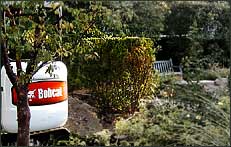 A decision was made about what to do about a couple of dead yews in midst of a long, tall hedgerow. This morning the courtyards on either side of the hedgerow are closed. A Bobcat was brought in to forcibly remove the dead yews from hedge while taking care not to harm the living ones. The keepers of the Garden will replace the dead yews with tall mature plants that they took from another place in the Garden. The appropriated yews will hardly be missed. They were planted along the edge of a garden plot that will look more open and natural without them. If the transplanted yews thrive after they are moved, the hedge should fill-in again by next summer. An elegant and fitting solution to a tough problem. A decision was made about what to do about a couple of dead yews in midst of a long, tall hedgerow. This morning the courtyards on either side of the hedgerow are closed. A Bobcat was brought in to forcibly remove the dead yews from hedge while taking care not to harm the living ones. The keepers of the Garden will replace the dead yews with tall mature plants that they took from another place in the Garden. The appropriated yews will hardly be missed. They were planted along the edge of a garden plot that will look more open and natural without them. If the transplanted yews thrive after they are moved, the hedge should fill-in again by next summer. An elegant and fitting solution to a tough problem.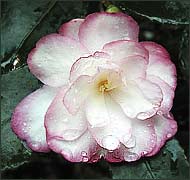 I like walking through the Linnean glasshouse at this time of year. Without fail, I get a sneak preview of the camellia season that will peak in late winter. Four varieties of Camellia sasanqua are blooming now. Even if they didn't bloom early, they would be among my favorites because their light colors show so well against their deep green, almost black leaves. And, unlike so many of the showier varieties, the Sasanquas blooms don't disappoint when I move in close to get a whiff. This is a picture of 'Leslie Ann,' one of the four Sasanquas flowering today.
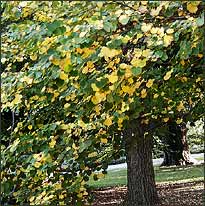 In other years, the serviceberrys are among the first trees to fall color. This year though it's the Katsura trees. Up close the pattern of color change is like a pointillist painting. Round leaves, some green, some bright yellow, dot the tree, up and down, in and out. In this morning's light breeze, the tree looks like a one of those shimmering signs used to lure people into used car lots.
Color change on the Katsuras (Cercidiphyllum japonicum) means that the leaves begin to release their scent. Stay down-wind of the trees and you will smell what some say is burnt sugar, caramel, toffee, or cotton candy. Others say the scent is more like ripe apples or fresh strawberries or cinnamon toast. My favorite description for the scent of Katsuras is a stodgy quote from The-Tree: "A noteworthy peculiarity of this tree is that the leaves, when freshly shed, give out a smell of freshly baked cakes, as if they had just been taken out of the oven. Alas I have never experienced this myself, but I've been told that this makes it possible for a human nose to locate the tree even in dense growth." Since the sweet smell of the Katsura can be just as anyone wishes it to be, I say that it smells like a chocolate bar just after the foil wrapper is pried opened. 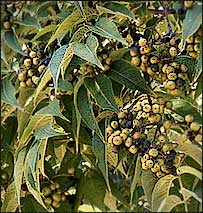 The berries of the Amur Cork trees (Phellodendron amurense) are turning a dark blue-black. Sources say that even after ripening, the clusters of dark berries will stay on the tree all winter. Maybe in some worlds they do, but here in the Garden the ripe fruit is a favorite of robins, doves, and squirrels. The concrete walk leading to the Rock Garden is splattered with inky colored spots from berries loosed from above and then crushed by walkers and the wheels of the touring tram. The freshly squashed berries have a musky citrus smell somewhat like those solvents and cleaners that add orange scents to mask their petroleum-like fumes.
Each May, the Garden hosts a "Rose Evening." Members sip wine and take meandering walks along grass paths lined with newly opened roses. I never miss it. But, I think roses and September are a better match. The roses have gotten over their first flush of bloom, endured a fallow summer, and now have come back, lush and full. A coincidence: last night I happened to look at the web site of The All-America Rose Selections (AARS) and saw their pick for the 2005 All-American Rose. This morning I saw a single bloom of that same rose in a display of "Plants in Bloom" in the visitor's center. The rose is named 'About Face,' and I found a plot devoted to them in the rose garden south of the Linnean glasshouse. Like new models of cars, announcements of AARS winners run a year ahead to allow time to promote the new models. The AARS describes 'About Face' as "a very novel 'backwards' bicolor whose light color of deep golden yellow is carried on the inside of the petals with a darker bronzy orange-red backside. This super-vigorous plant yields long stems with full old-fashioned blossoms that catch attention throughout the life of the bloom. The flowers, up to five inches in diameter, offer a mild fresh apple fragrance and are beautifully complimented by lush, clean green leaves." 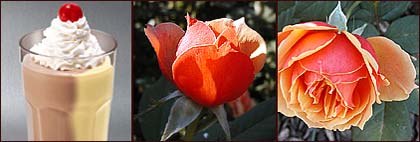 Looking at 'About Face' is one of those "How did they do that?" experiences. When I saw them, I thought of Steak 'n Shakes' new "Side-By-Side" milkshakes that vertically layer two colors and flavors in the same glass. 'About Face,' especially as it is just opening and when it is seen up close is just as unsettling. It's not hard to image them entering the floral trade as trendy boutonnieres or as petals in the baskets of flower girls. Symbolically, 'About Face' combines the red of ardent love with the yellow of infidelity making it the perfect flower for the many marriages that will end in divorce.
 high thin clouds: easy breeze: 60ºF high thin clouds: easy breeze: 60ºFGrow a hedge six-feet tall and a yard across. Then if you shear it so it looks like a long packing crate, it's easy to forget that it's the individual shrubs that form that green wall. Until, one shrub dies. In the hedge of yews that separates the Cohen Court from the Baer Garden, an old yew has died. It remains in place as a slab of brown surrounded by green, but its passing has destroyed the idea of hedge. 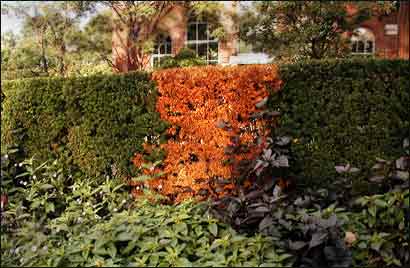 I'm less interested in the passing of one yew than how the keepers of the Garden will restore the hedge. Option 1: take out all the yews and put in row of new, younger plants that someday will cooperate to make a new hedge. But, my Sunset National Garden Book says that yews grow slowly. So even if all the shrubs were replaced, it would take years before the individual plants melted into a hedge. Option 2: take out the dead plant and replace it with another. Again my Sunset National Garden Book says while yews take well to being moved, "big ones are luxury items." And, even if the Garden keepers transplanted a new mature specimen, it still wouldn't fit in for many years. Option 3: take out the dead plant and wait for the plants on either side to plug the gap and meanwhile damn the aesthetics and the visitors who refuse to mind the gap between the courtyards. Option 4: take out the dead yew and make a new walkway between the two garden courtyards. That would work unless a yew in another part of the hedge dies. I see no good option. Yet, I know the keepers of the Garden are likely to come up with an option I have never considered. So, each week I'll pass by to see what they have decided to do. 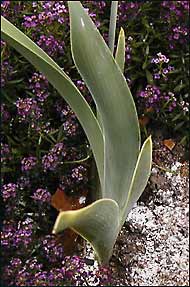 A white powder has been sprinkled around some of the clumps of iris in the newly renovated Iris Garden. It's likely not to be fertilizer this late in the season, although I guess it could be a superphosphate to help encourage the young rhizomes to set down stronger roots. Some web sites I checked say that bearded irises like a dose of lime in early fall to sweeten their soil. So maybe it's lime. I noticed that not all of the irises were treated, but I didn't try to figure out whether there was a pattern to the dusting. A white powder has been sprinkled around some of the clumps of iris in the newly renovated Iris Garden. It's likely not to be fertilizer this late in the season, although I guess it could be a superphosphate to help encourage the young rhizomes to set down stronger roots. Some web sites I checked say that bearded irises like a dose of lime in early fall to sweeten their soil. So maybe it's lime. I noticed that not all of the irises were treated, but I didn't try to figure out whether there was a pattern to the dusting.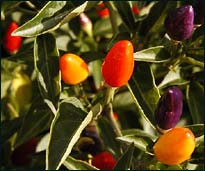 Where but in a botanical garden would an entire plot be devoted to planting a dozen varieties of decorative peppers? The peppers were planted to see how each would do in a Midwestern garden. The smallest peppers are the size of a pencil eraser; the largest are about the size of a thumb. Every plant is brimming with peppers - most are shades of red-orange, some are deep purple and one called "NuMex Twilight' (Capsicum annum) has cone-shaped peppers of all colors on every plant. None of the ornamentals bury their fruit under dense foliage. They all carry themselves above their leaves, turn on their stems, and suggestively point their tips upward. Where but in a botanical garden would an entire plot be devoted to planting a dozen varieties of decorative peppers? The peppers were planted to see how each would do in a Midwestern garden. The smallest peppers are the size of a pencil eraser; the largest are about the size of a thumb. Every plant is brimming with peppers - most are shades of red-orange, some are deep purple and one called "NuMex Twilight' (Capsicum annum) has cone-shaped peppers of all colors on every plant. None of the ornamentals bury their fruit under dense foliage. They all carry themselves above their leaves, turn on their stems, and suggestively point their tips upward.Visitors have to look hard to find any old-fashioned balsams (Impatiens balsamina) growing in the Garden. I found a few plants tucked into the edge of a corner of a plot along a path few would choose to take. Even if someone spotted the plants, they likely would turn away. People pay their admission to this Garden to see "pretty." Balsam aren't. The balsams I saw were leggy; they had more seed pods than flowers; their brown, sun-scorched foliage had collected more than one kind of mold or mildew; and their stems were engorged and bulbous. All around the plant nuisance seedlings had spouted from mature seed pots that had popped. 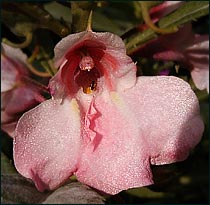 For good reasons then, balsams are much out of favor. I once planted a package of them that I got in a cereal box and then watched as these unlovely plants tried to stage a land grab in my garden. I never liked the plants. But I always prized the flowers. Each is decorated with folds that remind me of some willowy plant growing underwater. Their cave-like inner chambers give them a sensual quality that Georgia O'Keeffe would have like to painted. Turn the flower upside down and it resembles a lady slipper or an orchid with a protruding lower lip. It's curious that flowers of such exceptional beauty are trapped in such an ugly plant. For good reasons then, balsams are much out of favor. I once planted a package of them that I got in a cereal box and then watched as these unlovely plants tried to stage a land grab in my garden. I never liked the plants. But I always prized the flowers. Each is decorated with folds that remind me of some willowy plant growing underwater. Their cave-like inner chambers give them a sensual quality that Georgia O'Keeffe would have like to painted. Turn the flower upside down and it resembles a lady slipper or an orchid with a protruding lower lip. It's curious that flowers of such exceptional beauty are trapped in such an ugly plant.
|

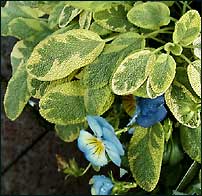 A sure sign that summer is passing: mums have replaced many of the warm-weather plants grown fat and leggy from an unusually temperate and wet summer. The tropicals in the container plantings are gone too. In their place are frost-withstanding cabbages, kales, mustards, and sages. For fall and winter color, the keepers of the Garden often rely on tri-colored sages and a variegated sage called Golden Sage (Salvia officinalis 'Icterina'). Each leaf of the Golden Sage is stamped with an oak-leaf shape. But no two oak-shaped leaves have the same pattern of lobes. As I stooped to get a closer look at each leaf, I thought about a book blurb I read by poet Howard Nemerov. He warned against missing the essence of "our little time in the world" by attending too much to "counting the streaks of the tulip." I resisted counting lobes, but I did take lots of pictures.
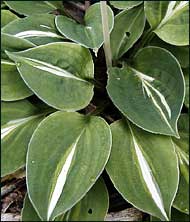 An axiom of mine: The larger the hosta leaf, the worst the plant looks in September. Conversely, smaller is better come late summer. Case in point: Pandora's Box, a smaller leafed hosta with a stylish white central vein growing under a magnolia tree in the hosta garden, looks just as fresh now as it did in May.
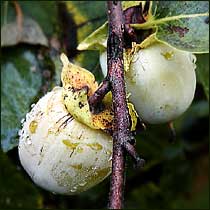 Along the loop walk that passes though the prairie and butterfly gardens, I noticed a persimmon tree filled with unripe fruit. To me, persimmons are large exotic fruit grown on trees in Asia and bought in specialty stores at rarified prices. This tree though made me think again about persimmons. The fruits were smaller than the Asian varieties. Most were about the size of large walnuts. The sign beside the tree named the tree Diospyros virginiana and placed it as specie native to Missouri. When I got home, I found the tree listed in the Department of Conservation's booklet Missouri Trees. The booklet says the wood is hard and dense and can be used for golf club heads and pool cues. They say that all sorts of wild animals and birds munch on the leaves, the flower buds, and the fruit. I have never tasted a persimmon. When ripe some say it tastes like an apricot. Unripe, wrote a 17th Century English settler of Jamestown, ". . . they are harsh and choakie, and furrie in a man's mouth like allam."
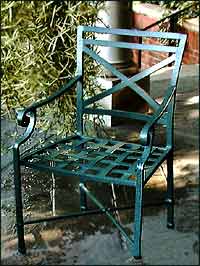 Other than plants, I like looking at what the keepers of this Garden choose to furnish it. This morning, I saw that new chairs, benches, and tables have added to the overlook pavilion of the boxwood garden. Good taste and elegance guide selection. Never cost. The furniture is made of cast aluminum with a stippled finish. It is covered with a dark green powder-coated paint. The seats have a basket weave and the backs are decorated with English country garden designs. A label on the back of chairs says "Brown Jordan." Checking the web, I found that