 |
|||||||||||||||||||||||||||||||||||||||||||
|
“And when the season turned again.
A world of shaken tinsel fell Like orange rain. We burned the leaves Yet learned from these our lives were frail.”  ---from "The Apprentice Lover by Jay Parini ---from "The Apprentice Lover by Jay Parini |
|||||||||||||||||||||||||||||||||||||||||||
|
 fog giving way to scattered clouds; light breeze; 74ºF fog giving way to scattered clouds; light breeze; 74ºF These first days of fall are still like summer: hot, humid, and hazy. Each week I tell myself that summer won’t last, but it does. Growing things know their end is near though. For the past month, they have grown fat and unruly, seeping out of their beds and spreading themselves over walkways and benches. Plants have grown tall and aggressive as they elbow one another still more space to expand. And why not? Why not a last fling before that sure to come frost in mid-October? These first days of fall are still like summer: hot, humid, and hazy. Each week I tell myself that summer won’t last, but it does. Growing things know their end is near though. For the past month, they have grown fat and unruly, seeping out of their beds and spreading themselves over walkways and benches. Plants have grown tall and aggressive as they elbow one another still more space to expand. And why not? Why not a last fling before that sure to come frost in mid-October?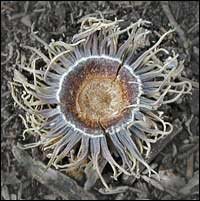 The sawtooth oaks (Quercus acutissima) that border the plaza at the entrance to the botanical garden have just started to drop their acorns. This morning caps and acorns litter the walkway under the trees. The acorns are unremarkable – ordinary oval shaped, burnished-brown nuts. The caps though have me and another morning visitor down on our knees taking pictures. The edges of freshly fallen caps are laced with a tangle of yellow-green tentacles. As the caps age a bit, they turn brown and the tentacles begin to straighten out to form a ring of radiating spokes around the edge of the cap. Especially nice is the luminous silver-gray ring that lines the edge of the caps. Add a hot glue a stick and a base to a cap and you get nature’s stand-in for a monstrance -- the reliquary-like vessel used in Catholic ceremonies to display communion host. The sawtooth oaks (Quercus acutissima) that border the plaza at the entrance to the botanical garden have just started to drop their acorns. This morning caps and acorns litter the walkway under the trees. The acorns are unremarkable – ordinary oval shaped, burnished-brown nuts. The caps though have me and another morning visitor down on our knees taking pictures. The edges of freshly fallen caps are laced with a tangle of yellow-green tentacles. As the caps age a bit, they turn brown and the tentacles begin to straighten out to form a ring of radiating spokes around the edge of the cap. Especially nice is the luminous silver-gray ring that lines the edge of the caps. Add a hot glue a stick and a base to a cap and you get nature’s stand-in for a monstrance -- the reliquary-like vessel used in Catholic ceremonies to display communion host.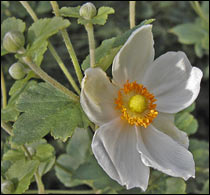 I’ve gotten over my sense of wonder when I see a Japanese anemone (Anemone hybrida) blooming. The first time I saw an anemone in bloom at this time of year, I thought that such a thing shouldn’t be. Anemones were supposed to bloom in the spring – and only in the spring. Now I’ve become blasé about when anemones are supposed to bloom. But the fall bloomers are still an awaited and expected part of this fringe season between summer and fall. I’ve seen Japanese anemones with rose-colored and with pink blooms, and even with fluffy double flowers. None though is a match for the single-flowered satiny-white anemone. A long-established clump of them is just beginning to flower in a shaded spot just out the east door of the Linnean House. I’ve gotten over my sense of wonder when I see a Japanese anemone (Anemone hybrida) blooming. The first time I saw an anemone in bloom at this time of year, I thought that such a thing shouldn’t be. Anemones were supposed to bloom in the spring – and only in the spring. Now I’ve become blasé about when anemones are supposed to bloom. But the fall bloomers are still an awaited and expected part of this fringe season between summer and fall. I’ve seen Japanese anemones with rose-colored and with pink blooms, and even with fluffy double flowers. None though is a match for the single-flowered satiny-white anemone. A long-established clump of them is just beginning to flower in a shaded spot just out the east door of the Linnean House.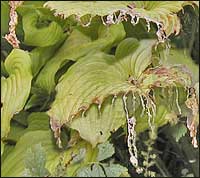 Oddly enough, I like watching the slow collapse of hostas. Leaves first wither and brown and then when the killing frost comes, they lose their bone and sinew and collapse into watery spokes around their central core. Each year I see variants of hostas loosing their battle against the changing season. This morning though is one of my all-time favorites of the demise of a hosta. In the Heckman Bulb Garden, I saw a yellowish-gold hosta named ‘Piedmont Gold’ that seemed to be drooling. The tips of many of the leaves had browned-out. The fleshy part of the leaves had disappeared leaving only the larger veins to cascade over the edge of what was left of the leaves. The Hosta Handbook says that ‘Piedmont Gold’ is a tough, slug resistant variety, so I have to think the sun and the prolonged heat did it in. Oddly enough, I like watching the slow collapse of hostas. Leaves first wither and brown and then when the killing frost comes, they lose their bone and sinew and collapse into watery spokes around their central core. Each year I see variants of hostas loosing their battle against the changing season. This morning though is one of my all-time favorites of the demise of a hosta. In the Heckman Bulb Garden, I saw a yellowish-gold hosta named ‘Piedmont Gold’ that seemed to be drooling. The tips of many of the leaves had browned-out. The fleshy part of the leaves had disappeared leaving only the larger veins to cascade over the edge of what was left of the leaves. The Hosta Handbook says that ‘Piedmont Gold’ is a tough, slug resistant variety, so I have to think the sun and the prolonged heat did it in.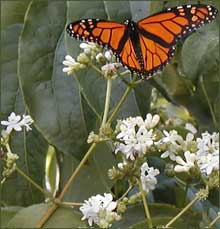 This morning’s main feature: the flowering Seven Sons Flower shrubs (Heptacodium miconiodes) just south of the Victorian garden. The clusters of tiny white flowers set against deep green foliage is arresting. But the reason I decided to get my feet wet to walk across a dew-damp lawn to get a closer look at the shrub (or tree? since it’s about ten feet tall) wasn’t to smell the flowers. It was the butterflies. Dozens of monarch butterflies were hovering around the shrub and alighting on the flowers. Bees and a few wasps were there too, but the monarchs dominated. The botanical garden’s website has a detailed description of the Heptacodium, but oddly enough doesn’t mention that butterflies are wild about it. This morning’s main feature: the flowering Seven Sons Flower shrubs (Heptacodium miconiodes) just south of the Victorian garden. The clusters of tiny white flowers set against deep green foliage is arresting. But the reason I decided to get my feet wet to walk across a dew-damp lawn to get a closer look at the shrub (or tree? since it’s about ten feet tall) wasn’t to smell the flowers. It was the butterflies. Dozens of monarch butterflies were hovering around the shrub and alighting on the flowers. Bees and a few wasps were there too, but the monarchs dominated. The botanical garden’s website has a detailed description of the Heptacodium, but oddly enough doesn’t mention that butterflies are wild about it. |
||||||||||||||||||||||||||||||||||||||||||