 |
|
|
“To me there always seems something perverse about those country dwellers who like autumn best. Their hearts, I feel, are not in the right place. . . . Spring is the time for exuberance, autumn for melancholy and regret. Season of mists and mellow fruitfulness?
Yes, of course, it is that. But promise, not fulfillment, is what lifts the heart.”  -- From 'The Twelve Seasons' by Joseph Wood Krutch -- From 'The Twelve Seasons' by Joseph Wood Krutch |
|
|
|
 heavy clouds, mist damp: chilly north breeze: 50º heavy clouds, mist damp: chilly north breeze: 50º Just after entering the Garden we saw a young man walking alone. He seemed to be doing more gazing than walking. We talked. He said that he and his girlfriend were visiting the city for the weekend and that the reason for his early morning visit was reconnaissance. He told us he planned to return to the Garden with his girlfriend later today. But now, his mission was to find the perfect spot to ask her to marry him. In that best of all Garden spots, he hoped she would say "yes." He didn't ask us for advice and we offered none. We wished him well as we walked on. I wonder what spot he chose? I thought about the spot I would pick if I were going to propose. For 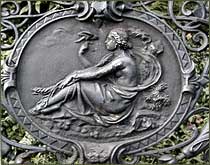 sheer beauty, I would bring my chosen to Arbor of the Plum Wind in the Japanese Garden. We would sit down on the bench under the arbor overlooking the life-sized bonsai pine fronting the lake and I would pop the question. Still, the Arbor of the Plum Wind is a long walk from the entrance to the Garden. Tired legs and pinched feet might not help my cause. A better choice, just yards from the Garden entrance would be the lovely Victorian wrought iron bench at the East end of Linnean House. With our backs to the embossed figure of a partly unclothed Roman goddess, taking in the powerful aroma of the fragrant olive trees, who could say "no" ? sheer beauty, I would bring my chosen to Arbor of the Plum Wind in the Japanese Garden. We would sit down on the bench under the arbor overlooking the life-sized bonsai pine fronting the lake and I would pop the question. Still, the Arbor of the Plum Wind is a long walk from the entrance to the Garden. Tired legs and pinched feet might not help my cause. A better choice, just yards from the Garden entrance would be the lovely Victorian wrought iron bench at the East end of Linnean House. With our backs to the embossed figure of a partly unclothed Roman goddess, taking in the powerful aroma of the fragrant olive trees, who could say "no" ?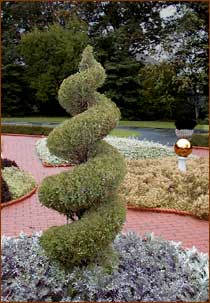 Topiary has never been a feature of this Garden. The only examples I've been able to spot are a few shrubs that I think are arborvitum or yews formally planted to mark the points of a square. The shrubs have been clipped to simple spiral. I would guess that this Garden has little interest in or money to spend on high maintenance Edward Scissorhead-like creations. But as an attraction, few things would grab the eye like a topiary clipped into peacock or a person. Imagine the number of photos visitors would take of their friends sideling up to a life-sized herd of boxwood rams or a yew clipped to resemble St. Louis rap sensation Nelly. Topiary has never been a feature of this Garden. The only examples I've been able to spot are a few shrubs that I think are arborvitum or yews formally planted to mark the points of a square. The shrubs have been clipped to simple spiral. I would guess that this Garden has little interest in or money to spend on high maintenance Edward Scissorhead-like creations. But as an attraction, few things would grab the eye like a topiary clipped into peacock or a person. Imagine the number of photos visitors would take of their friends sideling up to a life-sized herd of boxwood rams or a yew clipped to resemble St. Louis rap sensation Nelly.My favorite place to see topiary is the Topiary Garden in Columbus, Ohio. There done in sculpted deep green yews are about 80 topiaries that mimic the figures in Georges Seurat's impressionist painting "A Summer Sunday on the Island of La Grande Jatte, 1884." The pond in the park is meant as a stand-in for the River Seine in Seurat's painting. Free floating yews in the pond are clipped represent the passing boats in the painting. 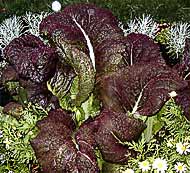 Recently I've noticed that colorful varieties of Swiss chard have joined kale and ornamental cabbage in the Garden's fall plantings. Near the entrance court to the Garden I spotted a big-leafed burgundy colored chard accenting a fall planting of primula and bi-colored sage. The crinkled leaves had a tropical look as the morning mist added an iridescent sheen to their distinctive shading. After leaving the Garden, I stopped at a small parking lot plant shop to buy some pansies and was surprised to find even they were selling some very pretty lemon-yellow ribbed chard as late-season ornamentals. Recently I've noticed that colorful varieties of Swiss chard have joined kale and ornamental cabbage in the Garden's fall plantings. Near the entrance court to the Garden I spotted a big-leafed burgundy colored chard accenting a fall planting of primula and bi-colored sage. The crinkled leaves had a tropical look as the morning mist added an iridescent sheen to their distinctive shading. After leaving the Garden, I stopped at a small parking lot plant shop to buy some pansies and was surprised to find even they were selling some very pretty lemon-yellow ribbed chard as late-season ornamentals.Most viburnum berries are favorites of birds and squirrels. Few berries ever get a chance to turn red or purple before they are picked off. Tea viburnum (Viburnum setigerum) 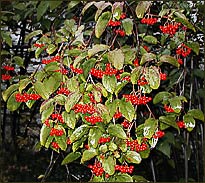 is a exception. Critters seem to take no notice of their hanging clusters of bright orange-red fruit. Like winterberries, the fruit of the tea viburnum lingers until spring. is a exception. Critters seem to take no notice of their hanging clusters of bright orange-red fruit. Like winterberries, the fruit of the tea viburnum lingers until spring.I wondered whether the leaves or the berries were used for tea. Poking around the web, I learned that the shrub is native to Mount Emei, a 10,000-foot mountain in the Sichuan Province of China. The mountain is the highest of four mountains that have been sacred to Buddhists since the first century. From the base to the summit are dozens of Buddhist monasteries. Some 300,000 tourists, pilgrims, and nature seekers now visit the mountain every year. According to a Fodor's guidebook, the walk to the summit is an easy two-day walk. Along the trail are hundreds of small shops that sell soft drinks, snacks, and walking sticks, and souvenirs. Walkers are warned to stay clear the mountain's golden monkeys that aggressively beg for handouts. Visitors with less time or energy can take a minibus, then a cable car to the top. Biologically, Mount Emei is a wonder. Britannica calls it "a paradise for botanists." With climates that range from subtropical to subalpine, the mountain has some 3,200 recorded plant species representing a tenth of all the plant species in China. The mountain is also a birder's destination and home to the endangered lesser (red) panda. Back to the Tea Viburnum. Turn of the century plant explorer "Chinese" Wilson reported that he found that Buddhist monks on Mount Emei dried the leaves and used them to brew tea. As I pass the tea viburnum this winter, I'll think of a mountain above a halo of clouds and monks in saffron. 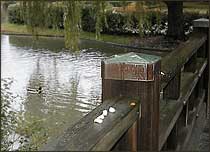 At one end of the wooden flat bridge that crosses the lake in the Japanese Garden is a coin-operated machine that dispenses fish food. Visitors put their money in and out pops a small handful of food for the open-mouth koi that look up at anyone who looks down at them. Regulars to the Garden ignore the machine, preferring instead to bring their own sacks of dried bread crumbs. Today as on other mornings, I noticed that an earlier visitor has kindly left behind a few bread crumbs arranged like a row of ducks on the bridge railing - a gift to those who come later and a snack to koi already well-fed. At one end of the wooden flat bridge that crosses the lake in the Japanese Garden is a coin-operated machine that dispenses fish food. Visitors put their money in and out pops a small handful of food for the open-mouth koi that look up at anyone who looks down at them. Regulars to the Garden ignore the machine, preferring instead to bring their own sacks of dried bread crumbs. Today as on other mornings, I noticed that an earlier visitor has kindly left behind a few bread crumbs arranged like a row of ducks on the bridge railing - a gift to those who come later and a snack to koi already well-fed. layed clouds, damp: breezy: 52º layed clouds, damp: breezy: 52ºI haven't seen the telltale wrappers of spring bulbs, but I know they have been planted because pansies have replaced summer flowers in most of the large display gardens. For many years now the Garden has used pansies to add color to mild winter days and to fill in the gaps between mass plantings of tulips. 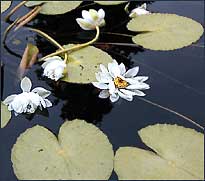 Aside from the pansy invasion, other preparations are being made for winter. This morning I noticed that the miniature palms accenting the entrance to the Linnean House have been taken away. Most of the smaller fountains already have been drained and cleaned. The once vibrant colors of the water lilies blossoms are fading as their sagging petals touch the water. Morning visitors have begun to wear light jackets. Some even appear with gloves, hoods and stocking caps. All that's needed are the fall colors on the trees. Aside from a few nut trees that seem eager to turn yellow, drop their leaves, and get on with winter, the color on the other trees is still a week or so away.
Weeks ago I thought I had seen the last of the hummingbirds. By now, they all ought to be settled into a climate where tubular flowers bloom in December. The solitary hummingbird bird I spotted today seemed less active on this chilly morning. It had 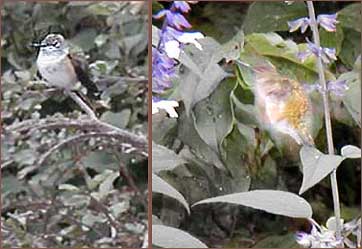 staked out a still flowering salvia. Occasionally it would make forays to the flower to feed or to chase away a bee who thought it had a claim to the flower too. But mostly, it would just sit on the upper branches of a nearby shrub. I watched it run though a list of things hummingbirds apparently do: it preened its wing feathers; it rubbed its beak along the sides of a twig as through the beak was a weapon that needed periodic sharpening or cleaning; it darted its long tongue out (was it really a tongue? do hummingbirds have tongues? anyone know?); and once in a while it dropped specks of white from its behind. Why is this hummingbird still here when any day now a frost will wipe out the tubular blooms of summer. 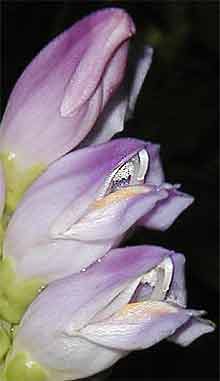 The English Woodland Garden is my favorite place to look for flowers that thrive without the sun. Today in full bloom in deep shade-odd flowers with odd names: Turtlehead (Chelone obliqua) and Toad Lily (Tricyrtis hirta). Turtlehead, I get. Each plump orchid-colored flower perched at the top of a woody stock does have the look of a wizened turtlehead, especially when seen from the front. Looked at from the side the flowers look like a school of hungry koi. The Toad Lily is not as obvious. It's a speckled flower, reminiscent of a passionflower. The blossoms appear on long arching stems that poke out of nodes where the leaves wrap around the stems. This is a flower that could benefit from better public relations. Get it a better name, and it could begin showing up in bridal bouquets. The English Woodland Garden is my favorite place to look for flowers that thrive without the sun. Today in full bloom in deep shade-odd flowers with odd names: Turtlehead (Chelone obliqua) and Toad Lily (Tricyrtis hirta). Turtlehead, I get. Each plump orchid-colored flower perched at the top of a woody stock does have the look of a wizened turtlehead, especially when seen from the front. Looked at from the side the flowers look like a school of hungry koi. The Toad Lily is not as obvious. It's a speckled flower, reminiscent of a passionflower. The blossoms appear on long arching stems that poke out of nodes where the leaves wrap around the stems. This is a flower that could benefit from better public relations. Get it a better name, and it could begin showing up in bridal bouquets.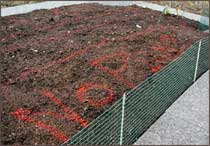 I was startled to see a freshly tilled plot in the Kemper Garden that was sprayed with orange florescent paint to mark the placement of yet to be planted plants. On one of the sections, "No Plant" had been sprayed on the raw earth. How differently gardening is done here from the way I garden at home. From planning through cleanup, I garden alone. I decide what to plant and where to plant it. I make my own schedule for what gets done and when. Here, gardening is done by a team of specialists.Team members sometimes must communicate with one another only by florescent paint markings on the ground. It must be an efficient way to get beautiful, predictable results. To visitors like me the flowers that will bloom in this plot will smell just as sweet as mine will. But after seeing what I saw today, I hope that each of the people who did a their bit to create those lush blooms will feel as much satisfaction from their work as I do in mine. I was startled to see a freshly tilled plot in the Kemper Garden that was sprayed with orange florescent paint to mark the placement of yet to be planted plants. On one of the sections, "No Plant" had been sprayed on the raw earth. How differently gardening is done here from the way I garden at home. From planning through cleanup, I garden alone. I decide what to plant and where to plant it. I make my own schedule for what gets done and when. Here, gardening is done by a team of specialists.Team members sometimes must communicate with one another only by florescent paint markings on the ground. It must be an efficient way to get beautiful, predictable results. To visitors like me the flowers that will bloom in this plot will smell just as sweet as mine will. But after seeing what I saw today, I hope that each of the people who did a their bit to create those lush blooms will feel as much satisfaction from their work as I do in mine. clear: calm: 55º clear: calm: 55ºThe annual "Best of Missouri" arts, crafts, and food festival has claimed big chunks of the Garden today. We got to the Garden before the sun did to wait in a good-natured line until the 7 a.m. opening. Volunteers and staff parade along the sides of the line plucking out "contributing" and "sustaining" members from us "regular" members. The favored ones are marched into a favored line to be led in first. Last year, all members were treated to a glazed "Krispy Cream" donut and coffee. The coffee is back this year; but, instead of a donut, we are offered slices of meaty bakery bread. Sheltered by white tents, sellers offer herbs, wreaths, jewelry, garden sculpture, and lots of food samples waiting to the stabbed by toothpicks. Foods with hot flavors are prominent this year. Pat introduced me to what she said was fashionable party dip - a cocktail cracker, dipped in cream cheese, and then dipped again in a jalapino pepper laced fruit jam. I wanted to ask the jam-maker what the trendy dip was called, but she was busy selling a couple of jars of blackberry jalapino jam. 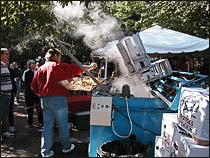 Outside the tents was a makeshift food court around the perimeter of the Latzer Fountain. The booth attracting the biggest crowds featured a trough large enough to water cattle filled with hot peanut oil. Belts, pulleys, and chutes brought Nebraska-grown russet potatoes to a slicing platform above the trough. We all watched as a stream of thin potato slices dived from the platform into the hot oil. Eight minutes later, with the press of a button, a basket rose from the oil and tilted like a car on a Ferris wheel to dump the fries into bin where they were seasoned and salted. Outside the tents was a makeshift food court around the perimeter of the Latzer Fountain. The booth attracting the biggest crowds featured a trough large enough to water cattle filled with hot peanut oil. Belts, pulleys, and chutes brought Nebraska-grown russet potatoes to a slicing platform above the trough. We all watched as a stream of thin potato slices dived from the platform into the hot oil. Eight minutes later, with the press of a button, a basket rose from the oil and tilted like a car on a Ferris wheel to dump the fries into bin where they were seasoned and salted.Someday someone will write a book about the Stella D'Oro daylily. One of the first dayliles to flower, and this morning it is last daylily left blooming in the Garden's huge collection. Stella was developed in the 1970's by hybridizer Walter Jablonski. Judging from what I see being sold at Home Depot and Lowe's and from what I see planted on the campuses of the corporate offices along the highways further West of here, Stella has to be number one on the daylily all-time best-seller list. For good reason too: Stella keep blooming and blooming and blooming and blooming; they're neither too big and nor too small so they fit well into a pot while they are substantial enough for large landscape plantings; they have a color that looks as though it was chosen by a focus group-vibrant and uniform without the eyes or banding that only a dedicated daylily grower could love. And finally, they are tough. I thinned my little patch of Sellas last fall. The bare-rooted thinnings ended up on the compost heap where without my help they survived the winter and began setting out new fans in the spring that I retrieved and replanted. 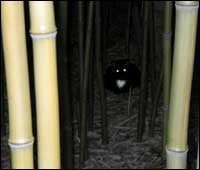 We spotted a cat sitting deep inside the tall stand of yellow-grooved bamboo near the daylily garden. We've seen cats here before, but never this one. It was all black except for white trim draped like an ascot on its chest. Perfect. No pandas munching on bamboo here, but this cat will do nicely. We spotted a cat sitting deep inside the tall stand of yellow-grooved bamboo near the daylily garden. We've seen cats here before, but never this one. It was all black except for white trim draped like an ascot on its chest. Perfect. No pandas munching on bamboo here, but this cat will do nicely.
|

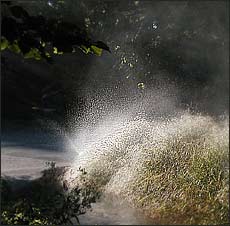 The fog made the sunlight into visible angles and blocks. Dew like beads of sweat collected on the arms and legs of the
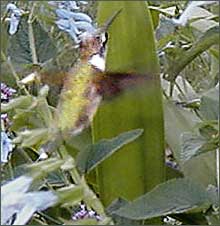 Rarely do we ever see a hummingbird. When we do, the tiny thing usually is gone before one of us can say, "Look at this hummingbird." Today though we saw four of them. They lingered around the lavender and pink salvia in the Samuels Bulb Garden and perched on the outstretched branches of a nearby Hawthorne tree. One of the birds scouted out Pat's fushia t-shirt; others posed long enough for me to take their picture. Never did I ever think that me with my automatic digital camera would get a picture of a hummingbird, but here it is. I have no idea what kind of hummingbirds these are. Ruby-throated ones are easy to spot; these weren't those. I wonder if the Garden is a resting place on the birds' migration South?
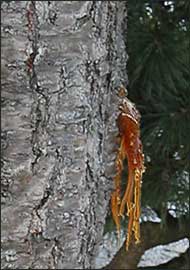 For several weeks, I've been watching the amber sap slowly ooze from several places along the trunk of a cherry tree in the Japanese Garden. Some of the sap forms boil-like domes. Some of it hardens vertically laying down deposits for more sap to flow into stalactites. The fully formed outcropping is a formation that now looks like a shrimp swimming toward the ground. I wonder, if like clouds, this formation will morph into something else before winter?
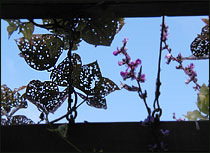 The leaves of all kinds of beans are food for spotted
 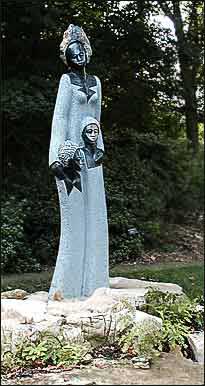 The Garden remembers the events and victims of September 11. A yellow oak called the "Remembrance Tree" was planted a year ago to "grow into a living memorial and symbol of life." Nearby is a solemn sculpture of a woman with unnaturally long arms enfolding her two children. The work is titled simply "Sole Provider." It was displayed at the Garden last year as part of a touring exhibition of works created by artists working with the Chapungu Sculpture Park in Zimbabwe. A plaque near the work sculpted by Joseph Mutasa reads "Presented by the people of Zimbabwe and the Chapungu Sculpture Park in memory of those who perished on September 11, 2001."