“ . . . and you wonder,
given the poverty of your memory, which road had the
most color last year, but it doesn't matter since
you're probably too late anyway, or too early --” -- from 'Leaves' by Lloyd Schwartz in "Urban Nature"
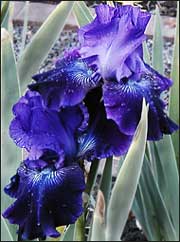
Tomorrow is Halloween. As if on cue, a reblooming tall bearded iris named 'Haunting' has flowered.
I headed straight for the Golden Larch tree to see if I might get a look at its yellow needles against the early morning sky. No luck. With plants and trees as with baseball, it's often "just wait until next year." The Golden Larch had lost nearly all of its needles. All that was left was a silhouette of stubs shaped like golf tees where the tufts of needles had been last week. The Dawn Redwoods and Bald Cypruses will soon drop their needle sprays, but not yet; not so soon.
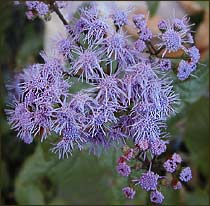
The sign stuck into the patch of violet mist flowers (Conoclinium coelestinum) in full bloom in the English Woodland Garden says that the flowers are natives of Missouri. I've never seen them, but maybe that's because I usually look for wildflowers in the spring. The mist flowers seem to have sprung up and flowered very hurriedly. Their name suits them. From a distance their flower heads packed with dozens of individual blooms seem hazy and out-of-focus. Soft whiskers poke from each tiny disk in the flat flower heads. Flora: A Gardener's Encyclopedia explains why I didn't notice the mist flowers before: "For much of the growing season the plants make a low spreading foliage mound, but from late summer they produce upright flower stems that bloom until cut back by the first frosts."
The long narrow peony bed that blooms each year by Mother's Day is being renewed. Temporary yellow sticks mark the spots were the new varieties have been planted. Why the patch is being renewed I can't guess since peonies are known for being extremely long-lived. Both the iris and daylily gardens were renewed a couple of years before conference of their national organizations had a meeting in town. Maybe the peony people are coming in 2006.
I jotted down the names of some of the replacement peonies. There was 'Coral Fay,' a hot pink number with a gold center; 'ZuZu, ' a pale pink that fades to white as it ages; 'Mikado,' a ruby red; and 'Light Out', a raspberry one with a puffy yellow center. None of the newly planted varieties that I noted were the old-fashioned double peonies with heads so large and round and full that they seem a burden to the stems that hold them up. All the new ones have either a single row of petals around a domed core or are the less amply stuffed "semi-double" peonies. According to White House Perennials, a seller that specializes in peonies, "We have found that interest in peonies has increased dramatically in the last few years. Our customers are looking for new and unusual varieties and especially like the single and semi-double flower forms because they hold up better to wind and rain." So, with these new peonies less is more.
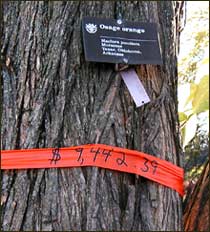
Every tree in the area slated to house the new children's garden now has been banded with an orange ribbon. The bands are at eye-level. Written on each one is the value of the tree to the penny. We think the bands are there as a constant reminder to the contractors who will soon arrive to shape the ground and build the new attractions. The message is: "You have been warned. Kill this tree and here's what it will cost you." Only God can make a tree, but once made, but only the Garden keepers know how to price them.
thick clouds giving way to clear skies: breezy: 72ºF
Colonies of insects traveling in tightly packed globes are zigzagging across the open spaces. I avoid them. Last week with temperatures in the 40's, the insects were quiet. Without a killing frost, they will likely reappear whenever the unseasonable temperatures do. With a head start in the 70's and a clearing sky, the temperature is likely to approach the mid-80's today.
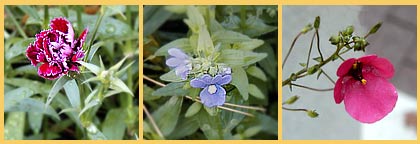
Still more pansies have been planted. I know they are a match for most winters, but I was interested to see what other flowers the keepers of this Garden chose to survive the frost. The display gardens west of the Linnean greenhouse feature three flowers: Carnation (Dianthus barbatus), Nemesia, and Diascia. They all have dainty blooms. None of them is very tall. Unless planted in a group, they are easy to overlook. I didn't see any of the three in local nurseries or garden centers. And, except for the carnation (a tiny imitation of the boutonniere version), none of the others has a common name. They also are exotics in the botanical sense: the Dianthus is native to Eurasia; Nemesia and the rose-colored Diascia come from South Africa. The test for the trio will be the first killing frost.
An old crabapple tree that shades summer hostas and spring bulbs has grown from two v-shaped trunks. Both trunks have begun to split apart exposing their soft insides. Neither trunk is strong, but together they survive by crossing-- giving and getting strength from the other.
The no-nonsense signs in the Garden tell few stories. Most of the black signs with their words in white give visitors just the facts: a plant's place in the Linnean scheme of things, its common name and country or region of origin. One sign though beside an exotic tree Golden Larch (Pseudolarix amabilis) tells a mystery story. The Golden Larch is a native of the mountains of southeastern China. A week before its tufts of long, soft needles drop, they turn shade of ochre yellow. Robert Fortune, the plant collector and explorer, spotted the Golden Larch on one of his trips to China and bought seeds and seedlings back to England in 1854. The fall-colored tree that I saw this morning while not claiming a lineage back to Fortune did start as a seedling in 1953. The seedling came from under a mature larch tree growing in a suburban St. Louis lawn. The property owner, a Mrs. McClure, had no idea why such a rare tree should be growing in her yard. As the mystery unraveled, it turned out that the James Blair family were former owners of the McClure property and that Mrs. Blair was the official hostess of the 1904 St. Louis World's Fair. The hunch is that the Golden Larch was given to Mrs. Blair as a thank-you gift by one of the Chinese representatives to the fair.
A tiny lily is blooming in the English Woodland Garden this morning. The sign nearby the single creamy-white flower with yellow witch-hazel-like anthers names it Diuranthera major and says it too is a native of China.
This little lily must be either extremely rare or far out of the horticultural mainstream. It is not mentioned in Flora, an encyclopedia of 20,000 plants. It is not sold by the large bulb-broker of fall-blooming bulbs McClure and Zimmerman. Nor does rareplants.co.uk, the "biggest and best bulb and rare plant site on the internet." Even a Google search yields little. The only mention I found of it was in the database of Florida Master Gardener and plant collector Dave Skinner. He says that a Diuranthera blooms in October in the English Woodland Garden of the Missouri Botanical Garden, the Garden where I walk. So, I've come full circle back to the single blossom of this tiny, rare lily that I just happened to see because I glanced down.
On the ledge above the pond in the Chinese Garden, I noticed a row of clay and plastic pots filled with non-too-thriving plants. A frog was using the two-gallon black plastic pot as an overlook.
fog: calm: 62ºF
By now I should know that it is risky to try to guess what the keepers of this Garden will do. I thought that the two dead yews in the middle of a hedge of thriving yews would be removed and replaced with a couple of mature yews. It didn't happen that way. The entire hedgerow of yews, both the living and the dead, were removed. This morning a row of new yews has taken their place. The new yews are not identified, but if they are to fit in with the rest of the neighborhood, they likely are 'Hicksii' yews (Taxus media 'Hicksii').
I checked the database that the botanical garden uses to keep track of where all of its permanent trees and shrubs are located and when each was planted. The hedgerow that was taken out was planted in 1991. Thirteen years is not much in yew-time. Three hundred year-old yews are not uncommon and claims have been made that some English yews (Taxus baccata) live to be a thousand. Why then did these youngsters in the Garden die? The Garden's website says that Hicksii yews shrug off bugs and blights. They will die though "if grown in heavy, poorly drained soils." Soil is the Garden's obsession. Would they in 1991 have planted their yews in anything less than the best? Whatever happened then won't happen again. The BobCat that was in the courtyard a couple of week ago dug a trench at least three-feet deep. I'm confident that the trench was backfilled with tailor-made soil laced with lots of water-draining Turface.
How long before these new yews again become a hedge? The Garden's website says they will grow tall and spread six to ten feet in twenty years. Twenty years to make a hedge: an expression of confidence in the future. At my age, I may never see the yews come together to make a hedge. Someone will though-- reason enough to plant things like yews and oak trees.
I understand why, but I don't like what the keepers of the Garden do at this time of year. Even before frost touches the summer plantings, they are ripped out and replaced by underground bulbs and aboveground pansies. I suppose that if I was faced with supervising the planting some 84,000 spring bulbs, I would use a work schedule based on some kind of bulbs-per hour per person ratio rather that waiting until a killing frost happens to arrive. Then too, for a public place such as this where visitors pay an admission fee to see botanical perfection, I understand that few people would pay to see acres of frostbitten flowers and foliage. Still, uprooting and trashing thousands of live plants remains unsettling.
Purple coneflowers (Echinacea purpuria) aren't just purple anymore. I've seen them disguised in magenta, white, rose, and pink. Until this morning though, I hadn't seen 'Art's Pride,' an salmon-orange coneflower. The petals of 'Art's Pride' look as though someone had taken a bristly watercolor brush and drawn the paint down from conehead to petal tip. The Garden's database makes no mention of 'Art's Pride,' but Google led me to Chicagoland Grows, a partnership of the Chicago Botanic Garden, The Morton Arboretum and the Ornamental Growers Association of Northern Illinois. 'Art's Pride' was one their 2004 introductions. It was developed by Jim Ault, the Chicago Botanical Garden's Director of Ornamental Plant Research. Chicagoland claims that 'Art's Pride' is the first-ever coneflower with orange flowers. In words meant to induce plant lust, they say it has "vibrant, perfectly formed tangerine-orange blooms that float carelessly above healthy, grass green foliage." As if that wasn't enough, they say that 'Art's Pride' has an "intensely sweet fragrance" much like orange spiced-tea. I don't know about the fragrance since it never crossed my mind to want to smell a coneflower, but next week I will. Whatever else 'Art's Pride' may or may have or be, it is very photogenic.
When a plant catches my eye at the Garden, I usually try to find out more about it by checking the Sunset National Garden Book or Flora: A Garden's Encyclopedia. Neither source mentioned the shade-blooming salvias that I saw in the English Woodland Garden this morning. The plants had stocks of lemon-yogurt colored flowers that grew from clumps of dense, rough arrow-headed leaves. The sign identified the plant as Salvia koyamae and said that it is native to Japan.
I have a catalog from a perennial nursery called Plant Delights. They say that their function "is to get plants into the marketplace, then allow other nurseries to produce them in mass-market numbers." It follows then, "the more popular an item becomes in the trade, the less likely we are to offer it." Plant Delights offers Salvia koyamae. Unusual among salvias, it stays away from electric hues; it begins to bloom in the fall; and it thrives shady places. All it lacks is fragrance-- maybe a new candidate for the Chicagoland folks.
The backs of some realistic stone sculptures of sheep and lambs have been worn down by the many kids who have mounted them to have their pictures taken. No grass grows near any of the sheep except for the untrampled tufts growing underneath them. When I saw the sheep sculptures this morning, I noticed that a couple of black walnuts had fallen into the grass at just the right distance from the backside of one of the larger sheep.

 -- from 'Leaves' by Lloyd Schwartz in "Urban Nature"
 Tomorrow is Halloween. As if on cue, a reblooming tall bearded iris named 'Haunting' has flowered.
 The sign stuck into the patch of violet mist flowers (Conoclinium coelestinum) in full bloom in the English Woodland Garden says that the flowers are natives of Missouri. I've never seen them, but maybe that's because I usually look for wildflowers in the spring. The mist flowers seem to have sprung up and flowered very hurriedly. Their name suits them. From a distance their flower heads packed with dozens of individual blooms seem hazy and out-of-focus. Soft whiskers poke from each tiny disk in the flat flower heads. Flora: A Gardener's Encyclopedia explains why I didn't notice the mist flowers before: "For much of the growing season the plants make a low spreading foliage mound, but from late summer they produce upright flower stems that bloom until cut back by the first frosts."
 Every tree in the area slated to house the new children's garden now has been banded with an orange ribbon. The bands are at eye-level. Written on each one is the value of the tree to the penny. We think the bands are there as a constant reminder to the contractors who will soon arrive to shape the ground and build the new attractions. The message is: "You have been warned. Kill this tree and here's what it will cost you." Only God can make a tree, but once made, but only the Garden keepers know how to price them.
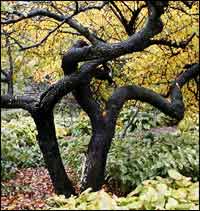 An old crabapple tree that shades summer hostas and spring bulbs has grown from two v-shaped trunks. Both trunks have begun to split apart exposing their soft insides. Neither trunk is strong, but together they survive by crossing-- giving and getting strength from the other.
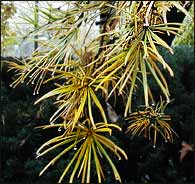 fall-colored tree that I saw this morning while not claiming a lineage back to Fortune did start as a seedling in 1953. The seedling came from under a mature larch tree growing in a suburban St. Louis lawn. The property owner, a Mrs. McClure, had no idea why such a rare tree should be growing in her yard. As the mystery unraveled, it turned out that the James Blair family were former owners of the McClure property and that
 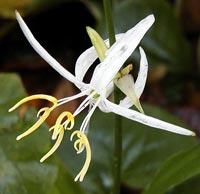 A tiny lily is blooming in the English Woodland Garden this morning. The sign nearby the single creamy-white flower with yellow witch-hazel-like anthers names it Diuranthera major and says it too is a native of China.
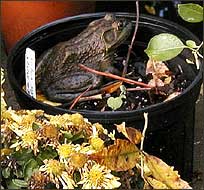 On the ledge above the pond in the Chinese Garden, I noticed a row of clay and plastic pots filled with non-too-thriving plants. A frog was using the two-gallon black plastic pot as an overlook.
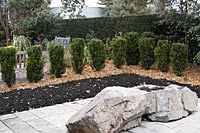 I checked the database that the botanical garden uses to keep track of where all of its permanent trees and shrubs are located and when each was planted. The hedgerow that was taken out was planted in 1991. Thirteen years is not much in yew-time. Three hundred year-old yews are not uncommon and claims have been made that some English yews (Taxus baccata) live to be a thousand. Why then did these youngsters in the Garden die? The
 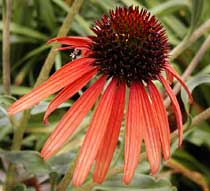 Purple coneflowers (Echinacea purpuria) aren't just purple anymore. I've seen them disguised in magenta, white, rose, and pink. Until this morning though, I hadn't seen 'Art's Pride,' an salmon-orange coneflower. The petals of 'Art's Pride' look as though someone had taken a bristly watercolor brush and drawn the paint down from conehead to petal tip. The Garden's database makes no mention of 'Art's Pride,' but Google led me to
 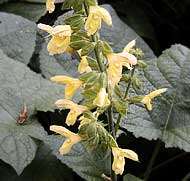 When a plant catches my eye at the Garden, I usually try to find out more about it by checking the
 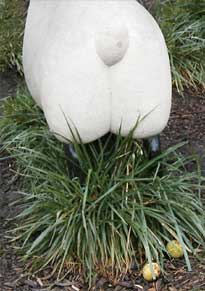 The backs of some realistic stone sculptures of sheep and lambs have been worn down by the many kids who have mounted them to have their pictures taken. No grass grows near any of the sheep except for the untrampled tufts growing underneath them. When I saw the sheep sculptures this morning, I noticed that a couple of black walnuts had fallen into the grass at just the right distance from the backside of one of the larger sheep.