 |
|||||||||||||||||||||||||||||||||||||||||||
|
“Why did summer go so quickly ?
Was it something I said ?”  -- from 'Windmills of Your Minds' in "The Thomas Crown Affair" -- from 'Windmills of Your Minds' in "The Thomas Crown Affair" |
|||||||||||||||||||||||||||||||||||||||||||
|
 clear: breezy: 43ºF clear: breezy: 43ºFWhat would a whole field of them look like, I wondered as I looked at one of the three-foot tall meaty stocks of a Monkshood in bloom. For weeks now, about a dozen Monkshood plants (Aconitum carmichaelii ‘Arendsii’) scattered around the borders of the Ottoman Garden have been in bloom. Their helmet-shaped flowers, each about two inches long, are neatly spaced from the tip of the stock to a foot or more down. Their intense bluish-purple blooms make them look like summer tropicals. Instead, here they are trying to outrun the coming killing freeze. The flower stocks are bold enough and exotic enough to look right at home in a vase of cut flowers in the refrigerated cooler of any flower shop. 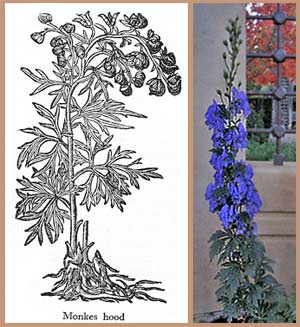 Monksheads do have one serious draw back though. They are high on the list of most poisonous plants. In John Gerard’s Herball of 1597, he said the plants “are so beautiful, that a man would think they were of some excellent virtue . . . but no part of the herbe it selfe touched.” Gerard goes on to write about a recent tale he heard from a traveler returning from Antwerp. “Certain lamentable persons” living there served a unwitting man a salad laced with monkshood leaves. Not long after, the man was “taken with the most cruell symptomes, and so died.” As a further caution to anyone tempted to eat any part of the monkshead, Gerard describes in graphic detail what would happen: “their lipps and tongue swell forthwith, their eyes hang out, their thighes are stiffe, and their wits are taken from them.” I’m convinced: I’ll look, but not touch. 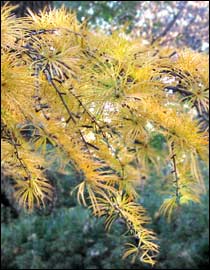 For this week only: the large Golden Larch tree planted in the botanical garden just outside the old museum building more than fifty years ago finally has turned golden. It won’t last. Already the soft needles have begun to fall. A few more cold mornings with some windy days thrown in and the tree will be bare. Last year, I was out-of-town when the larch turned, so it’s especially satisfying to see it this year. For this week only: the large Golden Larch tree planted in the botanical garden just outside the old museum building more than fifty years ago finally has turned golden. It won’t last. Already the soft needles have begun to fall. A few more cold mornings with some windy days thrown in and the tree will be bare. Last year, I was out-of-town when the larch turned, so it’s especially satisfying to see it this year.The botanical garden announced that the Chihuly exhibit scheduled to close on October 31st will be held over through New Year’s Day. Photographers have already posted lots of images of the show on the web, and now with the extension, I expect to see still more. I'm sure that the first snowfall on the walla walla onion globes in the reflecting ponds will be for photographers like the opening day of trout season is for anglers. I keep trolling for Chihuly postings on the web because many of the photos taken by local bloggers are so much more satisfying than any I take. The photos of Chihuly’s outdoor pieces (with some irises, tulips, and lilac thrown in for good measure) posted by Shelley Powers on her weblog Burningbird are spectacular. Then too, there’s the five-minute video tour of the exhibit posted by pwkstl on YouTube.com that’s fun despite the elevator music soundtrack. 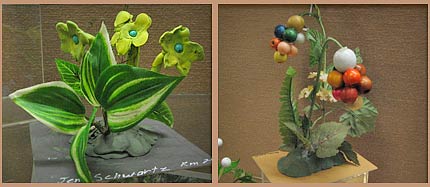 The photos and video made me think of the well-known René Magritte painting of a pipe with the words “This is not a pipe” written in French near the bottom. The images of the Chihuly exhibit on the web aren’t Chihuly glass; they are something new, remarkable, and moving in their own right. Ditto for another tiny exhibit I saw this morning in a display case along the wall of the botanical garden’s educational wing. The second, third, fourth, and fifth grade kids in Mrs. Standley’s art classes at Crestwood Elementary School visited the Chihuly exhibit and then transformed what they saw into small sculptural pieces. The kids used ordinary materials: pipe cleaners, ball ornaments, beads, clay, and plastic greenery to make their pieces. Again, “This is not a Chihuly.” But, I stayed to look at the kids' art a long time.  brilliant: calm: 38ºF brilliant: calm: 38ºF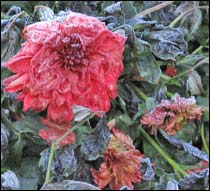 I arrived at the botanical garden before the sun had had a chance to clear the tall trees and buildings on the east side of the garden. The calm, clear, chilly night changed the dew on the grass to frost giving the lawns a white sheen. Most flowers have shrugged off this mild attack of fall, but for the dahlias, the season has ended. I arrived at the botanical garden before the sun had had a chance to clear the tall trees and buildings on the east side of the garden. The calm, clear, chilly night changed the dew on the grass to frost giving the lawns a white sheen. Most flowers have shrugged off this mild attack of fall, but for the dahlias, the season has ended.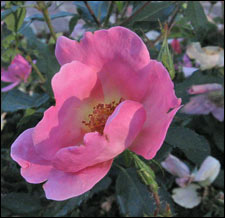 I wasn’t looking in the right place. The botanical garden does have the 2007 AARS award winning rose 'Rainbow Knock Out.' An entire hedge row of them, in fact. I didn’t see them because there were so many of them. I was looking for a shrub, maybe two -- not a landscape feature. This rose flowers and flowers and flowers. Even this late in the season with temperatures near freezing, the hedge row looks as though a shower of pink and white confetti had fallen on it. Individual blooms of Rainbow Knock Out are pink with a center that radiates yellow upon each petal. As the flowers age, the intensity of the pink fades until the petals turn nearly white. Life is good. Finally, I’ve seen all the 2007 AARS winners. I wasn’t looking in the right place. The botanical garden does have the 2007 AARS award winning rose 'Rainbow Knock Out.' An entire hedge row of them, in fact. I didn’t see them because there were so many of them. I was looking for a shrub, maybe two -- not a landscape feature. This rose flowers and flowers and flowers. Even this late in the season with temperatures near freezing, the hedge row looks as though a shower of pink and white confetti had fallen on it. Individual blooms of Rainbow Knock Out are pink with a center that radiates yellow upon each petal. As the flowers age, the intensity of the pink fades until the petals turn nearly white. Life is good. Finally, I’ve seen all the 2007 AARS winners.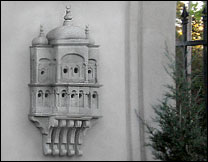 I took a picture of it because I intended to find out what it was. Made of stone; carved with care; built to palatial proportions, crowned by an onion dome, and topped with a crescent finial. The ornament was mounted near the top of a stucco wall enclosing the far side of the new Ottoman Garden. It’s a birdhouse I learned later when I took a tour of the garden. Looking closely, now I can see holes for the bird between the arched columns. Why so elaborate and meticulous done though? And why here? I came across an article in an old issue of a the Saudi oil company’s house magazine that explains. The article calls birdhouses like the ones I saw this morning “bird castles.” In Istanbul, they are everywhere: around homes, on mosques, bridges, tombs, churches, synagogues, palaces, libraries, and hotels. Fanciful birdhouses like these began appearing in Ottoman Turkey in the 1500’s. The article I read explains why, “Feeding birds, or freeing caged ones, is a meritorious act, the Turks believe. According to the Qur'an, the righteous ‘feed, for the love of God, the indigent, the orphan and the captive,’ and some interpret that verse as calling for charity to animals as well as to humans.” The website of the Turkish Cultural Foundation has pictures of some unidentified birdhouses in Istanbul that show just how baroque these Ottoman birdhouses can get. I took a picture of it because I intended to find out what it was. Made of stone; carved with care; built to palatial proportions, crowned by an onion dome, and topped with a crescent finial. The ornament was mounted near the top of a stucco wall enclosing the far side of the new Ottoman Garden. It’s a birdhouse I learned later when I took a tour of the garden. Looking closely, now I can see holes for the bird between the arched columns. Why so elaborate and meticulous done though? And why here? I came across an article in an old issue of a the Saudi oil company’s house magazine that explains. The article calls birdhouses like the ones I saw this morning “bird castles.” In Istanbul, they are everywhere: around homes, on mosques, bridges, tombs, churches, synagogues, palaces, libraries, and hotels. Fanciful birdhouses like these began appearing in Ottoman Turkey in the 1500’s. The article I read explains why, “Feeding birds, or freeing caged ones, is a meritorious act, the Turks believe. According to the Qur'an, the righteous ‘feed, for the love of God, the indigent, the orphan and the captive,’ and some interpret that verse as calling for charity to animals as well as to humans.” The website of the Turkish Cultural Foundation has pictures of some unidentified birdhouses in Istanbul that show just how baroque these Ottoman birdhouses can get.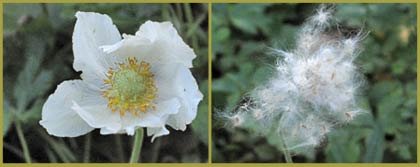 I expect Japanese anemones to be blooming now. And they are -- lots of them throughout the garden. But an anemone named ‘Snowdrop Windflower’ (Anemone sylvestris) is thriving along the walkway opposite the German Garden. A patch of them has been blooming continuously and prolifically since mid-August. Their poppy-like porcelain white flowers top ruler-length stems that pick up the slightest breeze. I’ve tried to take picture of these snowdrops twice before, but I got a white blur instead. From what I read, Snowdrop Anemones usually bloom in mid-April, but if they like where they’ve been planted and if the summer’s not too hot, and if their keepers water the hell out of them, they’ll bloom again in late summer right through to hard freeze. Aside from the blooming flowers, the patch I saw is filled with stems topped with a clump of seeds tangled together in coatings of silky fluff.  clear: calm: 46ºF clear: calm: 46ºFI read in the newspaper that 38,000 people are paying members of this botanical garden. Big numbers are good for the garden. Less good though for members who attend any of the botanical garden’s special events. Then parking lots are full, admission lines are long, and even once inside, visitors have to thread their way around one another. This morning was the opening of one of those big events. It’s called the “Best of Missouri Market” and features food, music, things for kids to do, and cooking demonstrations. The biggest draw is the over one-hundred vendors who sell good, down-home stuff. I saw and sampled glazed pecans, goat cheese, five kinds of hot relish and salsa, the wines from six different wineries, and a small cube of smoked something-or-other on a toothpick. Food aside, there were people selling home-made soaps and candles. There were lots of carvers, weavers, potters, jewelers, and a big selection of wreaths made of dried flowers and berries. New this year was a local man who made and sold an outdoor game called washers -- think tossing horseshoes, but with painted washers instead. The washers were packed in an elegant, handmade box lined with color-coordinated carpet. 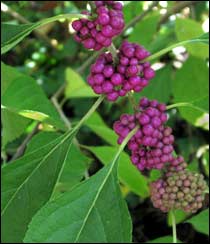 After I’ve seen and sampled all I want, I like to go back at look at the stalls that sell real plants and flowers. I could find just three: a nursery selling native wildflowers and shrubs (heavy on the purple beautyberries), one that specialized in blueberry shrubs, and a third that offered an unusual assortment of purple coneflowers (Echinacea) in colors other than purple. After I’ve seen and sampled all I want, I like to go back at look at the stalls that sell real plants and flowers. I could find just three: a nursery selling native wildflowers and shrubs (heavy on the purple beautyberries), one that specialized in blueberry shrubs, and a third that offered an unusual assortment of purple coneflowers (Echinacea) in colors other than purple.Once I left the sales area, I left the crowds. Inside the botanical garden, I passed very few people along the walking paths. My first stop was the rose garden. I’m always amazed at how the blooms return again at this time year. This morning most of the roses look better and have more blooms and buds than they did in May. I snaked my way though the grassy areas that separate the islands of rose beds looking for three particular roses: Strike It Rich, Moondance, and Rainbow Knock Out. Each is winner of a prized All America Rose Selections (AARS) award for 2007. The winners will be heavily promoted by garden writers and in garden magazines this winter and then will be available in nurseries next spring. As one of the trial and display gardens for the AARS, the botanical garden shows off the winners a year ahead of time, so I get a sneak peek.  I found Moondance and Strike It Rich in the rose garden. Moondance is a creamy white rose that glows from the inside. The flowers on the bushes I saw looked best when they were in full bloom. Buds and aging flowers were just so-so. Jackson & Perkins, a nursery that sells Moondance, compares it to its parent – a rose named Iceberg. This new offspring, they say, blooms more vigorously, is more beautiful, and has larger clusters of blooms packed with more petals than its parent. Then to top it off: “the fragrance is a sublime, sweet raspberry essence.” I hope Iceberg is proud. I’m not a big fan of white roses, so I’ll leave it at that. I found Moondance and Strike It Rich in the rose garden. Moondance is a creamy white rose that glows from the inside. The flowers on the bushes I saw looked best when they were in full bloom. Buds and aging flowers were just so-so. Jackson & Perkins, a nursery that sells Moondance, compares it to its parent – a rose named Iceberg. This new offspring, they say, blooms more vigorously, is more beautiful, and has larger clusters of blooms packed with more petals than its parent. Then to top it off: “the fragrance is a sublime, sweet raspberry essence.” I hope Iceberg is proud. I’m not a big fan of white roses, so I’ll leave it at that.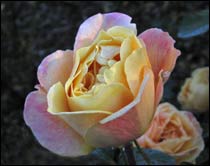 The blooms on Strike It Rich are mostly rusty orange, though some of the outer petals are swabbed with overlays of pink here and there. Again here’s the Jackson & Perkins take on the rose: “Ruby-swirled orange gold blooms spiral open from classically long buds poised on reddish stems. The sunny flowers are redolent of sweet fruit and spice.” The blooms on Strike It Rich are mostly rusty orange, though some of the outer petals are swabbed with overlays of pink here and there. Again here’s the Jackson & Perkins take on the rose: “Ruby-swirled orange gold blooms spiral open from classically long buds poised on reddish stems. The sunny flowers are redolent of sweet fruit and spice.”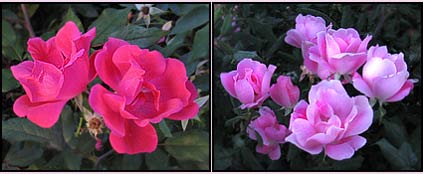 The rose I most wanted to see – the Rainbow Knock Out shrub rose – wasn’t there. I found both the red and pink Knockouts, but no Rainbow. In pictures I’ve seen, the flowers on Rainbow Knockout are coral pink blooms with a lemony-colored center. Rainbow is the latest addition to the growing family of Knock Out roses. The red Knock Out that won the AARS medal in 2000 has fast become as popular a rose as Stella d’oro is a daylily. I’ve see Knock Outs thriving in places where roses aren’t supposed to be – in medians of streets, around the borders of parking lots at Sam’s and Red Lobster, and along the partly shaded walls of commercial buildings. Heat, dry soil, and neglect don’t stop them from making mounds of elegant, graceful blooms all summer long. The buds on the hardy camellias that I look at every week are beginning to swell. ‘LuShan Snow’ (Camellia oleifera) looks as though it might flower in a week. The other four varieties of hardy camellia planted nearby are a bit further behind. Next week might be the week that I get to see a flower on a camellia growing outdoors in the Midwest. All of the plots in the trial gardens are filled with pansies – over 60 different varieties of them. They will winter over here and then come spring, they will be checked for their stamina. The fittest of them may be chosen for large-scale plantings in the more public display gardens next fall. If this garden is any indication, pansy breeders must be very busy turning out new varieties every year. Pansies though, unlike roses, are ignored by most of us. When I buy them, I look for big blooms, the right color, and stocks that aren’t too leggy. I don’t shop for particular varieties because I don’t know any. Pansies are short on boosters. I checked the internet and found that while there is a society of pansy aficionados in England, that holds shows, awards prizes, and publishes a journal, there seems to be scant interest in the flower by most flower fanciers here. Roses, daffodils, iris, hostas, even carnivorous plants – all have thriving organizations. Why not pansies? They’re durable, they’re colorful, they’re amiable to breeding. Maybe pansies seem too Victorian, too old-fashioned. to bother with. |
||||||||||||||||||||||||||||||||||||||||||