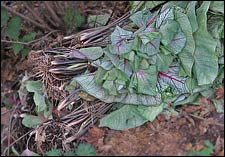
All the caladiums and cannas are gone. So are the mums. Sometime during the week the display gardens were gutted, tilled, replanted with tulips and pansies, and then covered with composted leaf mulch. I’m hopeful the keepers of the garden will put up signs that name the tulip varieties that they planted. Matching the names on the signs with the pictures in my bulb catalogs helps bring spring that much closer.
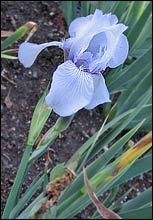
In the beds where hundreds irises are growing, there is one that has rebloomed. It’s a miniature, tall-bearded variety named ‘Claire Doodle.’ It’s lilac colored, but with a hue so light that it’s easy to pass without seeing.
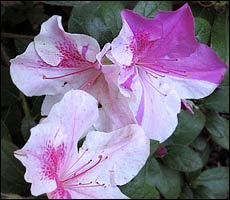
Another rebloomer: the “Encore Azaleas” that were planted recently in the English Woodland Garden. I noticed them blooming there about a month ago and took pictures of them then thinking that in other week they’d be gone. But they haven’t stopped blooming -- big flowers two- or three-inches across with vivid, often patterned colors. The Encore Azalea website says they’ve developed 23 Encore varieties so far – all named Autumn something or other. Encore Azaleas are supposed to bloom in the spring and then follow-up that up with repeat flowerings in the summer and fall.
The Encore Azalea I looked at most this morning was a variety named ‘Autumn Twist.’ It needed a lot of looking because each of the flowers was a different color. Some were purple of various hues; some were white with orchid-like purple spots and stripes; still others were half purple and half white. Since Encores were developed in places with warmer winters than here, I hope this won’t be their last performance.
The keepers of the garden also added another new planting to English Woodland Garden. Like the ‘Pinky Winky’ hydrangea I wrote about last week, this one’s from the Proven Winners plant developers too. It’s a small vibernum named ‘Blue Muffin’ (Viburnum dentatum). The spec sheet from Proven Winners pictures a shrub loaded with clusters of blue berries and text that promises “an impressive display of rich blue berries in late summer.” However further on down, the description continues “attracts songbirds.” To me that means this shrub will be blue in name only. Between the flocks of robins that live in this botanical garden and hoards that pass through it, I’d bet that all the berries will be gone long before they ever make it to blue.
A cardinal was eating the last of the red berries on a Prickly Ash or Toothache Tree (Zanthoxylum americanum). Last year the berries (said to produce a numbing effect that dulls throbbing pain) lasted well into winter. This year they’ll be gone before the first frost.
On my way out I stopped to look in on the daffodil society’s annual bulb sale. To whet a visitor’s appetite for spring, the society members put a vase of silk daffodils on each table along with a picture of each named variety that they had for sell. The color was a needed addition to the dull rows of net bags filled with dry, brown bulbs.
I bought a couple of small bags of bulbs labeled to bloom with pink cups and white petals. The bags were marked “Reed seedlings.” A daffodil society member explained that bulbs I bought were an unnamed variety of blooming size that came from a 17-acre daffodil farm in southern Michigan run by Dr. John Reed, a family doctor in that community. She told me that on a couple of weekends each summer Dr. Reed opens part of his farm to members of daffodil clubs in the Midwest who want to dig the unnamed bulbs that he doesn’t intend to develop into named varieties. The bulbs I bought came from that dig. As I was leaving the sale a society member called out to assure me that the bulbs I bought will be as pretty as can be and that when I see them in bloom I won’t care a bit about whether they have a name or not.
cloudy, feels like rain: breeze from South: 55ºF
Any leaf that’s changed color is still an oddity. Today I saw an early morning visitor tromp through a bed of epimedium to pick up a red leaf that she spotted there. She held it by its stem inspecting it – one side, then the other. Still standing in epimedium she pulled out her cell phone and made a call. I heard a bit of her side of the conversation as I passed: “so red . . . not a wrinkle.” I wondered about the person at the other end of the line. Surely a good heart to listen to someone detail the virtues of a leaf at 8:30 on a Saturday morning.
Wonder what a “neotropical migrant” is. I should have asked. I slowed my walk as I passed a couple with binoculars trained at an airplane as it was climbing toward a cloudbank. The woman noticed me watching them and asked, “Are you a birdwatcher?” I confessed I wasn’t. She told that they were in the botanical garden this morning looking for neotropical migrants. She explained, “They ought to be plentiful just now, but we haven’t seen a single one. I don't want to be paranoid, but I think they’re here. There're just hiding from us.” I walked on.
Three white pines within feet of one another: two are thriving, the third dying. It’s not the first time I’ve seen this kind of botanical strangeness, but each time I see it I wonder why it happens. It would make more sense if all the pines were dying. In my neighborhood a half dozen five-foot tall arborvitae were planted as screens around a telephone switching box. They've all browned and died. That’s sensible. Poor soil preparation, careless planting, or hit and miss watering affected them all. The result: they all died. But what rules decide when two get to live and one dies?
In the Linnaean glasshouse the first camellias of the season have bloomed. This year the first is Camellia sansanqua ‘Setsugekka.’ From now through March the camellias will bloom here warmed by heaters that hang from the ceiling and cooled by the breezes from overhead fans.
We noticed half a dozen of small hydrangea shrubs that were recently planted at the north side of the English Woodland Garden. All had a tag from Proven Winners plant growers identifying them as a hydrangea named ‘Pinky Winky’ (Hydrangea paniculata). None of the young plants were in bloom and I would have passed them by if it hadn’t been for their unusual wine-colored leaf stems and their oversized colorful tags. (Proven Winners plant tags are a marketing tour de force. Like pictures in seed catalogs, the tags show mature blooming plants at their prime.)
If these plants do bloom next summer, here’s what to expect: cone-shaped flower clusters that are 12- to 16-inches long (no mistake – that’s what the promo material says). The cones won’t droop and there will be so many of them that the shrub will be covered with blooms. Best yet – the flower cones will be two-toned: white and pink. The flowers will be white when they bloom then they will quickly switch to varying shades of pink. As if that weren’t enough, ‘Pinky Winky’ blooms on new wood. That makes them immune to late spring freezes. Proven Winners says of ‘Pinky Winky,’ “This Hardy Hydrangea is truly incredible. It blooms regardless of climate, soil, pH or pruning. The blooms are the largest that we have ever seen. It looks like the plant’s on steroids because it’s just blooming crazy.”
Suspicious of marketing hyperbole I decided to look for a source other than ‘Pinky Winky’s promoters. For new plant sensations that source is Tim Wood. Tim Wood is a plant expert who travels the world looking for interesting new garden and landscape plants. He wrote about ‘Pinky Winky’ and a his talk with the shrub’s creator Johan Van Huylenbroeek, a Belgian geneticist and plant breeder. Van Huylenbroeek said that he created the shrub by treating the seedlings of a pink hydrangea with a chemical known to produce mutations. The result was the two-toned variety he named ‘Pinky Winky,’ a name he said was a word play on a character from the BBC television show Teletubbies. After seeing the plant and talking with its creator, Tim Wood became a believer: “The time is right for Pinky Winky,” he concluded. Maybe the hype is justified. Next summer, I’ll see.
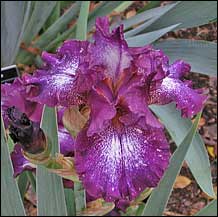
Dealers who sell reblooming irises always add their caveats to the appearance of second blooms. They often say that while these irises have a genetic tendency to bloom again in the fall, whether they do or not will depend upon some this or that over which they have no control. Of all the reblooming irises at this botanical garden a variety named ‘Decker’ is the most reliable. I’ve watched it bloom consistently fall after fall. Welcome back ‘Decker.’

 -- from 'Terrorist' by John Updike
 All the caladiums and cannas are gone. So are the mums. Sometime during the week the display gardens were gutted, tilled, replanted with tulips and pansies, and then covered with composted leaf mulch. I’m hopeful the keepers of the garden will put up signs that name the tulip varieties that they planted. Matching the names on the signs with the pictures in my bulb catalogs helps bring spring that much closer.
 In the beds where hundreds irises are growing, there is one that has rebloomed. It’s a miniature, tall-bearded variety named ‘Claire Doodle.’ It’s lilac colored, but with a hue so light that it’s easy to pass without seeing.
 The Encore Azalea I looked at most this morning was a variety named
 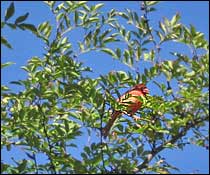 A cardinal was eating the last of the red berries on a Prickly Ash or Toothache Tree
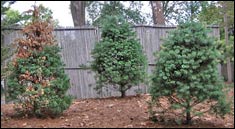 Three white pines within feet of one another: two are thriving, the third dying. It’s not the first time I’ve seen this kind of botanical strangeness, but each time I see it I wonder why it happens. It would make more sense if all the pines were dying. In my neighborhood a half dozen five-foot tall arborvitae were planted as screens around a telephone switching box. They've all browned and died. That’s sensible. Poor soil preparation, careless planting, or hit and miss watering affected them all. The result: they all died. But what rules decide when two get to live and one dies?
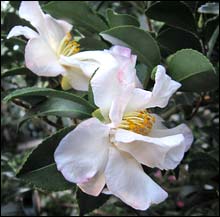 In the Linnaean glasshouse the first camellias of the season have bloomed. This year the first is Camellia sansanqua ‘Setsugekka.’ From now through March the camellias will bloom here warmed by heaters that hang from the ceiling and cooled by the breezes from overhead fans.
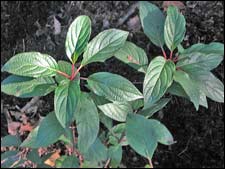 If these plants do bloom next summer, here’s what to expect: cone-shaped flower clusters that are 12- to 16-inches long (no mistake – that’s what the promo material says). The cones won’t droop and there will be so many of them that the shrub will be covered with blooms. Best yet – the flower cones will be two-toned: white and pink. The flowers will be white when they bloom then they will quickly switch to varying shades of pink. As if that weren’t enough, ‘Pinky Winky’ blooms on new wood. That makes them immune to late spring freezes. Proven Winners says of ‘Pinky Winky,’ “This Hardy Hydrangea is truly incredible. It blooms regardless of climate, soil, pH or pruning. The blooms are the largest that we have ever seen. It looks like the plant’s on steroids because it’s just blooming crazy.”