 |
|||||||||||||||||||||||||||||||||||||||||||
|
“Now the falls had fallen and nature was revealed,
like an old man whose beard has been shaved off to show what cruel tricks time had played on him.”
|
|||||||||||||||||||||||||||||||||||||||||||

|
 cloud cover: gusty wind from the northwest: 29ºF cloud cover: gusty wind from the northwest: 29ºF 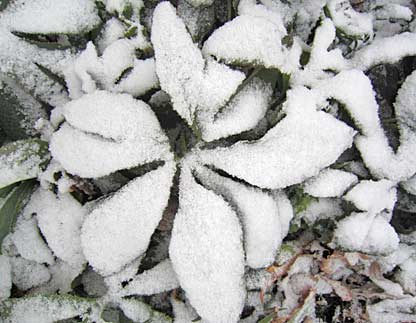 The last Saturday of the year and the first snow cover of the year: the botanical garden is covered with snow, but just barely. This first snow that clings to tree branches. It defines the outlines of plants without hiding them like this whorl of hellebore leaves. The last Saturday of the year and the first snow cover of the year: the botanical garden is covered with snow, but just barely. This first snow that clings to tree branches. It defines the outlines of plants without hiding them like this whorl of hellebore leaves.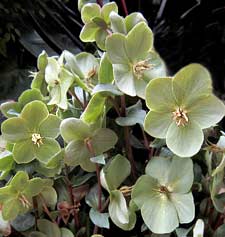 Hellebores (Christmas Roses) are one of the featured plants at the Garden’s holiday show. Pots of them are tucked in beside the model train tracks. Giant-sized silk likenesses of hellebore flowers dangle from the ceiling too. Hellebores never have made the jump from being a being a garden plant to becoming an indoor potted plant in the way mums have. Could be that poinsettias have the holidays so wrapped up that there’s no room for competitors. Also if truth be told, while hellebore flowers are stunning and surprising when there’s nothing else blooming outside, they aren’t much inside when compared to a pot of orchids that throws off beauty all winter. Hellebores (Christmas Roses) are one of the featured plants at the Garden’s holiday show. Pots of them are tucked in beside the model train tracks. Giant-sized silk likenesses of hellebore flowers dangle from the ceiling too. Hellebores never have made the jump from being a being a garden plant to becoming an indoor potted plant in the way mums have. Could be that poinsettias have the holidays so wrapped up that there’s no room for competitors. Also if truth be told, while hellebore flowers are stunning and surprising when there’s nothing else blooming outside, they aren’t much inside when compared to a pot of orchids that throws off beauty all winter.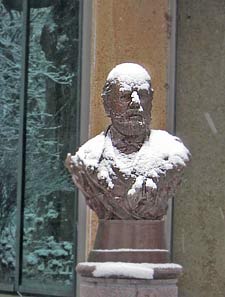 Snow has turned the sculpted busts of important and distinguished people scattered around the botanical garden into comic figures. This bust of the botanist George Engelmann looks as if it had he’d been hit in the face with a whipped cream pie and wasn’t at all pleased about it. Snow has turned the sculpted busts of important and distinguished people scattered around the botanical garden into comic figures. This bust of the botanist George Engelmann looks as if it had he’d been hit in the face with a whipped cream pie and wasn’t at all pleased about it.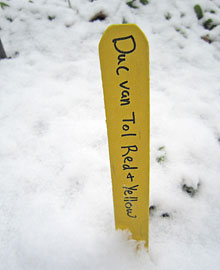 I found another marker for a historic tulip that I overlooked last week. It’s to the left of the entrance to the Ottoman Garden – ‘Duc van Tol Red and Yellow,’ the oldest known variety of tulip. It's been in cultivation since 1595. Like the other Ducs, ‘Red and Yellow’ flowers very early. It’s cherry red with petals tipped with yellow. Here’s a picture of a field of Red and Yellows taken last April at the Hortus Bulborum, a garden/museum in Holland dedicated to preventing historic spring bulbs from disappearing. I found another marker for a historic tulip that I overlooked last week. It’s to the left of the entrance to the Ottoman Garden – ‘Duc van Tol Red and Yellow,’ the oldest known variety of tulip. It's been in cultivation since 1595. Like the other Ducs, ‘Red and Yellow’ flowers very early. It’s cherry red with petals tipped with yellow. Here’s a picture of a field of Red and Yellows taken last April at the Hortus Bulborum, a garden/museum in Holland dedicated to preventing historic spring bulbs from disappearing.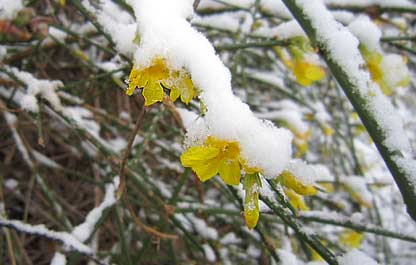 Snow can’t phase this clump of Winter jasmine (Jasminum nudiflorum) blooming in the Chinese Garden. It started to bloom at few weeks ago and right now it’s almost in full flower. This jasmine has no scent - cloying or otherwise - that I’ve ever been able to detect. Just as well. Any fragrance that it did have would be lost to winter noses too cold to smell much of anything anyway. Snow can’t phase this clump of Winter jasmine (Jasminum nudiflorum) blooming in the Chinese Garden. It started to bloom at few weeks ago and right now it’s almost in full flower. This jasmine has no scent - cloying or otherwise - that I’ve ever been able to detect. Just as well. Any fragrance that it did have would be lost to winter noses too cold to smell much of anything anyway.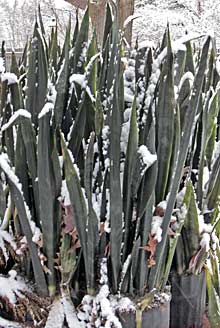 The highlight of the Chinese Lantern show last summer was two huge battling dragons made entirely of porcelain cup and plates. To mimic the sharp flames that came from their mouths, the keepers of the garden lined the planting spaces around the dragons with pots of Sansevieria trifasciata, a tropical plant with stiff pointed leaves that’s in the dragon tree family. After the dragons came down, the sansevieria were removed. I thought they had been taken to one of the Garden’s glasshouses to spend the winter. Apparently not all of them. A couple dozen pots were left outdoors lined up against the East wall of the garden’s gatehouse. Were they abandoned, forgotten, or being tested for hardiness? From personal experience I know sansevieria are tough to kill. Often it takes a few months to confirm that they’re truly dead. Still, overwintering a plant used to zone 11 in a zone 6 winter ought to do the trick. The highlight of the Chinese Lantern show last summer was two huge battling dragons made entirely of porcelain cup and plates. To mimic the sharp flames that came from their mouths, the keepers of the garden lined the planting spaces around the dragons with pots of Sansevieria trifasciata, a tropical plant with stiff pointed leaves that’s in the dragon tree family. After the dragons came down, the sansevieria were removed. I thought they had been taken to one of the Garden’s glasshouses to spend the winter. Apparently not all of them. A couple dozen pots were left outdoors lined up against the East wall of the garden’s gatehouse. Were they abandoned, forgotten, or being tested for hardiness? From personal experience I know sansevieria are tough to kill. Often it takes a few months to confirm that they’re truly dead. Still, overwintering a plant used to zone 11 in a zone 6 winter ought to do the trick.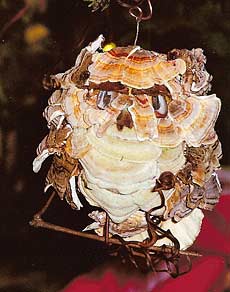 The Christmas tree in the garden center that’s decorated entirely with ornaments made of gourds comes down after New Year’s Day, so today’s my last chance to have another look. This is an owl ornament. The gourd is hidden -- completely covered by different colors of tree fungi meant to imitate feathers. The Christmas tree in the garden center that’s decorated entirely with ornaments made of gourds comes down after New Year’s Day, so today’s my last chance to have another look. This is an owl ornament. The gourd is hidden -- completely covered by different colors of tree fungi meant to imitate feathers. This is a Scotch Pine (Pinus sylvestris) named ‘Gold Coin.’ It’s growing in the display garden of dwarf conifers near the temperate glasshouse. Scotch pines were always chosen as our family Christmas tree when I was growing up, so I know about a bit about their long sharp thick needles that had to be dodged when the ornaments were hung. The needles were blue-green, as I remember. ‘Gold Coin’ is a holiday tree that doesn’t need to be decorated. The needles are a already burnished yellow color. In the summer it will change back to a greenish hue that will blend into the landscape. Nurseries that sell ‘Gold Coin’ say that the tree makes “a perfect ornamental accent in the landscape.” Looking at it today, I can see why. This is a Scotch Pine (Pinus sylvestris) named ‘Gold Coin.’ It’s growing in the display garden of dwarf conifers near the temperate glasshouse. Scotch pines were always chosen as our family Christmas tree when I was growing up, so I know about a bit about their long sharp thick needles that had to be dodged when the ornaments were hung. The needles were blue-green, as I remember. ‘Gold Coin’ is a holiday tree that doesn’t need to be decorated. The needles are a already burnished yellow color. In the summer it will change back to a greenish hue that will blend into the landscape. Nurseries that sell ‘Gold Coin’ say that the tree makes “a perfect ornamental accent in the landscape.” Looking at it today, I can see why. sunny: light breeze: 25ºF sunny: light breeze: 25ºF 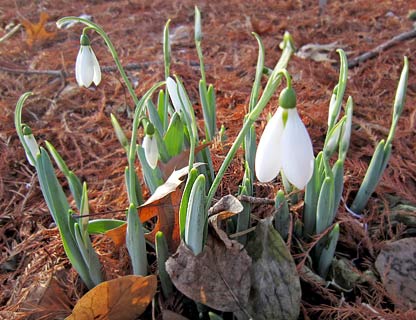 My plant reference book Flora calls snowdrops “the most welcome harbinger of spring.” That phrase may need revising. For the past few years I saw just a few snowdrops blooming in December. This year snowdrops of all kinds are blooming throughout the botanical garden. This one, blooming near the rose garden, is a Galanthus caucasius. Among snowdrops, it’s reputed to have some of the largest flowers. As much as I like seeing snowdrops, I’d like seeing them every more if they waited at least until winter got tiresome. They’re like party guests who arrive an hour too early – still welcome, but a bit out of place. 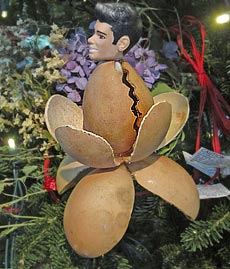 Each year botanical garden volunteers and staff decorate a fir tree with ornaments they make by hand. There are no restrictions on what their finished ornaments should look like, except that each ornament must somehow incorporate a dried gourd into its design. Visitors then vote on their favorites or place bids on the ornaments they would like to buy. This ornament is named Audrey II. It’s meant to represent the man-eating plant in Little Shop of Horrors -- half Venus fly trap and half avocado. Here the plant has eaten all but the head of a man who looks curiously like Elvis and who keeps on smiling as he’s being ingested. “Thank you, thank you. Thank you very much.” Each year botanical garden volunteers and staff decorate a fir tree with ornaments they make by hand. There are no restrictions on what their finished ornaments should look like, except that each ornament must somehow incorporate a dried gourd into its design. Visitors then vote on their favorites or place bids on the ornaments they would like to buy. This ornament is named Audrey II. It’s meant to represent the man-eating plant in Little Shop of Horrors -- half Venus fly trap and half avocado. Here the plant has eaten all but the head of a man who looks curiously like Elvis and who keeps on smiling as he’s being ingested. “Thank you, thank you. Thank you very much.”I bought a healthy young camellia (Camellia sasanqua ‘Chansonette’) from a nursery in North Carolina. I knew it couldn’t survive the winters here in zone 6, but I thought if I put it in a South-facing window and cared for it, I’d get an plentiful display of pink flowers next fall. Likely, that won’t happen. This week I received a catalog from the nursery that warned: “Camellias produce excellent flowers in a cool greenhouse . . . They are not easily cultured in a warm house with dry air since the plants need a dormant period of low temperatures.” Not to be thwarted, I read elsewhere that some camellia fanciers overwinter their camellias in dark unheated garages under grow lights. Others put them in the garage at night and then move them to a sunny window during the day. Still others say dormancy and low temperatures are bunk. High humidly is the key – go ahead and keep them indoors but mist the hell out of them. My camellia is staying in this winter. I’ll mist once a day, but that’s it. What ever happens next fall will happen. I’ll continue to enjoy the glossy leaves. 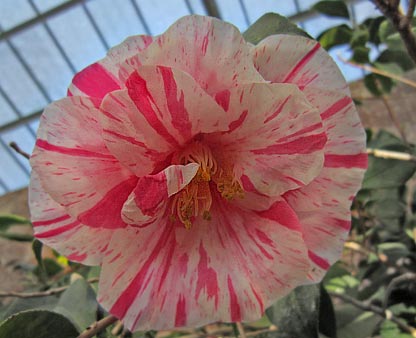 Despite what happens to my little shrub, I know that the camellias in the sparingly heated Linnaean glasshouse at the botanical garden will bloom. Sansanquas are about finished blooming now, and a some of the Camellia japonicas have begun to open. Just in time for Christmas, this candy-cane stripped Camellia japonica ‘Descanso Yuletide’ has come into full bloom. 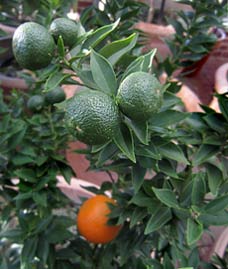 The Linnaean house now houses samples of the botanical garden’s citrus collection, so I get so see some kinds of citrus that will never make it into the fruit and vegetable aisles. This one is a Sour Orange (Citrus aurantium var. myrtifolia ‘Chinotto’). Wikipedia says it’s also called a myrtle-leaved orange tree because of its unusually small and densely packed narrow leaves. The bitter fruit citrus is mostly grown in around the Mediterranean where it's used with lots of sugar in marmalades, Italian liqueurs, and soft drinks. The Linnaean house now houses samples of the botanical garden’s citrus collection, so I get so see some kinds of citrus that will never make it into the fruit and vegetable aisles. This one is a Sour Orange (Citrus aurantium var. myrtifolia ‘Chinotto’). Wikipedia says it’s also called a myrtle-leaved orange tree because of its unusually small and densely packed narrow leaves. The bitter fruit citrus is mostly grown in around the Mediterranean where it's used with lots of sugar in marmalades, Italian liqueurs, and soft drinks.In late December, any shrub that looks as though it ought to bare, but has all of its glossy green leaves and still holds on to the browned remnants of its summer flowers will attract my attention. Abelia x grandiflora qualifies. It's a butterflybush- sized shrub with drooping canes that's growing near the top of the steps to the rose garden. In the summer the brownish remnants it holds on to now were light pink flowers that attracted bees and butterflies. The botanical garden’s website says that the Abelia is “generally deciduous” in this area. However since it hasn’t lost it’s leaves yet, I think it's likely to make it though the winter looking just as it does now unless we get some serious cold. There’s another abelia called Abelia chinensis growing inside the Temperature glasshouse. It’s a look alike of the one growing outside except chinensis isn’t supposed to do as well with the cold. Here are both Abelias – outside and inside, side by side. 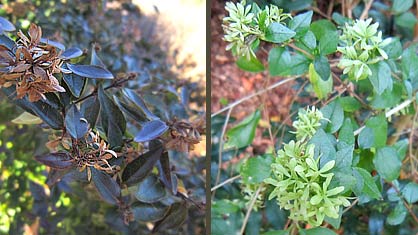 About forty miles northeast of Amsterdam in the village of Limmen there’s a garden called Hortus Bulborum. Since it began in 1928 it has amassed the world’s largest collection of historic tulip bulbs – some 2500 different varieties dating back to the 16th Century. It’s run entirely by volunteers who live in the village or who are retired employees from the Dutch bulb industry. The darlings of the garden’s collection are its 14 varieties of ‘Duc van Tol ’ tulips, named for a nobleman in North Holland. The ‘Ducs’ date back to 1595 and were mainstays of tulip plantings for over 300 years. The ‘Ducs’ come in a full range of colors. They are all early bloomers -- so early that they have been called Christmas Tulips because they can easily be potted and forced to bloom for the holidays. ‘Ducs’ open on stems just a hand span from the ground. Their fragrant blooms are small and they have a short flowering season. But apart from looking at their pictures in a catalog featuring heirloom tulips I’ve never seen a ‘Duc’ in bloom. 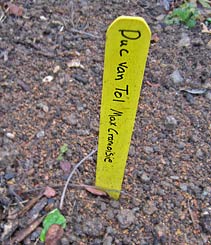 Next spring that will change. This fall dozens of varieties of rare, historic tulips were planted in the botanical garden’s Ottoman Garden. And among them are two varieties of ‘Duc Van Tols’ – Duc Van Tol Max Cramoisi, a bright red-orange tulip that’s been around since 1700 and is still planted along walkways at Jefferson’s Monticello, and Duc Van Tol Double, a scarlet double tulip that goes back to 1830. When I see them bloom next spring it will be like visiting an antique shop seeing objects that brought joy to people who lived long before me. I'll try to catch some of the pleasure they felt. Next spring that will change. This fall dozens of varieties of rare, historic tulips were planted in the botanical garden’s Ottoman Garden. And among them are two varieties of ‘Duc Van Tols’ – Duc Van Tol Max Cramoisi, a bright red-orange tulip that’s been around since 1700 and is still planted along walkways at Jefferson’s Monticello, and Duc Van Tol Double, a scarlet double tulip that goes back to 1830. When I see them bloom next spring it will be like visiting an antique shop seeing objects that brought joy to people who lived long before me. I'll try to catch some of the pleasure they felt. haze: north breeze: 27ºF haze: north breeze: 27ºF  It’s almost finished. A nearby sign says that soon after the new year, the newly installed weather station at this botanical garden will be posting weather information to its website. However, when I did some poking around on some of the NOAA websites, I found that the botanical garden’s station (MOBOT TT153) is up and running and is already recording and posting data to the national network of weather stations. The weather station has been set up in the home gardening section of the botanical garden. A Garden publication says the station is a Remote Automatic Weather Station (RAWS). “Remote” because most of the other 2200 RAWS stations are located in isolated places such as forests and national parks where they can monitor conditions that could lead to wildfires. “Automatic” because these stations run either on solar or battery power and transmit their readings by dish antenna to a satellite – much like the Mars rovers do. There are about a dozen similar stations throughout the state, but this is only one located in a city. The station will collect all the usual weather information as well as data on things like the energy of the sunlight received, the temperature and moisture level of the soil, and how prone the trees and plants are to catching fire. NOAA has a website that reports data from RAWS stations and National Weather Service stations from all over the county --just the thing for weather junkies. As for the station at the botanical garden, it’s supposed to be used as an “educational tool,” so when it begins posting to Garden's website, I suppose home gardeners can put away their Old Farmer’s Almanac. 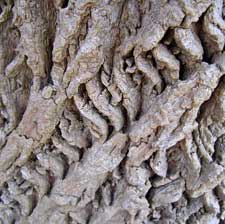 Thinking of Mars Rovers, I noticed these cleat-like formations on the bark of a tulip tree that’s growing in the English Woodland Garden. Thinking of Mars Rovers, I noticed these cleat-like formations on the bark of a tulip tree that’s growing in the English Woodland Garden.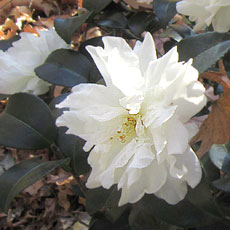 Also in the English Garden there are several camellias that are still blooming despite the hard freeze. The most vigorous, the most freely flowering variety is a Camellia sasanqua named Green 94-010 ‘October Magic Snow.’ It has white, double flowers, sometimes with a hint of pink-purple around the edges of their petals. In trials, October Magic Snow showed that it could survive temperatures down to -9 degrees and begin to flower freely while still small. The keepers at this botanical garden must be convinced that October Magic varieties will be survivors because they’ve planted a dozen or more plants from the series in partially shaded parts of the English Woodland Garden. As an aside, the ‘Green 94-010’ in the camellia's name refers to the developer, Bobby Green of Green Nurseries on the Gulf Coast of Alabama and to the number he used in his patent application. To get some notion of what it takes to bring a camellia from seed to being a registered cultivar, have a look at Bobby Green's blog ‘WinterGarden’ Also in the English Garden there are several camellias that are still blooming despite the hard freeze. The most vigorous, the most freely flowering variety is a Camellia sasanqua named Green 94-010 ‘October Magic Snow.’ It has white, double flowers, sometimes with a hint of pink-purple around the edges of their petals. In trials, October Magic Snow showed that it could survive temperatures down to -9 degrees and begin to flower freely while still small. The keepers at this botanical garden must be convinced that October Magic varieties will be survivors because they’ve planted a dozen or more plants from the series in partially shaded parts of the English Woodland Garden. As an aside, the ‘Green 94-010’ in the camellia's name refers to the developer, Bobby Green of Green Nurseries on the Gulf Coast of Alabama and to the number he used in his patent application. To get some notion of what it takes to bring a camellia from seed to being a registered cultivar, have a look at Bobby Green's blog ‘WinterGarden’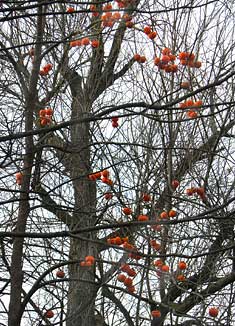 The Japanese Persimmon tree Diospyros kaki in the Chinese Garden has lost all of its leaves, but bright orange persimmons the size of big boy tomatoes are still hanging on. In years past, few of the ripe fruit were left on the trees. Squirrels I think did them in. This year a rare combination of fewer squirrels (or the availability of tastier food) and a mild spring that produced a bumper crop of fruit has kept the globes on the tree. I’ve never eaten a persimmon but I’ve read they are best left alone until after a couple of good frosts soften them up and tame their bitterness. Then some liken their taste to a overly sweet apricot and their mouth feel to jelly-like texture of boiled okra. The Japanese Persimmon tree Diospyros kaki in the Chinese Garden has lost all of its leaves, but bright orange persimmons the size of big boy tomatoes are still hanging on. In years past, few of the ripe fruit were left on the trees. Squirrels I think did them in. This year a rare combination of fewer squirrels (or the availability of tastier food) and a mild spring that produced a bumper crop of fruit has kept the globes on the tree. I’ve never eaten a persimmon but I’ve read they are best left alone until after a couple of good frosts soften them up and tame their bitterness. Then some liken their taste to a overly sweet apricot and their mouth feel to jelly-like texture of boiled okra.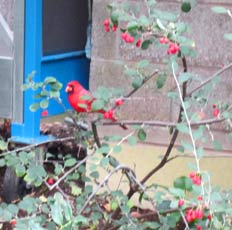 Most years after the ventilation windows close in the glasshouse that’s home to the temperate plants, a bird or two is trapped inside. This year it looks as though this red cardinal will be spending the winter inside. Here he is eating the berries from a Cherry Red Cotoneaster (Cotoneaster zabelli). In past years, the keepers of this glasshouse generously supplied their captives with enough bird seed to last the season. Most years after the ventilation windows close in the glasshouse that’s home to the temperate plants, a bird or two is trapped inside. This year it looks as though this red cardinal will be spending the winter inside. Here he is eating the berries from a Cherry Red Cotoneaster (Cotoneaster zabelli). In past years, the keepers of this glasshouse generously supplied their captives with enough bird seed to last the season.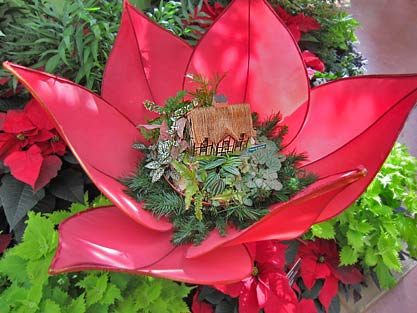 Over 350,00 visitors attended the Chinese Lantern Festival this past summer. After the show ended some of the lanterns were taken apart and recycled. Others were sold. This morning I see that some were saved for the Holiday Flower and Train show that opened this weekend. And added to ones that spent the summer outdoors, I see that the artisans made a few more lanterns especially for this show. Hanging from the ceiling are silk lanterns made to look like poinsettias, holly, fuchsia, Christmas cactus and cranes. Coming up from the floor are many of these silk red flowers. Inside each of them there’s a miniature, very detailed landscape scene that the creators of the show put together. The holiday show continues until New Year’s Day, so there’s plenty of time to have a closer look at each of the small scenes. |
||||||||||||||||||||||||||||||||||||||||||
|
+ Click to Subscribe
 | E-Mail me | E-Mail me |
|||||||||||||||||||||||||||||||||||||||||||