 |
|||||||||||||||||||||||||||||||||||||||||||
|
“The stealth of autumn
catches one unaware.”
|
|||||||||||||||||||||||||||||||||||||||||||

|
 clear sharp light: calm: 36ºF clear sharp light: calm: 36ºF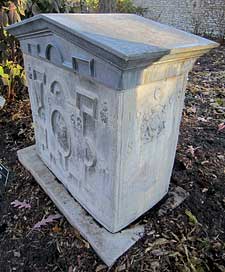 How many times have I passed by this thing? It’s mounted on a slab along the walkway through the hosta gardens. When it arrived at the botanical garden several years ago it was a just a rectangular basin. The gabled roof cap was added later. There is no sign identifying the piece but it is clearly dated 1668 and is embellished with crests that look British to me and the initials “SCI”. How many times have I passed by this thing? It’s mounted on a slab along the walkway through the hosta gardens. When it arrived at the botanical garden several years ago it was a just a rectangular basin. The gabled roof cap was added later. There is no sign identifying the piece but it is clearly dated 1668 and is embellished with crests that look British to me and the initials “SCI”.Turns out that a very similar item was offered at an auction by Christie’s in 2004. Christie’s called the item “An English Lead Rectangular Cistern.” They sold the two-foot high piece for about $2000. The piece in the botanical garden is in much better shape and it’s at least twice as tall without the cap, but who’s to say whether it’s an original or a reproduction.  English cisterns like these are now prized as garden ornaments, but in the 17th Century they had other more practical uses. I found an interesting history of lead cisterns on the Bulbeck Foundry’s website. Bulbeck makes authentic reproductions of cisterns at their foundry just outside of Cambridge. They say that lead cisterns were used extensively in the 17th and 18th century to collect water from the roofs of big houses. The rainwater would saved to be used for cooking, bathing, or watering plants. The cisterns were commonly dated and embellished with crests, arms, or initials. Lead was used for cisterns because it was plentiful in Britain, easy to extract, and malleable to work.  There are a dozen or so varieties of crinum lilies that have been left to overwinter in the bulb display gardens. Many more have been lifted and are spending the winter in the hallways of the botanical garden’s working greenhouses. Which stay and which go? Only the Garden’s bulb experts. Flora: A Gardener’s Encyclopedia says there are about 130 species of Crinum lilies and that they’re native to wet lands in South Africa. The bulbs are tender perennials belonging to the amaryllis family. After looking around the beds I noticed that this botanical garden uses many varieties of the hybrid Crinum x powelli. Crinum growers say that Crinum x powellii are “durable and hardy, reportedly surviving into zone 6.” Then as if adding a warning label to the bulbs, the growers add, “Some C. x powellii have lasted as pass-along plants for many years not because they are especially beautiful but because they are so durable.”   The clear blue sky is a perfect contrast for branches filled with native persimmons (Diospyros virginiana) and bright red possomhaw berries (Ilex decidua). Both trees are growing at the top of the rise in the native shade garden.  cloudy: north wind: 22ºF cloudy: north wind: 22ºF The botanical garden turned on the lights last night. The holiday show called “Garden Glow” drew some 3500 Garden members to see just what the garden had cooked up for its first ever outdoor display of lights. The botanical garden turned on the lights last night. The holiday show called “Garden Glow” drew some 3500 Garden members to see just what the garden had cooked up for its first ever outdoor display of lights. The lighted attractions are scattered along a mile-long, one-way walkway. At the center of it all is the Climatron, the botanical garden’s 70 foot-tall domed tropical greenhouse. LED lights trace the whole dome with green lights on the inner pipes and cool white ones on outer ones. The effect was like a green moon rising. As the packed line of visitors got closer to the dome, the line slowed noticeably as people fished out their cell phone cameras and took aim. All of the displays in the light show are powered either by solar power or LED lights. The show guide says that LED lights are being used because they are in keeping with the botanical garden’s mission of using and promoting energy-efficient practices. Ticket buying visitors may not care about energy savings or mission statements. Dazzle is what most of people want as they walk a mile on a cold night. LED lights deliver the dazzle. They’re brighter and have lenses that throw off light in all directions. Still better, they glow in colors that are still rare and unusual to see in holiday displays. Pastels and shades in the cooler part of the color spectrum are the norm here. As yet some of the colors don't even have names so who can be tired of seeing them? LED technology can produce 256 million colors and a single bulb can even scroll through the whole spectrum. Lots of amazement is in store for holiday light shows of the future as the cost of LED technology comes down and we tire of seeing pastels. 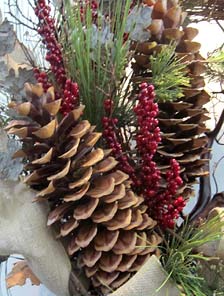 Holiday wreaths decorate the walls in the atrium leading to the Garden. Each year a dozen or so designers from local floral shops and garden centers make these huge wreaths that would need a whole wall in a great room to hang tastefully. Each of the designers has a different take on what a wreath needs to look festive. After seeing all the wreaths and picking my favorites, I then go back to look more closely at the details. Holiday wreaths decorate the walls in the atrium leading to the Garden. Each year a dozen or so designers from local floral shops and garden centers make these huge wreaths that would need a whole wall in a great room to hang tastefully. Each of the designers has a different take on what a wreath needs to look festive. After seeing all the wreaths and picking my favorites, I then go back to look more closely at the details.In a wreath called ‘Home for the Holidays’ the designer uses a lot of these pine cones. They’re so long and broad that I thought they might be cleverly made imitations. They’re real though. The sign says the cones come from Sugar Pine trees (Pinus lambertiana). Everything about the Sugar Pine is big. It grows taller than the scaffolding on most roller coasters and its trunk can be 7 feet around. The cones are usually 12 to 18 inches long, but can grow to a couple of feet. There’s an active market on the internet for sugar pine cones with the longest ones selling for about $2.80 a piece wholesale.
The trees and shrubs in the Japanese Garden are brilliant. Photographers, as numerous as fishermen on opening day of trout season, are catching views from every angle before they disappear.
|
||||||||||||||||||||||||||||||||||||||||||

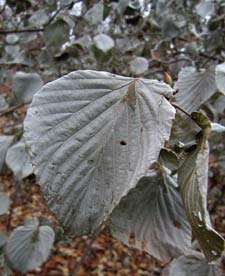 I saw a large Winter Hazel (Corylopsis sinensus) shrub tucked away off the pathway in the English Woodland Garden. It was thick with these silver-colored leaves. I only noticed the shrub because of the leaves. Silver isn’t a typical fall color for winter hazels. “Leaves turn variable but usually unexceptional shades of yellow in fall,”

 This was the last morning before the clocks return to normal. If I were ever to see the botanical garden at sunrise, today would have to be that day. So I arrived early; as did dozens of others. After three days of rain, we all wanted to see the leaves that had suddenly changed their outfits.
 After the color fades, the botanical garden plans to close the Japanese Garden until cherry blossom time in the spring. Work will be done on the lake itself, on the plumbing that keeps the water falling over the two waterfalls, and on the decking and supports of the bridges. Works has already begun on the zig-zag bridge and drum bridge. This is the drum bridge that connects the garden with the sacred tea island. The railings and walkway are gone. Only the curved supports remain.
 Trees and shrubs that I’ve never noticed before I see today. Color does that. Just off the walkway I saw this Three-Flower Maple (Acer triflorum). The foliage was so brilliant and intense that I detoured to see the tree up close. Intriguing leaf: three separate spreading leaflets that join at the stem.
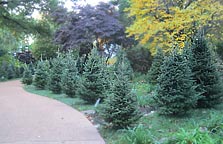 To get ready for Garden Glow, the walkway through the daylily garden has been “planted” with douglas firs. Dozens of them, all beautifully shaped, and scattered so artfully that I felt as though I was walking though a tree farm. Some of the trees are strung with lights, but there’s still much to be done.
 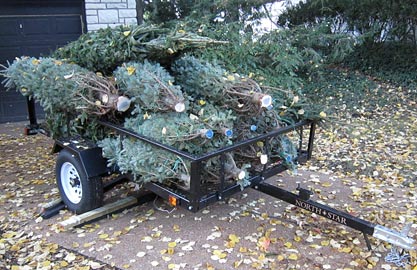 I thought the trees were alive until I saw this hitch hidden behind some shrubbery.
  Just as sassafras can’t make up its mind about which leaf shape it prefers, neither can it decide what color its three different leaf shapes ought to turn in the fall.
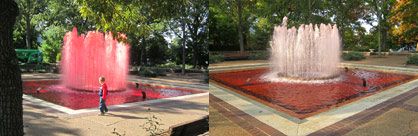 The water in circular fountain was dyed bright red to encourage the St. Louis redbirds to win the World Series. It didn’t work. Now to add salt to our wounded hopes, the fountain is sending up a spray of washed-out red.