 |
|
|
“ There is a curious difference between the end of summer and the beginning of winter.
Last month Nature and I were vaguely apprehensive. A vast change was imminent which we resisted and resented. Now the tide has turned, a crucial moment has definitely passed. The inevitable has been accepted and it turns out not to be so bad.”  -- from 'The Twelve Seasons' by Joseph Wood Krutch -- from 'The Twelve Seasons' by Joseph Wood Krutch |
|
|
|
 drizzle: West wind: 40ºF drizzle: West wind: 40ºFThe first hard freeze of the season was the day before Thanksgiving. Things of life have filled my Saturday mornings for more than a month now, so this is my first visit to the Garden since the freeze. Much has changed: the rose bushes have been reduced to leafless sticks pruned to look like racks of antlers; the bald cypresses and the dawn redwoods are now bare; the pansies and violas have given up on trying to bloom and now are struggling just to stay green; the small cluster of banana trees in the Chinese Garden has been cut down and the tree roots are buried beneath two feet of mulch. Everywhere the Garden looks leaner, more open: a place with fewer secrets concealed by leaves and less distracted by blooms. 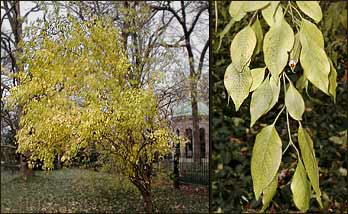 When other trees have shed their leaves or just hold on to lifeless brown ones, one tree begins to get noticed. It is not a large tree-ten- or twelve-feet tall at most and for years it has been content to stay put at that height. It has run-of-the-mill leaves for a tree -elongated ovals with delicately scalloped edges. What is remarkable about this tree called a Spindle Tree (Euonymus japonicus) is that its leaves don't drop. They yellow a bit, but still stay put even in the coldest weather. I like to take pictures of this little tree after a snow. All else is white or brown except for this oasis of green. 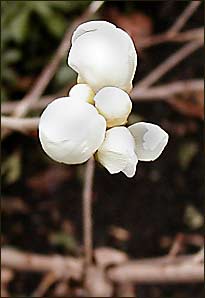 I'm not yet ready to appreciate the spare scaffolding that comes with winter. I keep looking for color--for flowers. This morning I found some. Poking out of the dead leaves in the English Garden I spotted a yellow primula (Primula vulgaris) that has just begun to bloom. Quinces, both white and rose-colored, have started to flower on inside branches. In the Chinese Garden a spring-blooming shrub called Pearlbush (Exochorda racemosa 'Northern Pearls') has offered some pure-white, round buds. While the odd bloom on a spring-flowering shrub is unusual, it is not unexpected. But, I wasn't expecting to see late winter bulbs in bloom. There they were though: a good-sized clump of snowdrops in full flower in the space between the bird garden and the children's garden. I tried to get a picture, but the clump was too far away for the 3x lens on my camera to manage. I'm not yet ready to appreciate the spare scaffolding that comes with winter. I keep looking for color--for flowers. This morning I found some. Poking out of the dead leaves in the English Garden I spotted a yellow primula (Primula vulgaris) that has just begun to bloom. Quinces, both white and rose-colored, have started to flower on inside branches. In the Chinese Garden a spring-blooming shrub called Pearlbush (Exochorda racemosa 'Northern Pearls') has offered some pure-white, round buds. While the odd bloom on a spring-flowering shrub is unusual, it is not unexpected. But, I wasn't expecting to see late winter bulbs in bloom. There they were though: a good-sized clump of snowdrops in full flower in the space between the bird garden and the children's garden. I tried to get a picture, but the clump was too far away for the 3x lens on my camera to manage.The snowdrops bloomed without a label nearby to identify them. The botanical garden's list of plants in bloom hasn't been updated for a couple of weeks, so I got no help there. From what I've been able to find in the books I have, the only late autumn flowering snowdrop is the rarely found Galanthus reginae-olgae. But G. reginae-olgae is supposed to flower before any leaves appear. These snowdrops have leaves. Likely they are some variety of common late-winter snowdrops. Why bloom now though? A mystery best left to the Galanthophiles (a great word to describe the people who have a passion for snowdrops) to deal with. 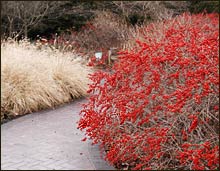 'Red Sprite' winterberries (Ilex verticillata) dominate the circular path around the bird garden. They cover the branches of their now leafless shrubs. 'Red Sprite' is bodacious: truly over-the-top. It has bigger fruit, brighter, more vibrant Santa Claus-colored berries than any other winterberry around. Let the birds feast on them in January, but let them last though the holidays. If I was a breeder of winterberries looking for something that would outdo 'Red Sprite' I would graft a bright gold variety on to a 'Red Sprite' so that some twigs would be red, others gold. My aim would be to have a kid walk up to the shrub and touch it to see if it was real or artificial. 'Red Sprite' winterberries (Ilex verticillata) dominate the circular path around the bird garden. They cover the branches of their now leafless shrubs. 'Red Sprite' is bodacious: truly over-the-top. It has bigger fruit, brighter, more vibrant Santa Claus-colored berries than any other winterberry around. Let the birds feast on them in January, but let them last though the holidays. If I was a breeder of winterberries looking for something that would outdo 'Red Sprite' I would graft a bright gold variety on to a 'Red Sprite' so that some twigs would be red, others gold. My aim would be to have a kid walk up to the shrub and touch it to see if it was real or artificial.For more than a month I've wondered why the fine Italian Cypresses (Cupressus sempervirens) in the temperate glasshouse have been cut down. They were mature, elegant trees, each ten to twelve feet tall. Flora: the Gardener's Encyclopedia, says that they are extremely long-lived too. In every way, the cypresses that were removed were the right plants planted in the perfect place. Whatever the reason for cutting them all down, I was pleased to see that nine large containers of tall Italian cypresses are waiting to be planted in places where the old trees once were. The trees likely will be planted after some work being done on the glasshouse heating on the wall behind the tree row is finished. |

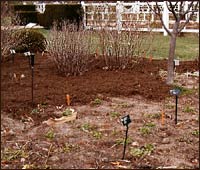 Slowly a new layer of leaf mulch is engulfing the entire botanical garden. With so many beds and so many acres to cover, the work is slow. In the bulb garden, the encroaching mulch cover looks like water's edge against coastline.
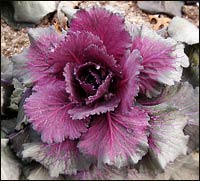 For several days last week the temperature neared zero - cold enough to kill off anything except the truly hardy. I expected to find the dianthus dead. They were. I was surprised though to find that the spotted leaves of reputably very hardy pulmonaria had withered and browned. Ornamental cabbage and kale though are still standouts. I know they will not survive until spring, but their end will be slow; their final collapse unpredictable. The herbs are still the freshest-looking of all the early winter plants. Even though the fennel has collapsed into an anise-scented heap, other herbs like rosemary, sage, germander, and lavender cotton are thriving.
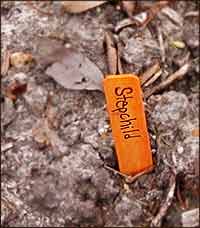 This morning, I saw orange stakes with these intriguing names: 'Balanced Equation,' 'Tillamook,' 'Ruddy Nosey,' 'Uncle Duncan,' and 'Stepchild.' From the registry of the Royal Horticultural Society (RHS), I found out that all were names of daffodils. None though was listed or pictured in any of my bulb catalogs my reference books. Nor did their pictures appear as Goggle images. Perhaps not surprising since over 20,000 varieties of daffodils have been registered with the RHS. So I'll wait. Come spring, I'll take a picture of each of the daffodils I found. Right now, though, I wonder where these unusual daffodils came from. Could there be some nursery somewhere that is obsessed with trying to stock and offer some sizeable chunk of the 20,000 registered varieties?
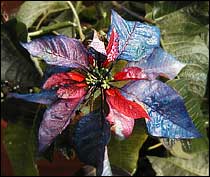 I spotted this poinsettia in the Temperate glass house. It, along with some pots of dead plants, was in a wheelbarrow near the side door. Next stop: the scrap heap outside. I had never seen a poinsettia with metallic-blue outer bracts before. They shimmered in the indirect light of the overhanging trees making the plant look as though it had been rendered blue by a