 |
|||||||||||||||||||||||||||||||||||||||||||
|
“night edges in on us from both directions
as this corner of the earth turns its face from the sun. yes the same old things go on, but they begin and end in the dark.”
|
|||||||||||||||||||||||||||||||||||||||||||

|
 cloudy: windy: 38ºF cloudy: windy: 38ºF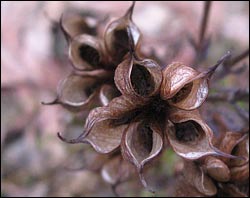 After their impressive show of royal-purple flowers, the monk’s hoods (Aconitum carmichaelii ‘Aredsii’) in the After their impressive show of royal-purple flowers, the monk’s hoods (Aconitum carmichaelii ‘Aredsii’) in the 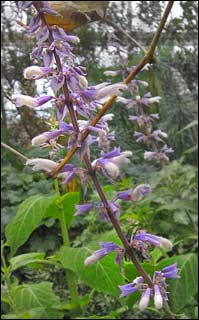 They’re hard to miss. With so few things blooming this morning in the glasshouse set aside for plants from Mediterranean climates, the clump of giant salvias on an interior hillside stands out. Their lavender and white blooms are supported by square stocks the size of twigs. Some of the flower stocks jut up at least five-feet. What a surprise to find a small, nearly hidden plastic tag that labels this towering plant “Salvia divinorum,” a member of the mint family native to parts of Mexico. They’re hard to miss. With so few things blooming this morning in the glasshouse set aside for plants from Mediterranean climates, the clump of giant salvias on an interior hillside stands out. Their lavender and white blooms are supported by square stocks the size of twigs. Some of the flower stocks jut up at least five-feet. What a surprise to find a small, nearly hidden plastic tag that labels this towering plant “Salvia divinorum,” a member of the mint family native to parts of Mexico.Salvia divinorum is the plant that’s been attracting so much attention in the media because of its psychoactive properties. Ingestion of the plant is said to produce unpredictable hallucinogenic effects that range from feelings of contentment and peace to frightening sensations of being detached from time and space. The substance is legal in all but eight states and it’s widely sold on the internet. In this state, possession of saliva divinorum is a felony offense punishable by a maximum sentence of seven years. The two plants that I saw this morning – monk’s hood and salivia divinorum –are both fascinating to see and potentially dangerous. The guide given to visitors when they enter this botanical garden says, “No collecting live plants, seeds, flowers, fruits, or vegetables.” Still here as elsewhere, prohibiting some behavior or activity doesn’t eliminate it. Is it ethical for a botanical garden to display plants that could harm visitors who choose to ignore a "look, but don’t take" rule? This garden’s policy seems to be to display any plant of horticultural or botanical interest without making a fuss about it. “Show, but don’t tell,” seems to be at work here. Never have I seen a sign next to a plant that warns visitors not to touch, rub, or take plant parts because a plant’s toxicity. Plants such as the salvia divinorum or the commercially valuable goldseal are planted in out-of-the way or hard-to-reach places and often are unlabeled. The result: most casual visitors never see the plants or pass them by with just a passing glance. I think this middle ground between banning certain troublesome plants and having security guards who watch all high-profile plants strikes just the right balance.  cloudy: breezy: 18ºF cloudy: breezy: 18ºF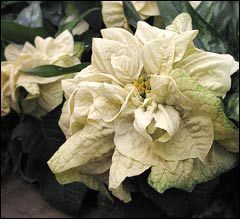 The holiday show in this botanical garden’s display hall is mostly about trains. There are plants and flowers too, but they act mostly as buffers filling the spaces between the trains and the crowds. Much as I like watching the trains and the expressions of the kids who watch the trains, I like the flowers too – especially the unusual ones. Making a repeat showing this year is ‘ The holiday show in this botanical garden’s display hall is mostly about trains. There are plants and flowers too, but they act mostly as buffers filling the spaces between the trains and the crowds. Much as I like watching the trains and the expressions of the kids who watch the trains, I like the flowers too – especially the unusual ones. Making a repeat showing this year is ‘Another holiday tradition at this botanical garden is the tall fir tree in the home garden center that is decorated with natural ornaments. The tree I was told is always topped with the dried flower stalk of a Shubertii Alium. It’s the size and shape of a soccer ball with spokes that burst from the center. My point-and-shoot camera wasn’t up to getting a picture of the tree top, but it was like this one, only a bit fuller. 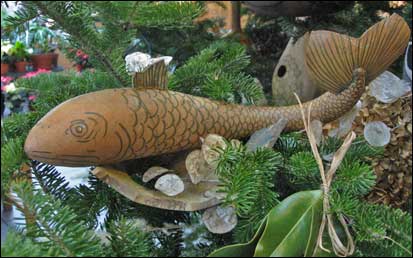 The best part of the tree is the ornaments. They’re all made from gourds by people who volunteer at this botanical garden. Each year the ornaments are different because when the season ends, they are all auctioned off. Among my favorites this year is a quail perched at the end of a branch and this koi embellished with shards from other gourds. 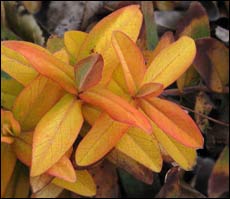 For late-season color after all the trees and shrubs have dulled, I’d pick this St. John’s Wort (Hypericum calycinum) named ‘'Brigadoon.' If this plant with these colors were here a month ago, it would have gone unnoticed among the maples and the burning bushes. Now though, it’s an unexpected reminder of the season that’s just closed. For late-season color after all the trees and shrubs have dulled, I’d pick this St. John’s Wort (Hypericum calycinum) named ‘'Brigadoon.' If this plant with these colors were here a month ago, it would have gone unnoticed among the maples and the burning bushes. Now though, it’s an unexpected reminder of the season that’s just closed. |
||||||||||||||||||||||||||||||||||||||||||