
 rain: wind gusts: 44ºF
A good day to stay inside and sleep late – rainy, now and then some thunder, and an approaching front that will bring snow and the first single-digit temperatures of the season. Whatever the weather though, it’s still a good day for a walk in a botanical garden.
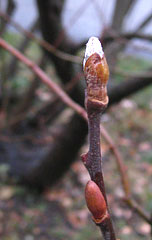
Last week I saw a snowdrop in bloom. This week at the far end of the Japanese Garden I saw this furry catkin poking out of one of the stems on a clump of pussy willows. Two reminders of spring before winter officially begins.
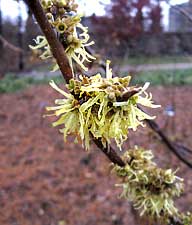
The fall blooming witch hazel (
Hamamelis virginiana) continues to bloom. I noticed the first blooms in early October. This shrub, a variety named ‘Harvest Moon,’ seems to flower longer and has larger, more plentiful flowers than any of the unnamed
Hamamelis virginiana shrubs planted nearby. Most of the witch hazels in this garden flower in late winter to early spring. Hybridizers seem to ignore fall flowering varieties so they can concentrate on the showier, late-winter bloomers. Those varieties, with their wider range of colors, petal shapes, and blossom lengths, are yet to come. This morning I noticed that the late-winter varieties are filled with buds that I hope will stay tightly closed for a couple months more.
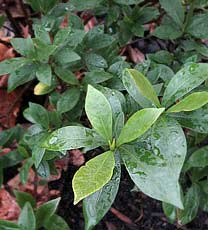
The southern
gardenia ‘Leeone’ JUBILATION that was planted this summer in the English Woodland Garden is still vibrantly green.
In June the small shrub had lots of fragrant white and yellow blooms. Since a southern gardenia and a mid-west winter seems an unlikely mix, I thought the gardenia would have been dug and put somewhere more to its liking. Yet here it is: a zone 7 plant (at best) in a Zone 6 garden. The snow and cold temperatures forecast for the week ahead will be telling. I’m coming back here again next week to have another look.

I stopped in to see the holiday train show again. Saturday morning. The show is filled with families. Younger kids are being hoisted up by moms and dads to see the trains running through landscapes filled with miniatures of people, buildings, and animals that might be found along the Appalachian Trail – the theme of this year’s train show. Older kids worm their way to the front of the crowd and point and squeal as they see the trains pass by. Parents and kids who are more goal-directed are playing an “I Spy” game. Together they dart from one landscape to another trying to find the miniature figures pictured on a handout so that they can check them off their lists.
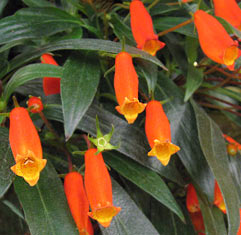
There are lots of plants and flowers here too. The handout says there are over 2,500 in the show. I came back to see a gloxinia named “Orange Bugle.” It’s bright orange on the outside, but inside it’s yellow. The shape of the flowers makes me think they could be plucked off and then strung together as beads to make a smashing necklace. Apart from their eye-catching color, what I like best about the Orange Bugles are the horns they have at the top of each blossom that look like cat’s ears.
 clear: calm: 38ºF
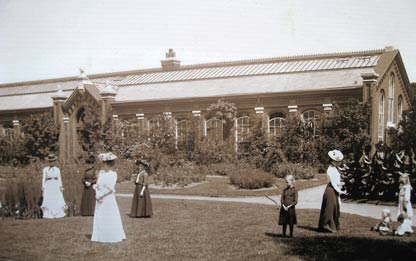
Winter is fix-up time at this botanical garden. During the slow, not much to see or do months, things get done on the insides and outsides of buildings. Renovation of the historic Linnean greenhouse is this year’s biggest restoration project. The greenhouse with a bust of Linneas topping the portico is said to be “the oldest continuously operated public greenhouse west of the Mississippi River.” It was built in 1882 and still looks much like this photo taken in 1890 even though it's had three major renovations.
Since the 1930’s, ithe Linnean House has housed the botanical garden’s camellia collection. But, before this latest renovation of the house started, the camellias were dug up and moved to a florist's greenhouse in St. Genevieve to spend the winter. Now the house is filled earthmoving equipment. The doors are boarded up. There is no roof. Only the brick walls remain. When the restoration is completed in early spring, the building will still look much as it did when it was built. But when it reopens, it will have new tuckpointing, an inground heating system, and a new all-glass roof supported by new structural steel beams. Then the camellias will come home.

This morning we noticed that new cresting is being installed atop the center beam of the greenhouse. Still more sections are waiting inside. The pattern of fleur-de-leis spears and what looks to me to be a cross section of a ripening seed pod is the same pattern used as cresting when the house was built.
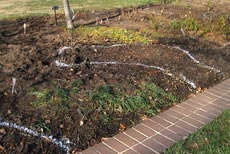 The ground in the display gardens has been marked for planting. Hyacinths are in already so I think that the chalk marks are for the tulips. Some tulips are already in and temporary yellow wooden labels poke out of the ground indentifying the varieties that will bloom next spring.
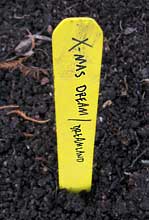 Usually two varieties of tulips are planted together – here’s one pair: Christmas Dream and Dreamland. Apart from names that sound like a “before and after” category on the Wheel of Fortune, I checked to see what else the pair had in common. Turns out not much. They’re different colors, different heights, and they bloom at different times. However, those kinds of differences will help stretch the spring blooming season and will mean that repeat visitors to the garden will see wave after wave of changing color.
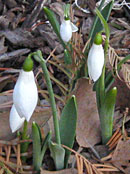 Even though it’s December I still haven’t adjusted to walking in this botanical garden and not looking for something in bloom. Maybe that’s why I spotted this clump of Snowdrops (Galanthus nivalis) blooming in the Bird Garden. Snowdrops are supposed to bloom in February or March around here, but I’ve seen this particular patch in this particular place bloom here twice before. I enjoy having a chance to welcome them now, long before the other spring guests arrive.
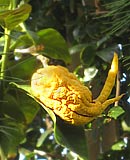 I saw this odd-looking citron (Citrus medica) hanging from a tree in the temperate glasshouse. It’s called a Fingered citron or ‘Budda’s Hand.’ This citron seemed to making a very un-Budda-like gesture. The pictures I saw of more typical Budda’s Hand citrons show the fruit as having more “fingers,” all of them pointing downwards. The Wikipedia entry on citrons says, “According to tradition, Buddha prefers the "fingers" of the fruit to be in a position where they resemble a closed rather than open hand, as closed hands symbolize to Buddha the act of prayer.” The citron in this botanical garden is definitely not praying.

clear: calm: 33ºF
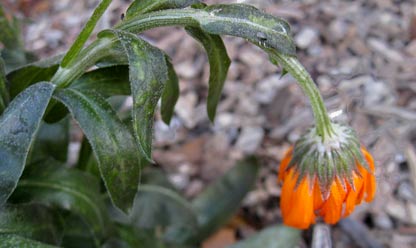
Lots of people must have decided to sleep in this morning. We walked most of the 79 acres of this botanical garden without seeing more than a half dozen people. With temperatures in the low 20s for the last couple of nights, most people rightly figured that whatever was left of summer color would have faded and that the last remains of fall would have been composted.
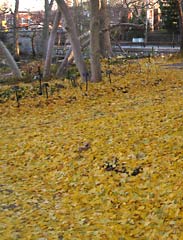 Color is scarce this morning. But luckily we got to the garden before the workers with the leaf blowers did. Last night most of the ginkgo trees dropped their leaves. We noticed that ginkgo leaves seem to be social creatures -- what one does, they all do. So since the winds were calm, every walkway near a ginkgo tree was covered with gold. This early, they haven’t been trampled on by walkers or kicked around by kids. It’s as though overnight all the leaves had been evicted from their branches to sleep on the sidewalks.
Last week when we were here, a few tender water plants were still in the reflecting ponds near the entrance to the garden. Sometime during the week most were lifted and moved inside. This year though the keepers of the garden decided to leave a few water plants out to winter over. A couple of sacred lotus plants were left behind along with a couple of hardy water lilies. I don’t think that the lotus will have much trouble surviving, but I’m curious to see whether the water lilies will make it though the winter. From what I’ve read, hardy water lilies are really tough. They can come back even after a spending the winter in a mountain lake in Utah. The catch is that even though they go dormant just fine, lilies don’t take to being wintered over in ponds or lakes that freeze solid. The unheated reflecting ponds in this botanical garden are only about four feet deep. And in very cold winters, they do freeze solid. So we’ll see.

One bright, clear mornings, the reflecting ponds live up to their name – especially at this time of year when the plants have been taken out. Often, I don’t see the reflections because I’m looking too closely at what’s in the water rather than what’s being reflected by it. Cameras aren’t fooled though. They ignore the odd bit of leaf debris floating on the water and focus on the picture that’s cast on the water. This is a picture of the Linnaeus glasshouse topped with the busts of Linnaeus, Nuttall, and Gray mirrored by the water.
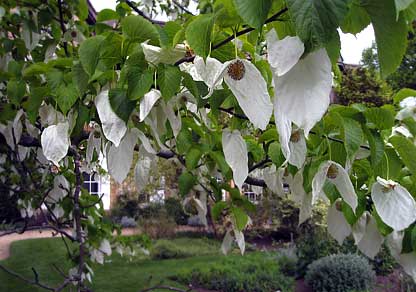
Last year, I saw a Dove Tree (Davidia involucrata) in full bloom in the Oxford Botanical Garden. The tree at Oxford was more than 50 years old. It was brimming with blooms that had button centers anchoring two white bracts that flapped in the wind. From a distance the tree looked like a shimmering white cloud moving in all directions.
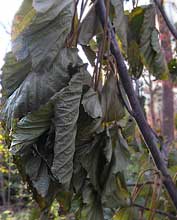 Last year, this botanical garden planted five small dove trees. I doubt that any of them will flower freely in my lifetime, but I’m watching them nonetheless, wishing them good growth. This morning I saw that all of the leaves on one of the trees in the Woodland Garden had shriveled. According to the botanical garden’s Plant Files, Dove Trees are supposed to turn from green to dull pastels or to bright oranges and reds, not just curl up their leaves and die. Something seems wrong here. Next week I’m going to check on the four other new Dove Trees to see what they look like at this time of year.
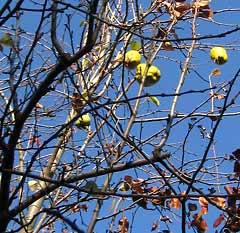 Once a week for more than fifteen years, I’ve taken a walk in this botanical garden. Yet I’m still amazed at what I’ve walked by for years without seeing. One instance: I looked up at the top branches of a tall shrubby-looking tree growing near the persimmon trees in Chinese Garden. There near the top were these bright yellow fruit – as large as mangos – dangling from twig-sized branches. The nearby sign named the tree: Pseudocydonia sinensis. No common name was given. However the botanical garden’s website called it a Chinese Quince. Like regular quinces, the site says the high-hanging fruit I saw could be used in jams in syrups. But the site said it’s not the fruit that makes the Chinese Quince special – it’s the bark of the trunk (which I missed seeing because I only had eyes for fruit). The bark is described as a “flakey, sycamore-like bark [that] exfoliates into an attractive patchwork of gray, green and brown on the fluted trunk of this tree.” Next week, I’ll look at the bark.
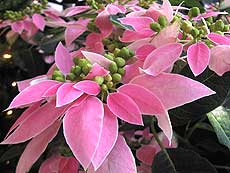 Thanksgiving weekend: The traditional opening of the annual train show at this botanical garden. We stopped in this morning just to do a quick run though before attending the official evening opening reception next week. The theme of this year’s show is “Along the Appalachian Trail.” I’ll see the trails and the trains later. For now though I wanted to see which poinsettias the planners had chosen to display. Attracting a lot of attention (perhaps because it was placed at eye level right at the entrance to the show) was this variety named ‘Eckory’ DOLCE ROSA. It was “invented” (USPP 15,849) by the kings of poinsettias – the Paul Ecke Ranch in Encinitas, California. Dolce Rose has appealing-shaped light pink bracts edged with thin creamy-white borders. And because it’s not Santa-colored red, Ecke says it can be used to “bridge the gaps before and after the traditional holiday season.”
