 |
|
|
" . . . they are maintained and cherished in gardes for the beautie and rarenese of the floures, and sweetness of their smell."
 John Gerard John Gerard |
|
|
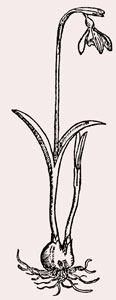
An excerpt on snowdrops from John Gerard's The Herball or General Historie of Plantes published first in 1597. In the Herball the snowdrop was called the "bulbous Violet."
"The bulbous Violet riseth out of the ground, with two small leaves flat and crested, of an overworne greene colour, betweene the which riseth up a small and tender stalke of two hands high; at the top whereof commeth forth of a skinny hood a small white floure of the bignesse of a Violet, compact of six leaves, three bigger, and three lesser, tipped at the points with a light greene; the smaller are fashioned into the vulgar form of an heart, and prettily edged about with greene; the other three leaves are longer, and sharpe pointed. The whole floure hangeth downe his head, by reason of the weake foot-stalk whereon it groweth. The root is small, white and bulbous."Snowdrops are also called "Candlemas Bells." Candlemas is a Christian festival celebrated on February 2. Forty days from Christmas, the festival honors the Virgin Mary and marks the day when Jesus was taken to the temple to be blessed. In the Catholic Church candles are blessed and carried in procession signifying Jesus as light of the world. In medieval times, everyone would light a candle and process outside the church to the nearby cemetery. After the ceremony, people would take the blessed candles home and light in times of fear or trouble. Since the flowers of snowdrop look like bells and they typically bloom about February 2, they came to the called "Candlemas Bells."
|