 |
|
|
“Nature has for the most part, lost her delicate tints in August. She is tanned, hirsute, freckled, like one long exposed to the sun. Her touch is strong and vivid. . . . Mass and intensity take the place of delicacy and furtiveness. The spirit of Nature has grown bold and aggressive; it is rank and coarse; she flaunts her weeds in our faces.”.
 -- "From 'August Days' by John Burroughs -- "From 'August Days' by John Burroughs |
|
|
|
 some clouds: calm: 68º some clouds: calm: 68ºThrough the lens of a snapshot taker like me, the autumn clematis (Clematis vitalba) covering the pergola near the Linnean House looks like a plate of mashed potatoes-all white, with a few lumps. Then again, taken from a distance perhaps even a good photographer would not do much better. Plentiful numbers of small overlapping blossoms don't make good pictures. Still, it's not the flowers that count. It's the scent - powerful, concentrated, reminiscent of honey added to citrus. On a calm morning like today, the scent drops heavily on visitors who pause under the pergola. 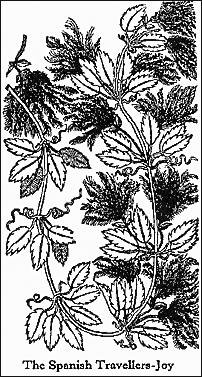 Autumn clematis was dubbed "Traveller's Joy" by the 16th Century botanist, John Gerard for its preference "of decking and adorning the waies and hedges where people travel." After flowering, the vines grow "great tufts of flat seeds, each seed having a fine white plume like a feather fastned to it which maketh in the Winter a goodly shew." Traveller's Joy then takes on another of its names: "Old Man's Beard." The best photograph I've ever seen of "Old Man's Beard" is a black and white fuzzy photo taken by Edna Walling, an Australian garden designer, photographer, and writer. The lighting she used makes the unruly seed tufts look like the second coming or something from The Day of the Triffids. Autumn clematis was dubbed "Traveller's Joy" by the 16th Century botanist, John Gerard for its preference "of decking and adorning the waies and hedges where people travel." After flowering, the vines grow "great tufts of flat seeds, each seed having a fine white plume like a feather fastned to it which maketh in the Winter a goodly shew." Traveller's Joy then takes on another of its names: "Old Man's Beard." The best photograph I've ever seen of "Old Man's Beard" is a black and white fuzzy photo taken by Edna Walling, an Australian garden designer, photographer, and writer. The lighting she used makes the unruly seed tufts look like the second coming or something from The Day of the Triffids.Last week I was going to take a picture of a triangular cluster of pecans on one of the lower branches of a pecan tree shading the Hosta Garden. I knew if I didn't take it then, chances were that by today, the squirrels would have gotten them. I didn't take the picture then, and now they're gone. I remember an exposé article in The St. Louis Post-Dispatch nearly five years ago that dealt with how the garden used to handle squirrels: a sharpshooter would pick them off with a pellet gun before the garden opened. When word leaked out, the garden said it would stop the killing. When asked about the practice by a reporter, the Garden's deputy director at the time was quoted as saying "I hate like hell to have the story out - but it's the truth," he said. "I don't know what else to say. What we'll do in the future, I don't know. We have to figure out an alternative." I guess they're still looking.  fast moving clouds to a hazy blue: breezy to calm: 76º fast moving clouds to a hazy blue: breezy to calm: 76ºChange comes slowly this time of year. Shrubs and trees are still green, but often the fringes of their leaves have started to crisp. Summer flowers are getting leggy, blooming less urgently, intent now on making seeds. A sure sign of times of come: The whine of a leaf blower that a keeper was arcing across a dusting of locust tree leaflets that had collected on the patio of the Garden Café. Last Sunday was the annual sale of the dividings of daylilies from the Jenkins Daylily Garden. I was at a family wedding last weekend, so I missed this once-in-a-year happening. I'd be willing to bet though that crowds were lined up waiting for the doors to open at 9:00 a.m. Offerings are never announced in advance, but it's easy to know what to expect by checking the daylily garden a week or so before the sale. If a daylily clump is expansive, it will not appear at the sale. If however, a clump has just three or four fans, it's a good bet it was separated and will be offered for sale. Even in years when I attend the sale, I rarely buy. I just go to pick up enthusiasm from the fans. For a photographer who had set up his tripod and camera aiming across the lily ponds to the glass panels of the Climatron, the lighting and the composition must have been just what he wanted. Then, as we was about to shoot, a woman dressed all in white walked into “his” landscape. He stopped and waited for her to pass. She didn't. Instead she sat on a bench for a long, leisurely look at water lilies. The photographer paced. When another photographer started taking to him, the frustrated picture-taker started pointing and gesticulating toward the woman. All of this was going on far from the woman in white who just sat, head down. Her focus was on the lily blossoms. I walked on. 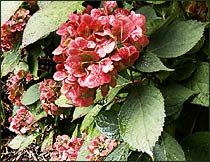 I missed seeing Hydrangea serrata ‘Preziosa’ when it flowered. My National Garden Book tells me the flowers were pink. No matter. They couldn't have been more striking that they are now with their salmon-rust color. The small shrub planted in the full sun of the Victorian Garden is bursting with fists of these jewel-like hues. I missed seeing Hydrangea serrata ‘Preziosa’ when it flowered. My National Garden Book tells me the flowers were pink. No matter. They couldn't have been more striking that they are now with their salmon-rust color. The small shrub planted in the full sun of the Victorian Garden is bursting with fists of these jewel-like hues.The conical tops of the Giant Redwoods look like rocks in a swift mountain stream as they seem to cut the clouds of a fast moving front passing through. So few people are here this morning. We guessed that the end of the school vacation season was to blame. I wonder though if because of the West Nile virus scare, visitors are avoiding the early morning hours when mosquito carriers are most active. 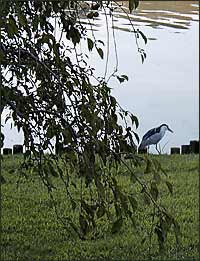 Every month of so, we see a squat black-crowned night-heron on the banks of the lake in the Japanese Garden. Each time we pause, gape, point it out to other visitors, and then take still more pictures of it. Some things never get old. Every month of so, we see a squat black-crowned night-heron on the banks of the lake in the Japanese Garden. Each time we pause, gape, point it out to other visitors, and then take still more pictures of it. Some things never get old.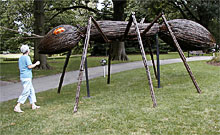 Seeing the whimsical giant bent-wood sculpture of an ant foraging in a grassy plot near the Climatron started me singing the ant verse from the 30’s classic “Never Swat a Fly.” The song begins: “Never swat a fly, He may love another fly.” The verse on ants starts with: “Don't step on an ant in the middle of a plant.” Seeing the whimsical giant bent-wood sculpture of an ant foraging in a grassy plot near the Climatron started me singing the ant verse from the 30’s classic “Never Swat a Fly.” The song begins: “Never swat a fly, He may love another fly.” The verse on ants starts with: “Don't step on an ant in the middle of a plant.” |
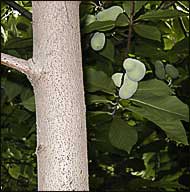 PawPaws are another delicacy for the squirrels and the birds too. I was surprised to see that the pawpaws on the trees in the English Woodland Garden are untouched. They are still quite green, so perhaps the critters are waiting until they begin to turn yellow before moving in. In years past, I've sometimes see a smashed pawpaw on the walks, but until today, I've never seen so many still on the trees.
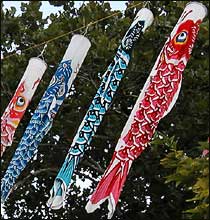 Once a year on the weekend that the Garden hosts the Japanese Festival, koi windsocks are hung high over the lawn on the North side of a lake that is the centerpiece for the Japanese Garden. From a distance the woodsocks look like the wash line of a clown. It isn't until you get closer that the markings of the stylized gills and round eye near the mouth of five-foot long red, green, and blue windsocks become visible. While seeing and watching the windsocks sway is satisfaction enough, I wondered why they were there at all. Since symbolism is so much a part of most things in Japanese Garden, I thought the hanging of tall fish had to some meaning too. Back home on the internet, I learned that in Japan koi windsocks and steamers are traditionally flown by families with boys on May 5th, the day of the annual boy's festival. Carp are respected as a strong, rugged fish because year they swim upstream to spawn. Japanese parents use the swaying windsocks of koi to remind their sons of that strength and determination are needed to become successful.
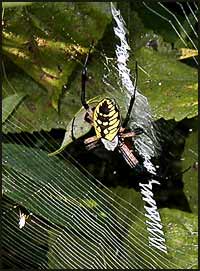 Near the lythrum plant in the perennial garden near the Linnean House, I spotted the glint of the web of a
 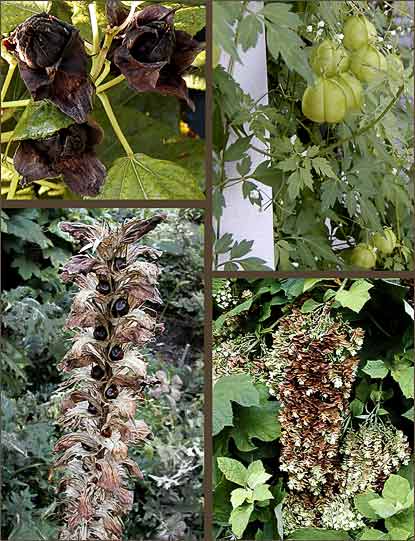 For the next few weeks the seed pods and drying blossoms of summer flowers will be at their peak. Many will last the winter, but now their contours are well-defined and they still have nuances of brown. I look at them and think of a box of Godiva samplers or a tray of country club hors d'oeuvres. The ones above caught my attention this morning: From top left: the exotic-looking seed pods of a saucer hibiscus; the hot air balloon-like puffs hanging from an unfamiliar vine in the Boxwood Garden; the shiny seeds of a Bear's Breech (Acanthus mollus) tucked into the V of each drying flower; and the unevenly aging grape clusters of a 'Snowflake' Oak-Leaf Hydrangea.
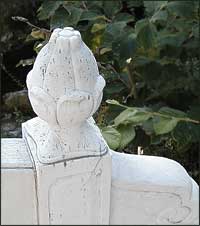 No matter the season, but in summer especially, I like putting my hands around the marble lotus-bud finials that decorate the hump bridge in the Chinese Garden. Their shape and constant coolness invites touching.