 |
|||||||||||||||||||||||||||||||||||||||||||
|
“Flowers fade,
the fruits of summer fade. They have their seasons. So do we.”
|
|||||||||||||||||||||||||||||||||||||||||||

|
 clear: easy breeze: 36ºF clear: easy breeze: 36ºF 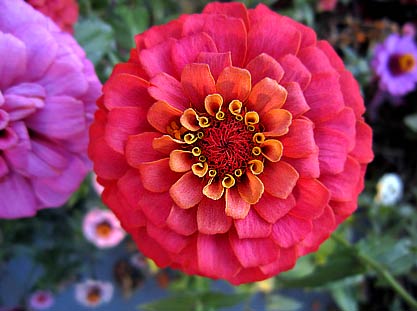 For me, summer’s still here. I’ve got on three layers this morning. I’m wearing earmuffs, gloves, and a scarf, but no matter. Summer ends when the first killing frost hits. And so far, it hasn’t. Begonias and zinnias are still thriving here in this botanical garden. They’re my markers of the season’s end. Like canaries in a coal mine, when they flop over, so does summer. 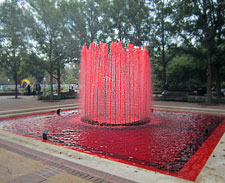 For the past few weeks the fountain in the botanical garden’s entry plaza has been spouting red water. The water jets were meant to cheer the baseball Cardinals all the way to the pennant. Last week lots of visitors dressed in Cardinal Red had their pictures taken in front of the red waters to show their support the team. But this week the waters are clear again, picture takers are few, and the Birds have returned to their roost until next spring. For the past few weeks the fountain in the botanical garden’s entry plaza has been spouting red water. The water jets were meant to cheer the baseball Cardinals all the way to the pennant. Last week lots of visitors dressed in Cardinal Red had their pictures taken in front of the red waters to show their support the team. But this week the waters are clear again, picture takers are few, and the Birds have returned to their roost until next spring.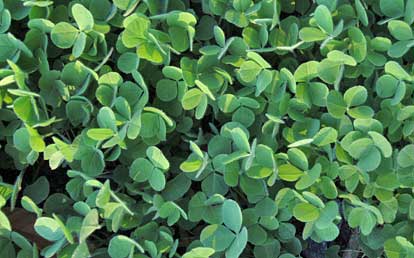 We’ve been watching tiny green seedlings sprouting from the strip of ground along the south wall of the Linnaean glass house. This week the seedlings grew into a swath of vivid green clover. 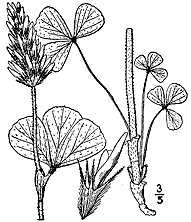 A sign indentifies the planting as Trifolium incarnatum, a species of clover called Crimson Clover because of their plume-like stems of red flowers that develop in late spring. From what I read, Crimson Clover is supposed to able withstand the winter, so I’m looking forward to seeing a band of green all winter long. A sign indentifies the planting as Trifolium incarnatum, a species of clover called Crimson Clover because of their plume-like stems of red flowers that develop in late spring. From what I read, Crimson Clover is supposed to able withstand the winter, so I’m looking forward to seeing a band of green all winter long. This botanical garden is turning ever more toward conservation and sustainability: the new parking lots features porous asphalt surfaces and rain gardens, the barrel vault of the entry center is covered with energy efficient panels, and the rose gardens are turning away from roses that need water and a regimen of chemical sprayings. This morning I noticed that a water fountain that allows visitors to fill their water bottles with chilled tap water had been installed in entry atrium. Even the restrooms are becoming green. Here’s a sign I saw above a urinal in the men’s restroom near the hosta garden. This botanical garden is turning ever more toward conservation and sustainability: the new parking lots features porous asphalt surfaces and rain gardens, the barrel vault of the entry center is covered with energy efficient panels, and the rose gardens are turning away from roses that need water and a regimen of chemical sprayings. This morning I noticed that a water fountain that allows visitors to fill their water bottles with chilled tap water had been installed in entry atrium. Even the restrooms are becoming green. Here’s a sign I saw above a urinal in the men’s restroom near the hosta garden. Planted along the walkway in the Bird Garden I saw this shrub. It’s a Hypericum – St. John’s Wort, but one so different from the scrubby tough looking ones that sprout up along railroad tracks or in dry fields, that I didn’t recognize it. This one is a well-behaved variety named HYPERICUM Hypearls Renu. It has large green leaves that define the flowers and fruit; large, perfectly shaped yellow flowers that refuse to crowd one another; and plenty of round pinkish-colored berries for contrast. From what I read on the web, Hypearls Renu was introduced just a year ago by Green Leaf Plants. It’s one of a series of four plants – all with traditional yellow flowers, but each with different colored berries. So far, there are new plants with cream, red, salmon, and pink berries. 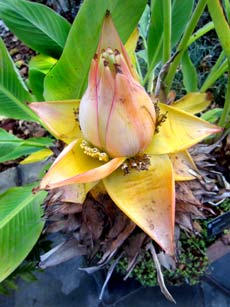 The pot of Chinese Yellow Bananas (Musella lasiocarpa) that has been in the Chinese Garden all summer is gone. Likely it’s going to spend the winter in the botanical garden’s greenhouses that are closed to visitors. Peter Valder, an Australian writer who visited, described, and photographed over 200 gardens in all parts of China, says that this plant is so different from regular bananas that Chinese botanists have given it a genus of its own – Mussella rather that just Musa. This aim of this banana plant isn’t to produce bananas. It’s sole purpose seems to be to produce a large yellow flower on top of a sturdy stem. Valder says that in Yunnan, the Chinese province where the plant is native, the Musella is known as the “golden lotus bursting from the underground.” Once the flower opens it stays in bloom for six to eight months. The pot of Chinese Yellow Bananas (Musella lasiocarpa) that has been in the Chinese Garden all summer is gone. Likely it’s going to spend the winter in the botanical garden’s greenhouses that are closed to visitors. Peter Valder, an Australian writer who visited, described, and photographed over 200 gardens in all parts of China, says that this plant is so different from regular bananas that Chinese botanists have given it a genus of its own – Mussella rather that just Musa. This aim of this banana plant isn’t to produce bananas. It’s sole purpose seems to be to produce a large yellow flower on top of a sturdy stem. Valder says that in Yunnan, the Chinese province where the plant is native, the Musella is known as the “golden lotus bursting from the underground.” Once the flower opens it stays in bloom for six to eight months.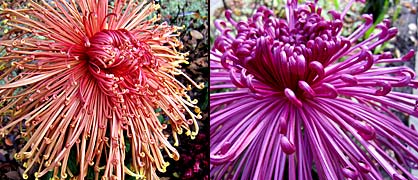 This time of year, chrysanthemums are everywhere. Pots and bushels of tightly packed mounds of flowers. Their impact comes from their quantity – many small flowers add up to a big splashs of color. In two places in this botanical garden though – the Japanese Garden and the Chinese Garden – chrysanthemums stand out as individuals. Both of the gardens have about a dozen tall potted plants supported by stakes, each producing just one flower. Those single flowers are inches across though. And each flower has some unusual arrangement or shape of petals that makes me want to stop, look more closely, and wonder how the growers were able to do what they did.  clouds: light breeze: 59ºF clouds: light breeze: 59ºF 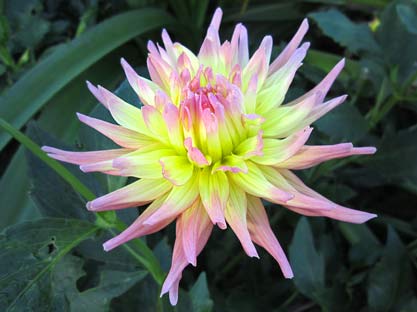 I miss seeing the tropical water lilies this year. The two dueling porcelain-china dragons that were the centerpiece of the botanical garden’s Chinese Lantern Festival spanned the three ponds where the lilies usually spend their summers. The festival has ended and the ponds have been refilled, but it’s too late in the season to expect the lilies to return. This morning though I saw this late summer dahlia blooming near the ponds. It’s called ‘Star Elite.’ Not a tropical water lily, but a decent understudy. 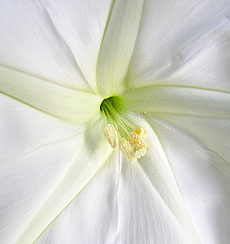 The moonflower vines (Ipomoea albare) growing on the pergola at the edge of the scented garden are in full bloom this morning. It’s cool. It’s cloudy too, so these flowers of the night have stayed open a little longer. I’m ever hopeful that their sweet scent will last too, but it doesn’t. The moonflower vines (Ipomoea albare) growing on the pergola at the edge of the scented garden are in full bloom this morning. It’s cool. It’s cloudy too, so these flowers of the night have stayed open a little longer. I’m ever hopeful that their sweet scent will last too, but it doesn’t.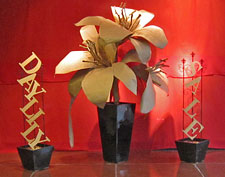 Sometime during the week, many of the daylilies growing in the daylily garden were dug, separated, and replanted. I thought that because of the prolonged summer heat and lack of rain that the daylilies wouldn’t be hassled this year. I was wrong. This morning the fans that weren’t replanted are being sold in the display hall. Crowds were very thin this year; tables of fans that in previous years spread the length of the hall were shorter by a third. Daylilies have seen better years. Sometime during the week, many of the daylilies growing in the daylily garden were dug, separated, and replanted. I thought that because of the prolonged summer heat and lack of rain that the daylilies wouldn’t be hassled this year. I was wrong. This morning the fans that weren’t replanted are being sold in the display hall. Crowds were very thin this year; tables of fans that in previous years spread the length of the hall were shorter by a third. Daylilies have seen better years.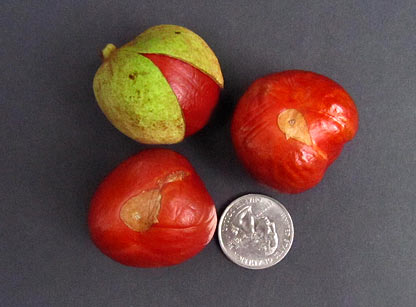 Bottlebrush buckeyes (Aesculus parviflora) shrubs: in the botanical garden there’s a brilliant planting of them that flowers in July on both sides of a walk south of the Climatron. After bottlebrushes flowered, I thought there was nothing left to see. But this morning I found that just like the big buckeye trees, these smaller shrubs also produce a crop of buckeyes.  The seeds are light, leather colored and the eyes are smaller than the buckeyes that drop from trees. But surprisingly, they’re still about the same size as the tree buckeyes because they’re encased by a very thin outer shell instead of the thick hull needed to protect the buckeyes that fall from trees. The seeds are light, leather colored and the eyes are smaller than the buckeyes that drop from trees. But surprisingly, they’re still about the same size as the tree buckeyes because they’re encased by a very thin outer shell instead of the thick hull needed to protect the buckeyes that fall from trees.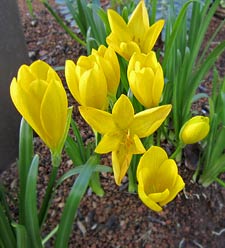 These bulbs are called ‘Autumn daffodils’ (Sternbergia sicula) – a good name for a flower that has strap-like leaves and a color that’s a dead-ringer for early spring daffodils. Here in this botanical garden they start to bloom after a few soaking rains and when the temperatures cool a bit. They’re all growing in well-drained, porous rocky ground. Web sources discuss cultivation agree saying that Autumn daffodils need sunny dry sites with sandy or pebbly soil to thrive.
 drizzle / heavy downpours: light breeze: 76ºF drizzle / heavy downpours: light breeze: 76ºF 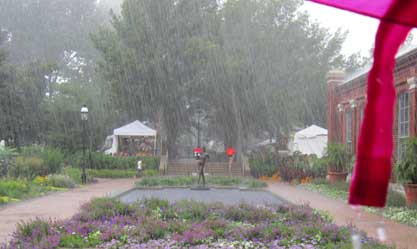 The botanical garden got some much needed rain yesterday and again today. What once was hurricane Isaac is spinning around here and seems slow to move on. This morning the Garden looks better than it has for months. It’s as though the trees, shrubs, and flowers have received a transfusion of fluids far more potent than Garden’s extensive system of sprinklers could ever supply. 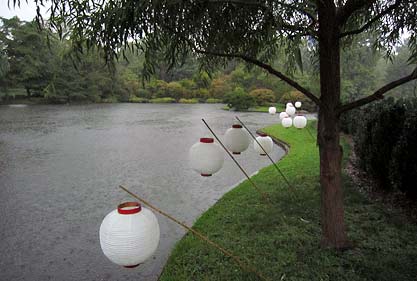 Likely because of the rain, the crowds at the annual Japanese Festival that begins today are far lighter than we expected. Participants and Garden staff outnumbered the visitors while we were there. Close to noon, I stopped at a tent to get some egg rolls, walked up to the counter and ordered. Last year, at about this time I had to wait in a long line to be served. The three-day Festival held over the Labor Day weekend usually draws about 35,000 thousand people, so if and when the weather clears, the visitors will start to arrive. They both are new to me. Sprouting from the edge of the hardwood mulch that covers the display gardens outside the Linnaean glasshouse I saw these colonies of gray and orange funguses. Each fungus is tiny – a quarter of an inch across, tops. But there are hundreds of them. I looked a picture of the colony that I took and then went to Google images to find a match. 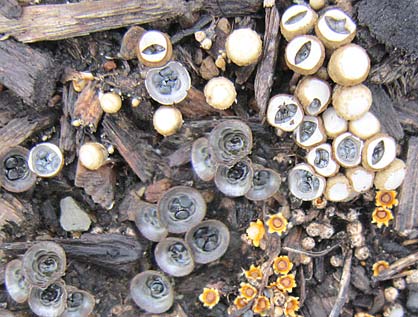 The gray ones are known as ‘Artillery,’ ‘Shotgun,’ or ‘Bird Nest’ fungus. Imagining eggs in a bird’s nest is easy. In some of the pleated cups there are several oval discs that look as though they could be eggs. The fact sheet from Cornell says they’re spore packets. When the cups get filled with water the spore packets shoot out, sometimes as far as 20 feet. The packets are sticky and they’re light seeking. So if the artillery fungus is growing in the mulch around your house, it’s likely to find your vinyl siding or your white car an appealing target. While the spore packets are maturing they’re covered with a white covering that opens like an eye when the spores are ready. Here’s a remarkable video of spore packets popping when touched by raindrops. The orange funguses are even smaller than the grays. They’re called ‘Cannonball’ funguses (Sphaerobolus stellatus). Like the ‘Bird Nest’ funguses, they shoot their spores toward light-colored targets. The ‘Cannonball’ develops one yolk-colored spore packet that puffs up like a balloon and then fires off with a pop eaving its star-shaped launcher behind. Here’s a video of everything but the launch. 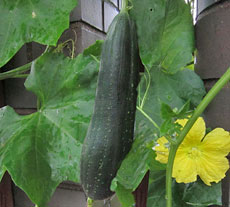 There was no sign identifying this vine wildly flowering and setting on long fruit that looked like zucchini on an archway in the Kemper Garden. Another visitor noticed our interest in the vine and said that he thought it was might be luffa gourd. He said he tried to raise them, but hadn’t had much luck. He never got it to flower, much less set fruit, but he said he recognized it by its distinctive grape-shaped leaves. Checked the web. He was right – flowers and fruit match. As the season wears on the gourds are supposed to get lighter as they begin to dry up inside. Then they turn brown and develop a hard shell. After the first frost, they’re supposed to be picked. Then they go through more steps than I’d care to do to turn them into sponges that can sell for a couple of bucks.
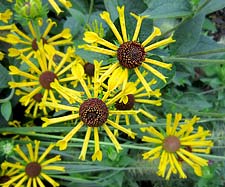 With the change in the weather came this: a late season sun-yellow coneflower with daisy-like petals tipped with curled quills. Its sign identifies it as a Henry Eilers Sweet Coneflower (Rudbeckia subtomentosa ‘Henry Eilers’) It’s a particular standout on an overcast, rainy day like today. Because breeders are continually developing new coneflowers, I thought this one was a newly engineered variety. Surprise: it’s a native wildflower first found not far from this botanical garden. Henry Eilers, a horticulturist and retired nurseryman, found it growing in a strip of undisturbed prairieland along a railroad right-of-way about 50 miles from here. The sweetness part of its name comes from the leaves, not the scent. Rub them gently and they’re supposed release a sweet vanilla-like scent. With the change in the weather came this: a late season sun-yellow coneflower with daisy-like petals tipped with curled quills. Its sign identifies it as a Henry Eilers Sweet Coneflower (Rudbeckia subtomentosa ‘Henry Eilers’) It’s a particular standout on an overcast, rainy day like today. Because breeders are continually developing new coneflowers, I thought this one was a newly engineered variety. Surprise: it’s a native wildflower first found not far from this botanical garden. Henry Eilers, a horticulturist and retired nurseryman, found it growing in a strip of undisturbed prairieland along a railroad right-of-way about 50 miles from here. The sweetness part of its name comes from the leaves, not the scent. Rub them gently and they’re supposed release a sweet vanilla-like scent.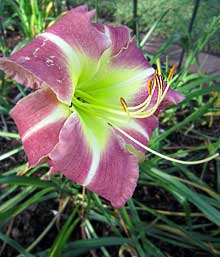 August has traditionally been the month of daylily sales at this botanical garden’s annual daylily sale. The daylilies offered for sale come of the Garden’s collection. Clumps of plants that have grown too large are dug, divided, separated, and replanted. The smaller clumps and single divisions are packaged in net bags, labeled, and then priced for the sale. This year though there was no sale. The keepers of the Garden must have decided that the prolonged summer heat and drought was enough without the added stress of dividing and replanting. With few exceptions, the daylily season is over. Even the late bloomers have finished except for this one. Most years, it’s the season’s last. It’s called ‘After Awhile Crocodile.’ Wonder if there’s late bloomer called ‘The Fat Lady Is Now Singing?’ August has traditionally been the month of daylily sales at this botanical garden’s annual daylily sale. The daylilies offered for sale come of the Garden’s collection. Clumps of plants that have grown too large are dug, divided, separated, and replanted. The smaller clumps and single divisions are packaged in net bags, labeled, and then priced for the sale. This year though there was no sale. The keepers of the Garden must have decided that the prolonged summer heat and drought was enough without the added stress of dividing and replanting. With few exceptions, the daylily season is over. Even the late bloomers have finished except for this one. Most years, it’s the season’s last. It’s called ‘After Awhile Crocodile.’ Wonder if there’s late bloomer called ‘The Fat Lady Is Now Singing?’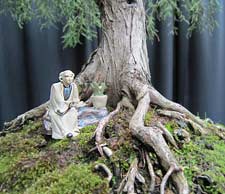 Today’s the day of the annual bonsai show. The judging was going on while I was there, so I didn’t get to see where the ribbons landed. Here’s a picture of a 25-year old false cypress that the owner has been training for twenty years – guided no doubt by Yoda’s philosophy of do or do not. There is no try. Today’s the day of the annual bonsai show. The judging was going on while I was there, so I didn’t get to see where the ribbons landed. Here’s a picture of a 25-year old false cypress that the owner has been training for twenty years – guided no doubt by Yoda’s philosophy of do or do not. There is no try. |
||||||||||||||||||||||||||||||||||||||||||
|
+ Click to Subscribe
 | E-Mail me | E-Mail me |
|||||||||||||||||||||||||||||||||||||||||||