“I was reconciled to the change in the weather. I've accomodated my style.
I'm geared up for early sunsets and long, dark evenings,
and to the interior journeys of winter . . .
I'm turning my attention back to. . . the muted light of this side of time.” -- Lisa Thompson in "Field Notes"
The doors to the Garden open into a plaza. The attention-getter in warmer seasons is a fountain. Nozzles arranged in a circle spray jets of water a dozen feet up. The fountain and the catch basin around it have been roped off for the winter. The focus now should shift to four expansive clumps of winterberries that anchor each corner of the plaza. They are 'Red Sprite' winterberries - a variety that teems with berries of the most vibrant red. For months we watched the shrubs as they formed their berries. Green first, then tinges of orange. Finally they began to redden.
This morning there was nothing. Every berry on every shrub was gone. Birds? Squirrels? Whatever it was, there will be nothing to beckon visitors to come outside. Nothing to make the background for a souvenir picture.
Today the pansies were playing dead. Wilted and frostbitten, they looked forlorn. I knew they would recover gradually as the sun got higher. No surprise there: I ignored them. On the other hand, petunias blooming after a hard freeze call for a second look.
In the plots of the Victorian Garden I spotted some trailing petunias called Surfina 'Pink Vein' that were growing and blooming as if it were July. Neither foliage nor blooms made any concession to the season. I checked the web for notes about the hardiness of Surfina. There was nothing. I did learn from the University of Arkansas Extension Service that the Surfina brand is a creation of big-business horticulture. It was developed in 1987 by Suntory Ltd., a Japanese conglomerate that makes hard liquor and pharmaceuticals and is also involved in the restaurant business, sports enterprises, music, movies, publishing, plant breeding, and resort development. Proven Winners Inc., a consortium of European, Asia, and American firms that specializes in selling new plants to the nursery trade, is in charge of marketing the petunia. Bear Creek Corporation, whose brands include Harry and David and Jackson & Perkins, grows the petunias under the Proven Winners label. Plants then are sold at retail in 4" pots at premium prices. Because Surfina petunias don't form seeds, the market renews itself each year. All of this is so far, so far, from grandma's petunia patch sown from seed and renewed each year by nature.
The stems of the lotus in the Japanese Garden are broken and bent. The intense blue of sky color on the lake around the spent twigs makes it hard to know a real shape from a reflected one. Like a kaleidoscope, real and reflected join to form the letters of some secret alphabet.
filtered sun: light breeze: 59º
If I were in charge here, I'd be worried. The hard freeze that will end it all hasn't happened yet so much of pulling, pruning, and mulching has yet to be done. The freeze is due to arrive within the next three days. After that the cleanup of wasted foliage will begin. By next week this will be a cleaner, sparer, and far less colorful place.
My timing was perfect this morning. As I arrived at the entrance to the Japanese Garden a Japanese maple tree had begun to drop all of its leaves. I've seen this tree in other years. When it judges the time is right, it drops all of its leaves within a few hours. The freshly fallen leaves added vivid color contrasts to the green and yellow shrubs inside its drip line. As I stepped under the tree, a scattering of leaves landed on my cap and shoulders. It was like being in a butterfly house with exotic butterflies flying around, some occasionally pausing to rest on me.
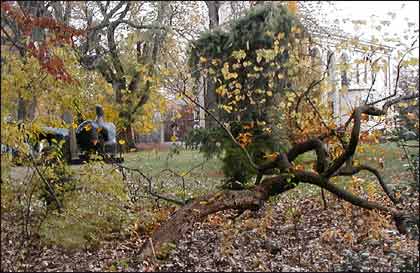
By walking slowly and stopping to look back, I sometimes happen on unexpected sights. In the English Woodland Garden, I looked back at a fallen Red Bud tree. Its branches were touching the ground, but it was still firmly rooted. Usually such trees would be cut and removed. But as I looked beyond the tree I saw why the tree had to stay. Just beyond the tree was the Henry Moore sculpture of a reclining figure. A striking combination -- two reclining shapes, each with twists and tunnels: one alive and shifting, the other solid and immovable.
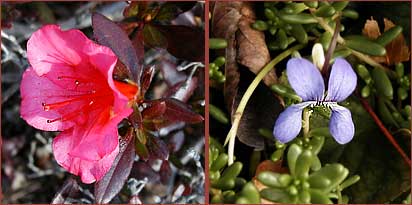
Strawberries in December. Peaches in February. I may not want to buy these out-of-season fruits, but I always look at them in amazement. Same with flowers. Out-of-season, they are never as plentiful or quite so natural looking, but they amaze just by being there. Today I spotted a single violet and a smattering of rose azalea flowers on a shrub whose leaves had already bronzed.
For weeks now an Umbrella Plant (Darmera peltata) has been blooming in a shady, moist spot in the English Woodland Garden. The nearby sign says it's a California native, but it thrives here in a sheltered location. The umbrels of lavender star-shaped flowers are supported by a merlot-red stock -a flare for style we are not used to here in the Midwest. A quick web search says the plant is also called Indian Rhubarb because some say its fleshy leafstalks in spring may be peeled and eaten raw or put into a salad. Maybe it's a California thing.
low clouds: slight breeze: 43º
We could see them from the walk. Tulip bulbs dotted the ground on a lobe of a large curved bed in the Samuels Bulb Garden. The bulbs had been spotted for planting, but left unplanted. We thought of squirrels looking for winter meals. We thought of visitors who had yet to shop for spring. We wondered how many bulbs would be left when the keepers of the Garden returned on Monday morning to finish the job. We wondered why they started, then stopped, putting the springtime show in jeopardy.
The names of the tulips slated for planting were hastily printed on yellow plastic markers stuck in the ground. Seeing the bulbs and the markers made me feel as though I was getting a sneak preview of April. The markers directed that two varieties of tulips be interplanted: 'Pinocchio,' a short, stocky, early Greigii tulip that is an eye-assaulting red laced with white, and 'Color Spectacle,' a midseason variety timed to bloom after 'Pinocchio' fades. 'Color Spectacle' throws out five or more blooms of bright yellow flowers with blazes of red. I couldn't wait until spring so I checked some catalogs of tulip sellers and digitally forced a couple of bulbs to bloom in November.
I went back to the Chinese Garden to look at the persimmons I saw a couple of weeks ago. Most of the fruit is still there, but now they hang on a bare branch against a background of bare branches. They look like warm additions to a chilly Jackson Pollock painting.
If I'm not careful, I'm going to start to learn to identify birds. I know when I've seen a bird before, and I know when I spot a bird that I've never seen before. But, that's where my knowing stops. We saw this gray bird with a bad toupee taking a puddle bath in Chinese Garden. For its own reasons it didn't like bathing on bare paving stones, so it found some ginkgo leaves and used them to line the pavement.
Too often I see the remains of flowers that have bloomed without me. I see dried remains and wonder what I missed. At the edge of the Butterfly Garden a stand of Wild Petunia (Ruellia humilis) once bloomed. It's long dead there, but it blooms in Edgar Denison's book of Missouri Wildflowers. He says its "petunia-like" because like a petunia the flowers have five billowy lobes and usually come in that old-fashioned petunia lavender. There the similarity stops. Their botanical lineage isn't even close. Still I wished I could have seen them bloom so I could have compared these wild lookalikes to their domesticated namesakes.
It's surprising how some of the flowers of summer end when the season does and others get a second wind just when the cold takes hold. The Cobbitty Daisies (Argyranthemum frutescens) in the Lehmann Rose Garden are thriving just now. Their lemon-yellow color glows on a grubby morning like this one. The newsletter of a nursery near me says that Cobbitty Daisies came from Australia. Besides being good-looking, the nursery claims that they are mildew resistant, have no known problems with pests and diseases, and are "long lasting on the stem and in a vase." They go on to say that last year the Cobbittys bloomed in their gardens from spring through December. I'm anxious to see how winter will treat the ones in the Garden and whether they will recover to bloom next spring.
cloudy: windy: 35º
Until this morning, I felt as though I was an observer of fall. It changed trees and made flowers leggy, but I was watching dispassionately, still dressed in a tee shirt and light-colored slacks. Today, I become a part of the new season. I tore the dry-cleaner's plastic from my quilted winter-coat and rummaged through the basket of winter clothes in the back of the closet to find my gloves and stocking cap. I wasn't overdressed. The few other visitors walking this morning were dressed as I was. Some even wore scarves and hoods. The ticket seller at the entrance said encouragingly that the weather wasn't so bad and that we'd get used to it. Taking up her tune, I replied. "By January, a morning like this will feel warm."
The color had left all of the impatiens planted around the houses where I live. Since the Garden is just six miles east of where I live, I expected to see the same there. I didn't. Closed in by the city, the impatiens growing in the neighborhoods outside the Garden were still in pastels. Inside the Garden too the temperature never lowered enough to bite even the tender coleus, begonia, canna, or cleome. The impatiens we ordinary folk plant and nurseries sell by the millions rarely get much play in the Garden. It's like my mom used to say when we went out to eat, "Why would I order meatloaf? I can get that at home."
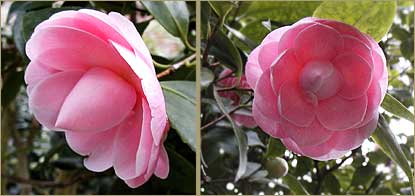
After the year-end festivities, the Garden will begin calling attention to the Linnean greenhouse where its collection of camellia grows. More flowers open then, but some of the trees have been flowering unnoticed for at least a month. In full bloom, a camellia blossom looks full and rounded like a peony or carnation. Whatever form the bloom might have before it opens fully is masked by the frothy petals heaped in the middle.
This morning I looked at some blossoms just before they were filled in. The petals that will complete the job are tightly wrapped in a phallic-shaped capsule at the center. Around the capsule are concentric circles of petals. The petals in each succeeding row are offset from the ones just ahead of them like seats in a theater. Camellias have always dazzled me with their exuberance. Now I have seen their elegance.
Autumn has been slow in coming. Here and there a tree or shrub surges into color. But the season hasn't been choreographed into an everybody-on-stage showstopper. That's why the coordinated colors on the walk toward Shaw's house stood out: yellow contributed by a yellow wood tree; orange-yellows added by a pair of old sassafras trees; and finally the accents of billows of red sumacs along the ground.
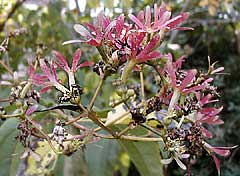
A pair of cardinals was clearing a Seven-Sons shrub (Heptacodium miconioides) of its fat berries. The round berries are at the base of its maroon, star-shaped sepals. The birds go right for the berry leaving the star shape to dangle at the end of their beaks.
I first noticed the Seven-Sons shrub in late September when it was in flower. As promised, when the white flowers faded, the sepals grew longer and turned an azalia-like orchid color. The effect was like a second blooming. The berries also were supposed to change from green to orchid too, but birds being birds, you know.
Balanced on one-foot on a stepping stone leading from the Plum Arbor to the lake in the Japanese Garden I saw a Great-Blue Heron -- my first-ever sighting in the Garden. Last August I saw a squat, black-crowned night heron, but never a bird as large as this. The book of "Birds in Garden" that I looked at in the gift shop, called such a sighting "unusual" - a step down from "rare."
Even from a distance the bird looked as tall as a penguin. I was tempted to get closer for a better look and a picture to convince the skeptical, but decided just to look hoping the bird would extend its neck a classic s-shape. Instead it flew. I watched thinking back to the first time I took off in a 747.
My picture of the Great Blue leaves much to faith and imagination. Audubon does better.
Everyone has a favorite hosta. I read that the streaked ones now are in favor. And, growers are still seeking for what my hosta grower friend calls the "Holy Grail" -- the red hosta. My favorite just now is a hosta called 'Gypsy Rose' planted at the lower entrance to the Kemper Garden Center. It's a "sport," a mutation, of a hosta called (you guessed it) 'Striptease.' 'Gypsy Rose' has an almost unnoticed white outline that traces the edge of its leaves. That same white line does it best to separate a gold insert that runs along the central vein from the deep, glossy green of the leaves. If the white lines in the leaves were uninterrupted and thinner, this beauty would be rendered in plastic and sold at Frank's Nursery and Crafts.
rain: calm: 52º
Each year at this time I am awed by the tousled golden tresses of a pair of ginko trees planted as sentinels at the original entrance to the Garden. Today the leaves on one of trees have turned, almost as though it was expecting us. Next week the path beneath the tree will be paved with yellow, but today the leaves cling tightly to branches that escape from the tree in graceful directions. The face of the statue of Orpheus in the reflecting basin near the tree turns away from the spectacle. He seems to have taken to heart the warning of the gods of the underworld not to look back at beauty.
Burning bushes (Euonymus alatus) are a staple of every nursery and big-box store. They sell well because at this time of year they never fail to turn a flamboyant shade of red. They are like neon signs calling attention to whatever they border. A nearby supermarket uses the shrubs to ring its parking lot. The Garden uses them like runway lights to edge the road leading up to the entrance.
More than the group plantings, I was interested in a single euonymus growing in the Garden Knolls. Before I saw this specimen, I thought that all euonymus were shrubs. This one was a fair-sized tree. The marker beneath confirmed that it was a Winged Euonymus (Euonymus alatus), just like the shrubs. When in doubt about woody things, I check with Michael A. Dirr whose Manual of Woody Landscape Plants; Their Identification, Ornamental Characteristics, Culture, Propagation and Uses tells all very, very well. Dirr says that if left alone the shrub "transmogrifies itself into a handsome, small, low branched tree." While entranced by the euonymous as trees, he dislikes them as shrubs and scolds those who prefer "butchering the plant into 'architectural' meatballs."
Putting aside the tree versus shrub debate, I was curious about the name "Winged Euonymous." Again Dirr explains that the wings for which the tree/shrub is named are outcroppings of soft cork-like spines that run down the branches. The wings "form small valleys where snow and ice collect and highlight branches in the winter landscape." Interesting, but not what I was looking at today. My attention was on their red, raisin-sized berries. I had to get close to the tree to see them because many of them prefer to hide under leaves. The berries pop out of scissors-like reddish capsules. I saw some berries that looked as though they were about to be eaten by the jawed capsule creature. I saw others that could have been spaceships powered by wing-like capsules catching solar power. On a damp November morning, I take fantasy where I find it.
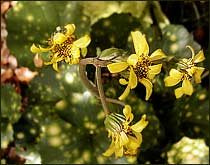
Since early summer I've been intrigued by a plant without a marker. It's flourishing in deep shade under a magnolia tree in the Heckmann bulb garden. Each week I return, hoping that the keepers of the Garden will give it an identity. The plant has glossy, deep green heart-shaped leaves that are dotted with randomly placed yellow spots of assorted sizes. The spots set against the deep green leaves make the plant shimmer like an op-art painting. Today, with help from the plant and floral database in the Garden shop, we figured out what it is. The plant helped us a lot too by finally flowering. The flowers have button centers and are surrounded by unruly yellow petals. We thought "Aster family." Putting that with the shape of the leaves and the color of the flowers, we knew it had to be some kind of Farfugium. The floral database confirmed our hunch and did the final identification for us. The plant is a member of the Asteraceae family. Its formal name is Farfugium japonica 'Aureo-maculata.' Its common name: leopard plant. I like that.
My mother recently sold a house that her family members had lived in for more than eighty years. Before them, other families had lived there since the house was built in the late 1800's. As I was going through things to help her move, I found a wooden cigar box with a mortise lock and a pair of bronze doorknobs inside. The doorknobs were embossed with an ornate floral design work radiating from a four-petaled flower at the center. The embossed lettering stamped on the mortise lock told me the set was made by the Sargent Company and patented in 1897. I think the knobs and lock were removed by my grandfather and replaced by a set that he felt worked better or were more in tune with modern taste.
Seeing those knobs set me thinking about the doorknobs on the door to Henry Shaw's Mausoleum on the Garden grounds. Shaw died in 1889, so I thought his doorknobs might be as ornate as the ones I found in my family's house. They were. The doorknobs had an eight-pointed compass design in the center with arrowheads pointing to eight floral designs reminiscence of Maltese crosses. I don't know whether the doorknobs were a standard Victorian design or whether George Barnett, mausoleum designer and long-time friend of Henry Shaw, had them specially crafted to signify something more than decoration.
dense clouds with some rain: breezy: 58º
No season-ending frost yet. Forecasts of the jetstream cupping just South of us later this week may finally bring an end to summer. For now though, the Garden is a curious mix of seasons. Some plots have moved through their progression of summer plantings to mums and now finally to the pansies that will stay put until late spring. Other plots, further away from the display gardens where most visitors wander, still sport the plantings of high summer: flame-red salvia, petunias, and marigolds. All of the exotic tropical waterlilies have been lifted and the potted palms have been taken indoors. But, pots of staghorn ferns still hang from a crabapple tree, and the banana trees and giant taros still remain exposed. The rose gardens look almost as good as they did at their Rose Evening opening in May. Now though, visitors dress in hooded sweatshirts as they lean over to sniff and touch.
In summer the walks and vistas that front the Linnean House were bordered with richly colored flowers and foliage that billowed into soft curves. With most of the color and shapes stripped away, the walks now have the formal austere look of a sheet of graph paper.
Birds are in a hurry about something this morning. They fly squawking, in pairs, at reckless speeds. A pair flew so close to me that I felt the wind of their wings. Another pair, flying side by side, was headed right toward my torso before they suddenly separated and then rejoined behind me as though I was a rock in a current.
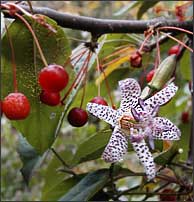
Toad Lilies and crabapples: an unusual pair. I spotted this tall Toad Lily bloom reaching up into the lower branches of a crabapple loaded with ripe fruit.
Just off the walk leading to the daylily garden, I noticed a small tree planted near the Garden wall. Threaded along the branches between the leaves were fist-sized clusters of ripe black berries. A fall feast for squirrel and birds I thought until I looked at the ground below the tree. There were few remnants of half-eaten fruit or dye-stained grass. The tree was a Common Buckthorn (Rhamnus cathartica). Back at my computer, I learned why the tree was being ignored. Birds don't like the fruit. They will ignore it unless there is nothing else left to eat because the berries give them a bad case of diarrhea. A Minnesota nursery alert says that if Buckthorn berries are the only source food for birds, the birds will eat them, excrete them, eat more of them, excrete again, repeatedly until they become dehydrated and weak and possibly die.
I learned too that like many other shrubs, only the female Buckthorn produces berries. No male nearby, no noxious berries. Now I understand why there is a nearby stump labeled Buckthorn Tree. The label doesn't identify the felled tree's gender, but I feel sure that next October, the tree I spotted will bear no fruit.
Things gone: The leaves of the peonies along the curved walk in the Japanese Garden have been cut to the ground. Evident already are the salmon-colored pips that will make splendor next year. My mother-in-law, who lives in a part of the country where rain is less generous, never cuts her peonies until February. She says that the foliage is needed to catch every drop of moisture from winter snows.
Gone too is the wrought-iron fence around Shaw's mausoleum garden. The uprights are still there so I suspect the rusted fence is being replicated, not done away with. Without the fence, Shaw's resting place looks exposed, common. In his will he declared that he was to be the only body buried on these grounds. I hope the new fence returns soon. Shaw deserves sanctuary.
The experimental, demonstration plots in the Kemper Garden are filled with pansies - 60 different varieties-- five plots with a dozen each. Among all these, none was the media darling: the Icicle Pansy. Who would have imaged that a pansy would be featured in full page ads in Better Homes & Gardens or that a pansy would take center-stage on television commercials, or that a pansy would have its own web-site complete with testimonials from satisfied customers? A nursery in Ontario about 100 miles due west of Buffalo owns the name and sells the plants. They guarantee that their fall-planted pansies will winterover to bloom again in the spring. If they don't, and you swear you have followed all the proper care instructions, then you can send them your name and address along with your sales receipt and, of course, the plant tags from your pansy six-packs and get up to $15 back. I saw these pansies at a nearby nursery about a month ago - thousands of them. Last week when I was primed to buy at double the price of ordinary pansies, they were sold out. Is it hype or are Icicles the real thing? Too bad the Garden pansy testing plots aren't testing them.
Persimmons (Diospyros kaki) are beautiful objects. They hang like clusters of sculpted sunny acorns. I have never tasted the fruit that the National Garden book describes as tasting "something like a date" with the flavor of a "high quality prune" or that a journal writer living in rural Japan says has the "juicy sweetness you lose the taste for if you're jaded by city sweets." But, seeing them today hanging from a tree outside the wall of the Chinese Garden, I'm convinced they ought to stay on their trees and to be marveled at but never sampled.

 -- Lisa Thompson in "Field Notes"
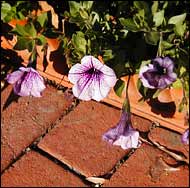 In the plots of the Victorian Garden I spotted some trailing petunias called Surfina 'Pink Vein' that were growing and blooming as if it were July. Neither foliage nor blooms made any concession to the season. I checked the web for notes about the hardiness of Surfina. There was nothing. I did learn from the University of Arkansas Extension Service that the Surfina brand is a creation of big-business horticulture. It was developed in 1987 by Suntory Ltd., a Japanese conglomerate that makes hard liquor and pharmaceuticals and is also involved in the restaurant business, sports enterprises, music, movies, publishing, plant breeding, and resort development. Proven Winners Inc., a consortium of European, Asia, and American firms that specializes in selling new plants to the nursery trade, is in charge of marketing the petunia. Bear Creek Corporation, whose brands include Harry and David and Jackson & Perkins, grows the petunias under the Proven Winners label. Plants then are sold at retail in 4" pots at premium prices. Because Surfina petunias don't form seeds, the market renews itself each year. All of this is so far, so far, from grandma's petunia patch sown from seed and renewed each year by nature.
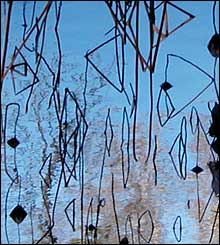 The stems of the lotus in the Japanese Garden are broken and bent. The intense blue of sky color on the lake around the spent twigs makes it hard to know a real shape from a reflected one. Like a kaleidoscope, real and reflected join to form the letters of some secret alphabet.
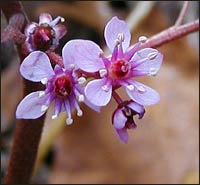 For weeks now an Umbrella Plant (Darmera peltata) has been blooming in a shady, moist spot in the English Woodland Garden. The nearby sign says it's a California native, but it thrives here in a sheltered location. The umbrels of lavender star-shaped flowers are supported by a merlot-red stock -a flare for style we are not used to here in the Midwest. A quick web search says the plant is also called Indian Rhubarb because some say its fleshy leafstalks in spring may be peeled and eaten raw or put into a salad. Maybe it's a California thing.
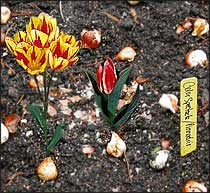 The names of the tulips slated for planting were hastily printed on yellow plastic markers stuck in the ground. Seeing the bulbs and the markers made me feel as though I was getting a sneak preview of April. The markers directed that two varieties of tulips be interplanted: 'Pinocchio,' a short, stocky, early Greigii tulip that is an eye-assaulting red laced with white, and 'Color Spectacle,' a midseason variety timed to bloom after 'Pinocchio' fades. 'Color Spectacle' throws out five or more blooms of bright yellow flowers with blazes of red. I couldn't wait until spring so I checked some catalogs of tulip sellers and digitally forced a couple of bulbs to bloom in November.
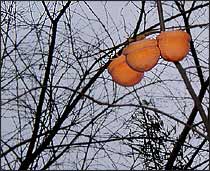 I went back to the Chinese Garden to look at the persimmons I saw a couple of weeks ago. Most of the fruit is still there, but now they hang on a bare branch against a background of bare branches. They look like warm additions to a chilly Jackson Pollock painting.
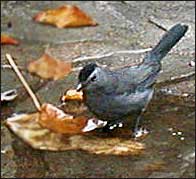 If I'm not careful, I'm going to start to learn to identify birds. I know when I've seen a bird before, and I know when I spot a bird that I've never seen before. But, that's where my knowing stops. We saw this gray bird with a bad toupee taking a puddle bath in Chinese Garden. For its own reasons it didn't like bathing on bare paving stones, so it found some ginkgo leaves and used them to line the pavement.
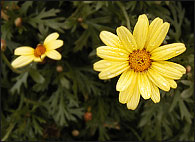 It's surprising how some of the flowers of summer end when the season does and others get a second wind just when the cold takes hold. The Cobbitty Daisies (Argyranthemum frutescens) in the Lehmann Rose Garden are thriving just now. Their lemon-yellow color glows on a grubby morning like this one. The newsletter of a nursery near me says that Cobbitty Daisies came from Australia. Besides being good-looking, the nursery claims that they are mildew resistant, have no known problems with pests and diseases, and are "long lasting on the stem and in a vase." They go on to say that last year the Cobbittys bloomed in their gardens from spring through December. I'm anxious to see how winter will treat the ones in the Garden and whether they will recover to bloom next spring.
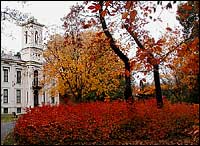 Autumn has been slow in coming. Here and there a tree or shrub surges into color. But the season hasn't been choreographed into an everybody-on-stage showstopper. That's why the coordinated colors on the walk toward Shaw's house stood out: yellow contributed by a yellow wood tree; orange-yellows added by a pair of old sassafras trees; and finally the accents of billows of red sumacs along the ground.
 I first
 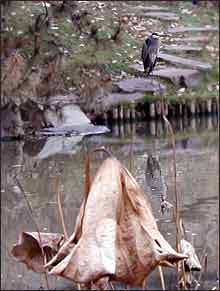 Balanced on one-foot on a stepping stone leading from the Plum Arbor to the lake in the Japanese Garden I saw a Great-Blue Heron -- my first-ever sighting in the Garden. Last August I saw a squat,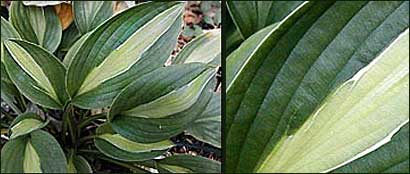

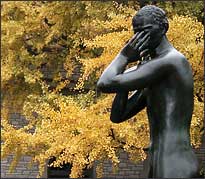 Each year at this time I am awed by the tousled golden tresses of a pair of ginko trees planted as sentinels at the original entrance to the Garden. Today the leaves on one of trees have turned, almost as though it was expecting us. Next week the path beneath the tree will be paved with yellow, but today the leaves cling tightly to branches that escape from the tree in graceful directions. The face of the statue of Orpheus in the reflecting basin near the tree turns away from the spectacle. He seems to have taken to heart the warning of the gods of the underworld not to look back at beauty.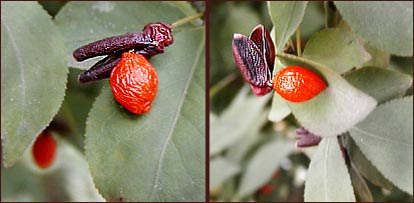
 Since early summer I've been intrigued by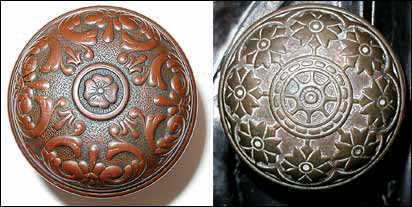

 Toad Lilies and crabapples: an unusual pair. I spotted this tall Toad Lily bloom reaching up into the lower branches of a crabapple loaded with ripe fruit.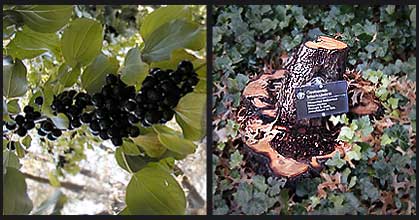
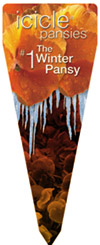 The experimental, demonstration plots in the Kemper Garden are filled with pansies - 60 different varieties-- five plots with a dozen each. Among all these, none was the media darling: the Icicle Pansy. Who would have imaged that a pansy would be featured in full page ads in Better Homes & Gardens or that a pansy would take center-stage on television commercials, or that a pansy would have
 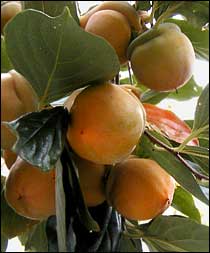 Persimmons (Diospyros kaki) are beautiful objects. They hang like clusters of sculpted sunny acorns. I have never tasted the fruit that the National Garden book describes as tasting "something like a date" with the flavor of a "high quality prune" or that a