 |
|
|
“Summer is the time when one shed's one's tensions with one's clothes,
and the right kind of day is jeweled balm for the battered spirit. A few of those days and you can become drunk with the belief that all's right with the world.”  -- Ada Louise Huxley, 'New York Times' architectural critic -- Ada Louise Huxley, 'New York Times' architectural critic |
|
|
|  clear: calm: 73º clear: calm: 73º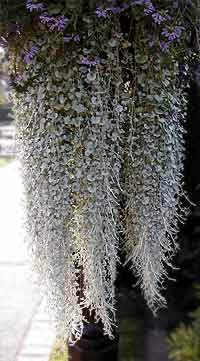 What if I put a plant that was used to creeping along the ground into a sphagnum-lined basket and suspended it from the top of a lamppost? I might never have thought of doing it. But if I had, I'd likely have hung the basket somewhere in my backyard out-of-view until I saw what would happen. The planners of this Garden are bolder than I am and smarter. They put a ground hugger in the container baskets that hang along the walk near the Linnean glasshouse - the Garden's front yard and parlor. The plant they chose is named Dicondra 'Silver Falls' (Dicondra micrantha). The result: stunning. 'Silver Falls' spins out five-foot long necklaces of silver-gray strands that interwine into chandelier-like pendants. Spaced along each strand are tiny leaves shaped like lily pads. I took five pictures of 'Silver Falls.' None was good. The dazzle of the sun on the leaves and runners burned out detail and contrast making 'Silver Falls' something better seen than written about or photographed. What if I put a plant that was used to creeping along the ground into a sphagnum-lined basket and suspended it from the top of a lamppost? I might never have thought of doing it. But if I had, I'd likely have hung the basket somewhere in my backyard out-of-view until I saw what would happen. The planners of this Garden are bolder than I am and smarter. They put a ground hugger in the container baskets that hang along the walk near the Linnean glasshouse - the Garden's front yard and parlor. The plant they chose is named Dicondra 'Silver Falls' (Dicondra micrantha). The result: stunning. 'Silver Falls' spins out five-foot long necklaces of silver-gray strands that interwine into chandelier-like pendants. Spaced along each strand are tiny leaves shaped like lily pads. I took five pictures of 'Silver Falls.' None was good. The dazzle of the sun on the leaves and runners burned out detail and contrast making 'Silver Falls' something better seen than written about or photographed.A medium-sized lime-colored hosta called 'Golden Scepter' has been planted along a walk paved with aggregate stone. The leaves closest to the pavement are bleached and burned. Less than a foot away, the leaves keep their advertised color. Same plant, different microclimate of heat, sun, and moisture. As necessary as gold-hued hostas are to the landscape, I think they are the fussiest of hostas about where they want to be planted. Plant them in places that are too hot, too dry, or too sunny and they either fail to thrive or will look dowdy until taken by frost. Most of the iris plants in the Garden have been removed. The beds where they grew have been emptied of a foot of soil. We try to guess why: a better underground irrigation system?; some new research finding about the kind of soil mix irises like best?; improved drainage to keep rain from forming gutters along the edges of the beds? We'll likely never know. Even after the soil is replaced and the irises return I know the rebloomers will be too occupied with rerooting to put on a second show this season. For the past several weeks, there was a sign outside the newly refurbished herb garden said that a new "water feature" was being installed. Today it was in and running: a horizontal stone grinding wheel raised about a foot from the ground. From the center of the stone a small dome of water spills over curved-shaped etchings carved on the face of the wheel. From there the water trickles over the edge of the stone on to a bed of smooth slate-gray rocks below. We sat on a nearby bench to look at the piece for a long while. I know I will come back to that bench again and again. I will close my eyes and listen to quiet sounds of the falling water. I likely will not open my eyes through because the names of the donors have been engraved so deeply and in such large letters around the edge of the stone that looking adds nothing to the experience. 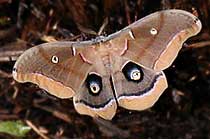 I spotted it on some mulch vibrating its body like an old prop plane revving its engines before takeoff. It was a moth with two eyespots on the lower curve of its wings. It stayed only long enough for me to take its picture and then crawled off into a leafy cover. I used the web to identify the insect as a Polyphemus moth. Sources I read said it is named for those two prominent bluish-black eyespots on its lower wings. The other identifying features are the pink markings that trace the top of the eye and outline the edges of the wings. The eyespots are used for camouflage. If camouflage fails, the moth will flap its wings to scare or intimidate its predators. The insect eats only during its larva stage. To avoid temptation, adult moths such as the one I saw have no mouth. I spotted it on some mulch vibrating its body like an old prop plane revving its engines before takeoff. It was a moth with two eyespots on the lower curve of its wings. It stayed only long enough for me to take its picture and then crawled off into a leafy cover. I used the web to identify the insect as a Polyphemus moth. Sources I read said it is named for those two prominent bluish-black eyespots on its lower wings. The other identifying features are the pink markings that trace the top of the eye and outline the edges of the wings. The eyespots are used for camouflage. If camouflage fails, the moth will flap its wings to scare or intimidate its predators. The insect eats only during its larva stage. To avoid temptation, adult moths such as the one I saw have no mouth.According to the species distribution map on web site of the Northern Prairie Wildlife Research Center, there has been no confirmed sighting of the Polyphemus moth in the city of Saint Louis. I, great explorer of these uncharted City regions, will send the Center my photo as evidence of my discovery. 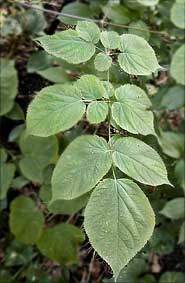 In recent weeks, I've been looking more closely at the plantings in the English Woodland Garden. The Garden is heavily shaded in places as are two spots in my backyard where I'm looking for ideas on what to plant. Just off the walkway growing in deep shade, I saw a shrub called Spikenard (Aralia racemosa). I noticed it because its auger-like spikes of tiny yellowish flowers mixed with round berries starting to purple stood out from a background of mostly green. Getting past the berries, I saw that the Spikenard had an unusual leaf arrangement. It had ordinary compound leaves, but from the leaf stems of some of the leaflets, other smaller leaves had sprouted. It was as though the shrub was trying to create a compound leaf within a compound leaf. I thought of Japanese Angleica Tree now blooming in the Daylily Garden. It has successfully managed to do what the spikenard is trying to do. When I checked my Sunset National Garden Book of plants, I found that the Angelica Tree is an Asian relative of the Spikenard, a native of East coast. In recent weeks, I've been looking more closely at the plantings in the English Woodland Garden. The Garden is heavily shaded in places as are two spots in my backyard where I'm looking for ideas on what to plant. Just off the walkway growing in deep shade, I saw a shrub called Spikenard (Aralia racemosa). I noticed it because its auger-like spikes of tiny yellowish flowers mixed with round berries starting to purple stood out from a background of mostly green. Getting past the berries, I saw that the Spikenard had an unusual leaf arrangement. It had ordinary compound leaves, but from the leaf stems of some of the leaflets, other smaller leaves had sprouted. It was as though the shrub was trying to create a compound leaf within a compound leaf. I thought of Japanese Angleica Tree now blooming in the Daylily Garden. It has successfully managed to do what the spikenard is trying to do. When I checked my Sunset National Garden Book of plants, I found that the Angelica Tree is an Asian relative of the Spikenard, a native of East coast.For years we have passed a stone sculpture of an eight-inch green frog half-immersed in trough of water in the Kemper Home Garden. The frog is attached to an underwater pump that is attached to a solar panel. If all goes as planned, an arc of water spouts from the frog's upturned mouth. Until today, we have seen the frog drool, and sometimes spit, but never arc. The problem seems to have been with the placement of the solar panel powering the frog. It used to be mounted at ground level in part-shade. Now it is positioned at the top of a pergola, pointed south in full sun. A happy frog. 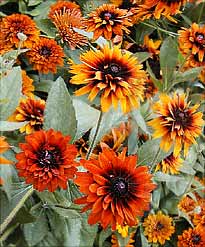 In a planter opposite the frog's pond was a dazzling display of rudbekia in high color. Colors ranged from yellows thorough rich furniture-colored mahoganies. Petals were arranged in single layers, double, and ever triple layers. There were daisy shapes, dahlia buttons, and a few flower heads that pushed me ahead in time to think of the specimen mums that will appear in the Japanese Garden. A sign on this remarkable bouquet identified the flowers as Rudbekia 'Cherokee Sunset.' From a web search, I found that 'Cherokee Sunset' was a 2002 All-American Selection winner developed by the British seedsellers Thompson and Morgan. The description in my T&M seed catalog says the flower is the result of "over 10 years' breeding and selection by T&M's flower breeders" and that colors range "resembles the attractive colour spectrum of an Indian Sunset." Hyperbole is alive and well in England, 4000 miles from where the wind goes sweepin' through the plains. In a planter opposite the frog's pond was a dazzling display of rudbekia in high color. Colors ranged from yellows thorough rich furniture-colored mahoganies. Petals were arranged in single layers, double, and ever triple layers. There were daisy shapes, dahlia buttons, and a few flower heads that pushed me ahead in time to think of the specimen mums that will appear in the Japanese Garden. A sign on this remarkable bouquet identified the flowers as Rudbekia 'Cherokee Sunset.' From a web search, I found that 'Cherokee Sunset' was a 2002 All-American Selection winner developed by the British seedsellers Thompson and Morgan. The description in my T&M seed catalog says the flower is the result of "over 10 years' breeding and selection by T&M's flower breeders" and that colors range "resembles the attractive colour spectrum of an Indian Sunset." Hyperbole is alive and well in England, 4000 miles from where the wind goes sweepin' through the plains. misty: calm: 75º misty: calm: 75ºThe drenching rain that filled most of Friday has revitalized life in the botanical garden. Plants lucky enough to live in this garden never go thirsty, but the processed water they get from sprinklers and hoses only tantalizes them; just sustains them. They need the water from rain, long and deep. If plants here could purr with contentment, this would be a noisy place this morning.  The Lily of the Nile (Agapanthus orientalis) bulbs in the Linnean greenhouse are sending up bouquets of delft-blue flowers balanced at the end of green spires. The flowers stalks are leaning out an open window, bent as far as they can to catch the excitement of life outside the big house. A reference book I have says that Lily of the Nile lives a long natural life in plant zones south of here. The ones growing in the greenhouse look as though they would be willing to forego that long life just for a chance to get out. The Lily of the Nile (Agapanthus orientalis) bulbs in the Linnean greenhouse are sending up bouquets of delft-blue flowers balanced at the end of green spires. The flowers stalks are leaning out an open window, bent as far as they can to catch the excitement of life outside the big house. A reference book I have says that Lily of the Nile lives a long natural life in plant zones south of here. The ones growing in the greenhouse look as though they would be willing to forego that long life just for a chance to get out.Trident forms abound at the garden. A massive gingo and an elm that is its equal have single trunks that expand into three elegant forks. Somewhere I read that trident shapes are satisfying, calming, and compelling because we see our lives in their tines - past, present, and future. Because I am always on the watch for trident shapes, I see them in places others pass. This morning I found a trident among the vines of a wisteria twisting up a pergola. 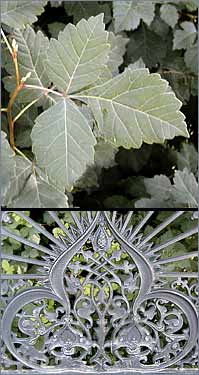 While thinking of things with threes, I noticed a wonderful complement of threes as we walked near Henry Shaw's 1849 house. A garden planner with a superb eye for detail placed an old Victorian iron bench with a back of black metal curled into grand fleur-de-lis in front of a patch of Fragrant Sumac (Rhus aromatica). Not coincidentally, the sumac had leaves of three branching leaflets. While thinking of things with threes, I noticed a wonderful complement of threes as we walked near Henry Shaw's 1849 house. A garden planner with a superb eye for detail placed an old Victorian iron bench with a back of black metal curled into grand fleur-de-lis in front of a patch of Fragrant Sumac (Rhus aromatica). Not coincidentally, the sumac had leaves of three branching leaflets.Annuals have a way of jumping around the garden plots from year-to-year. I always begin looking for my favorite annual in the place where I saw it the year before. But I've learned that only rarely will the planners of this place repeat plant and place. Last year I heaped attention on a knee high-sized cleome with a dainty spidery flower head. Rows of the variety called 'Linde Armstrong' were planted in a long plot across the walk from the scented garden. This year a mid-sized cleome called 'Sparkler' has taken its place. I found 'Linde' under an arbor in the Kemper Garden, acres away from where it was last year. This year 'Linde' was being used as a specimen plant. Each individual was backed by the regal, florescent purple of Persian Shields. The effect was electric, but unsettling. This plant, the cleome, that the books call an old-fashioned darling, now has gotten prissy and has started to hang around with royalty. 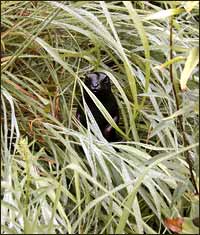 The prairie grass has grown so tall that it has nearly hidden a life-like sculpture of a prairie dog perched atop its heaped mound. Peeking out of its cover of grass, the creature looks like one of those jungle beasts peeping out a painting by Rousseau. The prairie grass has grown so tall that it has nearly hidden a life-like sculpture of a prairie dog perched atop its heaped mound. Peeking out of its cover of grass, the creature looks like one of those jungle beasts peeping out a painting by Rousseau.Of the prairie flowers blooming now, the 1920's lip-stick red of catchfly (Silene regia) is my favorite. Their stick-figure stars seem as though they have been pasted to the green and fawn colors of the arching grasses. They remind me of the neon-colored tiny Mylar confetti stars that my sister stuffs into the greeting cards she sends for my birthdays. I've never gotten close enough to a catchfly to know, but I've read that the flower gets its name because parts of the plant are lined with a sticky flypaper-like goo that is meant to lure and entangle small flying insects. Nowhere could I find a clue to why the catchfly wants to trap bugs. Could the catchfly be the Venus flytrap of the plains? 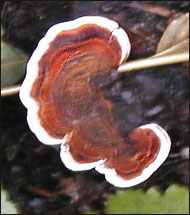 Growing at the base of a healthy clump of Liguaria in the English Woodland Garden, was a fungus shaped like a kidney or an ear. On the inside it had concentric arcs of brown; the edge was lined in pure white. Its odd-shape got me to thinking about a theory called the doctrine of signatures that I once came across. The idea was that God marks every plant with a shape, color, or a clue of some kind - its signature-- to let us know how best to use the plant for our benefit. If I had to guess, I would say that fungus we saw could be put over the ear like a poultice to cure an earache or it could be chopped, diced, sautéed, and stirred into an omelet to ease a kidney infection. Since I suffer from neither ailment, I'm not planning to test the theory. Growing at the base of a healthy clump of Liguaria in the English Woodland Garden, was a fungus shaped like a kidney or an ear. On the inside it had concentric arcs of brown; the edge was lined in pure white. Its odd-shape got me to thinking about a theory called the doctrine of signatures that I once came across. The idea was that God marks every plant with a shape, color, or a clue of some kind - its signature-- to let us know how best to use the plant for our benefit. If I had to guess, I would say that fungus we saw could be put over the ear like a poultice to cure an earache or it could be chopped, diced, sautéed, and stirred into an omelet to ease a kidney infection. Since I suffer from neither ailment, I'm not planning to test the theory. clear: soft breeze: 75º clear: soft breeze: 75º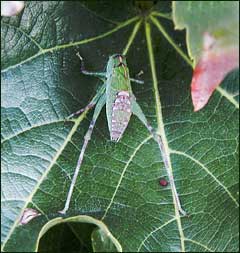 Even though this is a temple for plants, I am drawn to pieces of nature that move. Birds, cats, possums, and insects fascinate because they never stay put long enough for the Garden keepers to give them a black marker telling them what their name is in Latin. Today we looked hard at a bug no longer than the width of thumbnail. It was on an ivy leaf with its legs splayed. Whatever it was, it had found the perfect spot to be out in plain view and yet not be seen. It had the limey color of the leaf. Its wings and thorax mimicked the yellow veins traced on the leaf. Even the bit of scorching on a nearby leaf was matched by the scabby-brown on the bug's back. We figured whatever the bug might be, it was not a day creature. It never moved while we watched. Nudged it gently with a twig, it moved a leg and then settled back to rest or wait or voyeuristically watch. Even though this is a temple for plants, I am drawn to pieces of nature that move. Birds, cats, possums, and insects fascinate because they never stay put long enough for the Garden keepers to give them a black marker telling them what their name is in Latin. Today we looked hard at a bug no longer than the width of thumbnail. It was on an ivy leaf with its legs splayed. Whatever it was, it had found the perfect spot to be out in plain view and yet not be seen. It had the limey color of the leaf. Its wings and thorax mimicked the yellow veins traced on the leaf. Even the bit of scorching on a nearby leaf was matched by the scabby-brown on the bug's back. We figured whatever the bug might be, it was not a day creature. It never moved while we watched. Nudged it gently with a twig, it moved a leg and then settled back to rest or wait or voyeuristically watch.The birds looking for handouts in the garden café were neither reticent nor subtle. A black beady-eyed bird with a gravel voice perched on a branch of a yellow locust tree that shaded our table. We moved after the bird added its schmeer to the cream cheese on my bagel. From our new table, we saw a shiny black bird perfectly balanced on one foot. We suspected it was a ruse to garner attention and pity and a larger share of muffin crumbs. 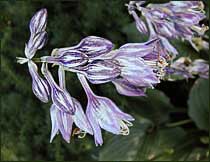 While wandering though the gardens of the National Garden Clubs that seamlessly join the botanical garden, I saw a hosta scape bursting with flowers that I didn't know hostas allowed. White flowers, yes. Purple ones: they're ok too. This one though combined painterly swaths of purple and white on each flower and bud. Even though the leaves are a ho-hum bulging green, this is one hosta I want to own. Labeling isn't as obsessive here at the National Garden Club plots (expect for all the daylilies named for past presidents of the organization), so I don't know what this hosta oddity might be. While wandering though the gardens of the National Garden Clubs that seamlessly join the botanical garden, I saw a hosta scape bursting with flowers that I didn't know hostas allowed. White flowers, yes. Purple ones: they're ok too. This one though combined painterly swaths of purple and white on each flower and bud. Even though the leaves are a ho-hum bulging green, this is one hosta I want to own. Labeling isn't as obsessive here at the National Garden Club plots (expect for all the daylilies named for past presidents of the organization), so I don't know what this hosta oddity might be.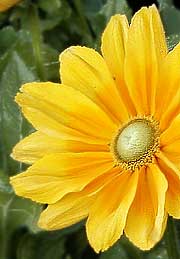 For the last two weeks a flower called Blackeyed Susan (Budbeckia hirta) 'Prairie Sun' has been blooming in the display gardens outside the Linnean greenhouse. I'm watching, waiting for their domed eyes to turn from golden to black. These Blackeyed Susans must be the city cousins of the ones I've seen along two-lane roads and in undisturbed fields. Those are meant to be seen and admired, especially when they are clustered in large colonies. 'Prairie Sun' is different. It says "Pick-me. I'm a one-of-a-kind individual. I want to come inside and live in a fine-looking vase in your living room." 'Prairie Sun' blooms are big - about the size the new miniature sunflowers. Their petal arrangement has none of the toothy gaps that the roadside varieties have. So far, the ones I've seen in the garden seem immune to the insect nibbles and leaf burns that I think of when I think of all the Susans I've known. For the last two weeks a flower called Blackeyed Susan (Budbeckia hirta) 'Prairie Sun' has been blooming in the display gardens outside the Linnean greenhouse. I'm watching, waiting for their domed eyes to turn from golden to black. These Blackeyed Susans must be the city cousins of the ones I've seen along two-lane roads and in undisturbed fields. Those are meant to be seen and admired, especially when they are clustered in large colonies. 'Prairie Sun' is different. It says "Pick-me. I'm a one-of-a-kind individual. I want to come inside and live in a fine-looking vase in your living room." 'Prairie Sun' blooms are big - about the size the new miniature sunflowers. Their petal arrangement has none of the toothy gaps that the roadside varieties have. So far, the ones I've seen in the garden seem immune to the insect nibbles and leaf burns that I think of when I think of all the Susans I've known.The daylily ghetto is still glowing with color. I've decided on my choices for my best of 2003 list. But I'm waiting for the end of the month just to see if any of the late-bloomers will rival anything I've seen so far. Next week I'll come, list in hand, to count the number of fans that all of my favorites have. If they have a half dozen or more fans there's a good chance that some of them will end up on the table at the garden's annual daylily sale in late summer. I'll be there.  Connections. One thing leads to another. For all the years it has been there skirted by a thick mass of boxwoods, I had never really looked at it: a relief sculpture named "Birth of the Muses" by Jacques Lipchitz. I decided to take a closer look after I came across the name Jacques Lipchitz, sculptor, in a thick paperback called The 20th Century Art Book that we keep on the ledge of the window next to the toilet. It's a picture book of works of art done by five hundred of the leading lights of the last century. I found that Lipchitz is a world-renown artist who was heavily influenced by Picasso and his circle of Parisian friends. So, I take notice. The piece, I learned from the web, is a rendering of the mythical flying horse Pegasus at the moment he struck one of his hoofs against the side of a Greek mountain opening up a spring. To anyone who drank the water of that spring the gods gave the gift of artistic creativity. The piece in the botanical garden is a companion piece to one in the lobby of the New York State Theater at Lincoln Center. Connections. One thing leads to another. For all the years it has been there skirted by a thick mass of boxwoods, I had never really looked at it: a relief sculpture named "Birth of the Muses" by Jacques Lipchitz. I decided to take a closer look after I came across the name Jacques Lipchitz, sculptor, in a thick paperback called The 20th Century Art Book that we keep on the ledge of the window next to the toilet. It's a picture book of works of art done by five hundred of the leading lights of the last century. I found that Lipchitz is a world-renown artist who was heavily influenced by Picasso and his circle of Parisian friends. So, I take notice. The piece, I learned from the web, is a rendering of the mythical flying horse Pegasus at the moment he struck one of his hoofs against the side of a Greek mountain opening up a spring. To anyone who drank the water of that spring the gods gave the gift of artistic creativity. The piece in the botanical garden is a companion piece to one in the lobby of the New York State Theater at Lincoln Center.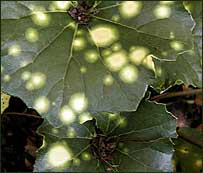 For the last two weeks, I've stopped to look at the leaves of a small plant growing in deep shade at the fringe of the bulb garden. The glossy, deep green leaves would be unremarkable if it weren't for the spots. The leaves are dotted with randomly placed yellow spots in assorted sizes. The glow of yellow against the deep green makes the leaves shimmer as though the leaves were being lit by dappled sun. A nearby sign calls the plant bellevalia, a grape hyacinth wannabe, but I suspect the sign is a leftover from spring. For the last two weeks, I've stopped to look at the leaves of a small plant growing in deep shade at the fringe of the bulb garden. The glossy, deep green leaves would be unremarkable if it weren't for the spots. The leaves are dotted with randomly placed yellow spots in assorted sizes. The glow of yellow against the deep green makes the leaves shimmer as though the leaves were being lit by dappled sun. A nearby sign calls the plant bellevalia, a grape hyacinth wannabe, but I suspect the sign is a leftover from spring.
|