 |
|
|
“[My grandfather] was one of those gardeners who would pull weeds anywhere --
not just in his own or other people's gardens, but in parking lots and storefront window boxes too. His world was under siege, and weeds to him represented the advance guard of the forces of chaos. .”  -- From 'Weeds Are Us' by Michael Pollan -- From 'Weeds Are Us' by Michael Pollan |
|
|
|  clouds give way to clear sky; calm: 69º clouds give way to clear sky; calm: 69ºMost of the plants in the Garden have labels that tersely identify their common name, botanical name, and their native lands. Just a chosen few have larger signs that tell the story of the plant in about a hundred words. My favorite sign is one stuck at the edge of a patch of red, lavender, and white yarrow planted just south of the Linnean glasshouse. I always read the sign when the yarrow blooms, but I often read it even when the yarrow roots are sheltered under a cover of leaf mulch. 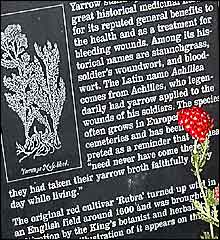 I am always startled by the contrast between the heroic qualities of the yarrow described by the sign and the little unassuming plant that I see in front of me. I read the words and expect a commanding plant, one sporting thorns perhaps. Instead I see a dainty plant: a plant whose flowers could fill the vases on the tables of a restaurant serving high tea. Yarrows have composite heads stuffed with flowers so small that only the young would consider bending over to look at them closely. The leaves are airy and feathery: think of goose down. Yet the story of the plant is larger than life. As the sign says, "The Latin name Achillea comes from Achilles, who legendarily had yarrow applied to the wounds of his soldiers." Web sources amplify the legend: Achilles learned about the power of yarrow to staunch wounds from his teacher Chiron, an immortal being with the body of horse and the torso and head of a man. Achilles remembered what Chiron had taught him and used yarrow to treat his fallen troops in the Trojan War. I am always startled by the contrast between the heroic qualities of the yarrow described by the sign and the little unassuming plant that I see in front of me. I read the words and expect a commanding plant, one sporting thorns perhaps. Instead I see a dainty plant: a plant whose flowers could fill the vases on the tables of a restaurant serving high tea. Yarrows have composite heads stuffed with flowers so small that only the young would consider bending over to look at them closely. The leaves are airy and feathery: think of goose down. Yet the story of the plant is larger than life. As the sign says, "The Latin name Achillea comes from Achilles, who legendarily had yarrow applied to the wounds of his soldiers." Web sources amplify the legend: Achilles learned about the power of yarrow to staunch wounds from his teacher Chiron, an immortal being with the body of horse and the torso and head of a man. Achilles remembered what Chiron had taught him and used yarrow to treat his fallen troops in the Trojan War.Throughout history and across cultures, yarrow has been a blockbuster healer and helper. Yarrow was the original snake oil. It has been used for fortune telling. It was tucked into bridal bouquets to guarantee that a marriage would last at least seven years. It has been put under pillows to induce dreams of love. The 16th Century herbalist, John Gerard called yarrow "nosebleed" because it cured headaches if the leaves were jammed into the nose far enough to cause a nosebleed. At different times and places it was used to reduce fever, shrink gallstones, make childbirth painless, cure depression, treat colds, bad breath, internal hemorrhages, incontinence, and gas. It could repel mosquitoes, grow hair, and even protect against witches' spells. Yarrow grows in full sun. I have none. Still, I will plant a yarrow seed. 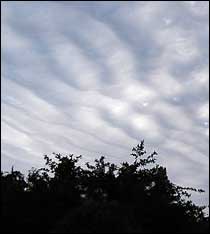 There are no weather fronts close by; no rain is expected. Nothing in the forecast to cause me to look to the sky. But, when Pat told me to look up, I saw a stream of clouds passing over that looked like a giant's guts. These puffy coils of clouds passed just to the south of us, and then the sky opened to blue. There are no weather fronts close by; no rain is expected. Nothing in the forecast to cause me to look to the sky. But, when Pat told me to look up, I saw a stream of clouds passing over that looked like a giant's guts. These puffy coils of clouds passed just to the south of us, and then the sky opened to blue.The Easter Lilies have grown so tall and so full that the sign identifying them as Easter Lilies has been plucked from the ground where it was hidden by foliage and placed among the clusters of flowers. Identification doesn't matter though; it's the sight and the overpowering scent that lures us closer. I've just returned from a visit to friends in the East who raise hostas, mostly out of love, but a bit because they enjoy the company of others who appreciate the subtle beauty of these shade dwellers. I thought of my friends as I looked at the unruly scapes of hosta flowers blooming in every part of the Garden this morning. I thought of them too as I remembered a conversation I had at breakfast last week with another friend. She said as much as she liked hostas, she couldn't abide their yearly habit of poking out droopy stocks filled with ho-hum flowers. Her solution: "I cut them off just as soon as they get taller than the leaves." I wondered as I looked at the arching scapes in the Garden's hosta collection what might happen if my hosta-growing friends and my breakfast companion hosta-tamer ever met. 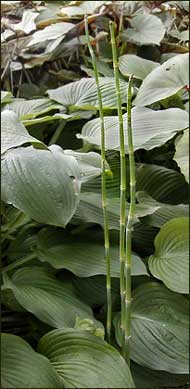 I picked up a new idea for a companion plant for hostas. At the edge of the bog garden is a field of hosta sieboldianas. Jutting up among them are pencils of deep-green horsetails that could be taken for flowerless scapes. Straight, orderly, no flowers: something my breakfast buddy would approve of. I picked up a new idea for a companion plant for hostas. At the edge of the bog garden is a field of hosta sieboldianas. Jutting up among them are pencils of deep-green horsetails that could be taken for flowerless scapes. Straight, orderly, no flowers: something my breakfast buddy would approve of.The daylily garden is stunning. Waking the path between the beds of flowers is like cutting through a Warhol collage of color. To try to make some order of this frenzy, each year I pick my ten favorite flowers. The exercise slows me down allowing me to separate figure from ground. So far, I've picked two daylilies for my top ten list. Pictures to come when the list is finished. 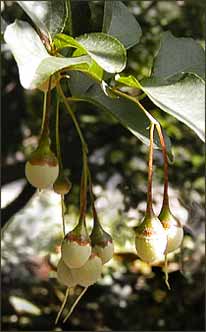 Clusters of fruit that look like miniature eggplants or thumbnail-sized atomic red hot peppers have replaced the bell-shaped flowers of the Japanese Snowbell tree (Strax japonicus) in the Chinese Garden. The branches of the tree are heavy with clusters of fruit draped out and away from the trunk. I walked under the tree's umbrella to look at the fruit backlit by the morning sun. Since I like this tree in all seasons, I looked it up in National Garden Book when I got home. So says the National Garden Book: "Splendid tree to look up into." It's humbling to know that others have seen what I thought I was first to notice. Clusters of fruit that look like miniature eggplants or thumbnail-sized atomic red hot peppers have replaced the bell-shaped flowers of the Japanese Snowbell tree (Strax japonicus) in the Chinese Garden. The branches of the tree are heavy with clusters of fruit draped out and away from the trunk. I walked under the tree's umbrella to look at the fruit backlit by the morning sun. Since I like this tree in all seasons, I looked it up in National Garden Book when I got home. So says the National Garden Book: "Splendid tree to look up into." It's humbling to know that others have seen what I thought I was first to notice. cloudy with outbreaks of sun: flutters of wind: 76º cloudy with outbreaks of sun: flutters of wind: 76ºAn in and out visit this morning. I arrived just as a guard was unlocking the doors to the Garden and activating the sensors to the smart doors. I had only an hour before I had to leave to catch an early flight. Something is better than nothing I've heard said. The cloudburst we had two days ago has washed away the soil and leaf mulch from any bed that slopes, even a little. None of the plantings has shifted, but the beds have open veins where water traced a course. Summer weather here outdoes the tropics. The humidity is just as high while the temperatures best the Congo. Taking advantage of what is sure to come when summer finally does arrive, the keepers of the Garden have brought many of their hothouse plants out to play. Banana trees, crotons, hibiscus, birds of paradise, taro, climbing gloriosa lilies (Gloriosa rothschildiana), and palms with unfamiliar names are already in place. Of all the outdoor palms, my favorite is one (still without a label) with leaves that abruptly end before coming to their expected points. The ends of the leaves are ragged and uneven, as though a rabbit had nibbled them. This morning, added to all of the other signs of the tropics, I found that huge baskets of staghorn ferns had been hooked to the lower branches of a crabapple tree in the bulb garden. How odd. A crabapple tree plays host to a fern from the topics of Southeast Asia. Call it an exchange plant here for the summer? Sadly, I will be away as the time of the lilies comes and goes. This morning I got a sneak preview of what was yet to come, but I will miss the opening of these majestic flowers on stalks that grow taller than I. A cloudy day just after days of rain keeps most of the garden photographers away. Today must be the kind of day that separates the dedicated from the dilettantes. The two photographers that I did see today looked serious: heavy-duty equipment, blue screens that they put behind their chosen flowers to make the light obey, and a willingness to aim, watch, and wait until nature did what they wanted. 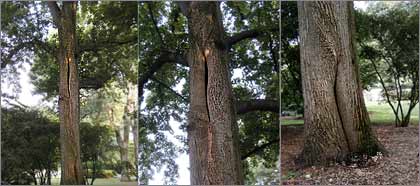 Most weeks just as I arrive at the Garden I wonder there is anything left for me to see. Have years of seeing made this place too comfortable and too familiar to offer up still more? It never happens. This morning, perhaps because of the lighting, I noticed a tulip tree I had never seen before. It was massive; it dominated the open space just west of the sculpture of Mother and Child. In two places the bark of the tree had opened and then folded in upon itself to form deep curving cavities. When I saw the self-assured cursive stokes on the tree, I thought of a Georgia O'Keeffe painting I saw last year at the St. Louis Art Museum. She called her work Birch Trees at Dawn on Lake George. The curve of those birch trees she painted and the spaces formed between the branches are here in this tulip tree, a natural O'Keefe. How could I have missed seeing such a spectacle for so many years?  fog: calm: 59º fog: calm: 59ºWeather radio says that visibility is an eighth of a mile. Fog subdues the Garden. Colors are muted. Shapes are indistinct. It's the kind of morning that St. Louisan Vincent Price would have relished. The fog veils light-colored flowers and foliage and favors the darker hues. Until couched by the fog, I wasn't aware of how much the Garden designers have embraced Gothic shades. The dark burgundies of coleus, sweet potato vines, taro, and 'Purple Majesty' ornamental millet now dominate the main display gardens. These dark colors are the latest in garden fashion according to an article I read a couple of days ago. The writers speculate that darker plants are in vogue because they echo the sophistication of black dress among the young and urbane. So far, the Garden seems to be content to use these plants from the dark side as foils for brighter plants. Nowhere have the keepers of the Garden planted a garden of entirely black and burgundy plants. Several summers ago though, I did see such a garden planted as a living sculpture in Laumeier Sculpture Park. I've forgotten the name of artist who planned the piece or the names of most of the plants. What I do remember though is the unsettling feeling I had looking at that plot filled with vines, nettles, and odd flowers all growing together, purposely unkempt. Gothic, magical, and forbidding. A garden I wish still could see again and again, but one that I would never consider planting or tending. It was gone. We walked into the Temperate House expecting to tilt our heads back to see the top of the 40-foot Alangium tree (Alangium platanifolium) planted in the northwest corner of the glasshouse. Not a sign of it. Two weeks ago it was here -- today not a trace: no sawdust, no signs of disturbed soil. I wonder if botanical gardens lend specimens to other gardens just as museums lend works of art? 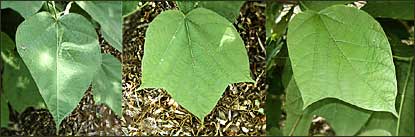 The Alangium is not a tree many would notice, let alone miss. It was brown or bare in winter so the eye passed it by. It was planted out of reach on a little-used walkway. Its high canopy made it invisible from ground level. Pat though took a liking to the tree. The leaves fascinated her. Alangium leaves take one of three shapes: a heart-shaped leaf with a smooth, unbroken edge; a scalloped, a symmetrical leaf that looks like a gentrified sycamore or the background for a coat of arms; and a rarer, maverick leaf that is a cross between the two other leaves. It was the usual asymmetry of that third leaf that moved Pat to create a commissioned work of fiber art based on the shapes of the Alangium leaves. She is going to miss that odd tree. It's small consolation, but last fall I discovered an Alangium growing outdoors in a place little seen and seldom visited. Outdoors the Alangium grows to only shrub size, but the leaves of many shapes are still there, now close enough to touch. 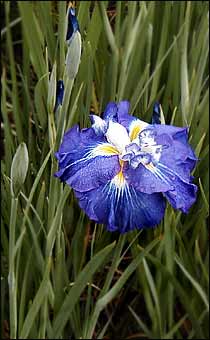 The blunt-nosed Japanese Irises have just started to bloom in the containers along side the zig-zag bridge in the Japanese Garden. Like so much here in the Garden, this another short-lived treat meant to be savored in season and then anticipated until it arrives again next year.
 |