 |
|
|
“Mid-July through August the garden seems to be a thick, stodgy parade,
with all of its outlines dulled and clouded. It seems to lumber along, muffled in too much rich living . . . A pageantry, . . . sometimes lovely, sometimes not. It will soon be over. Pods of seeds are forming. I have seen sweaters.”  -- Robert Dash: ''Notes From Madoo: Making a Garden in the Hamptons" -- Robert Dash: ''Notes From Madoo: Making a Garden in the Hamptons" |
|
|
|  clouds: calm: a humid 75º clouds: calm: a humid 75ºI don't often visit the Linnean glasshouse at this time of year even though the doors are propped open and the window sashes are up. Without going in, I know the camellias are in there biding their time until winter approaches. With so much green outside, I see little reason to go inside just to see more green. Today though I went in. 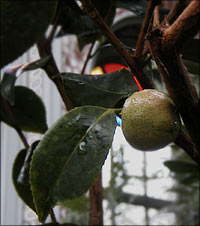 Hanging from the lower branches of a Camellia japonica tree near the entrance, I saw a sprinkling of pear-green fruits about the size of a quince or a walnut. Like pears just before they fall, some of the camellia fruit had developed a rusty blush along their top sides. Until today I didn't know that camellia formed fruit. When I got to a computer I checked the web site of The International Camellia Society. They identified what I had seen as seed pods. The pods mature in the fall. They say that on most camellias, the pods are from a half-inch to two inches in diameter, although on some varieties they can be as large eight inches across. Each pod has from three to a dozen seeds that will mature to a rich brown color when the pods open. As it happens, the maturing seedpods on the japonica are the most interesting of the camellia pods. As they mature their red blush will intensify until they begin to look like small apples. Next week I plan to have a closer look at the other camellias now that I know what to look for and what I am seeing.
I was drawn to the rose garden outside the Linnean House because of what wasn't. A least three of the beds were bare. All the roses where gone. A sign in the mounded earth began "Pardon our empty beds." It went on to say that some of the roses contracted a fatal virus with the intriguing name "witches broom." Other nearby healthy plants were destroyed to prevent the spread of the disease. Why the name "witches broom?" The Extension Office of the University of Nebraska says the name comes from a symptom that shows up at an advanced stage of the infection. Infected roses send out many short, thick, bright red stems that grow helter-skelter helter out of their side shoots. Someone, somewhere thought the jumble of twisted shoots liked like witches brooms. With nothing left but bare earth now, I wonder what varieties of roses were infected and whether more empty beds will soon appear. 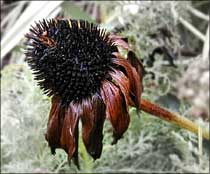 Purple coneflowers (Echinacea purpurea) never loose their appeal. I like seeing their puffy buds expand; I like watching them as the color in their petals brightens to their true color; I like the refined purple of the flowers they put at the ends of their coarse-looking leaves and stems; and I like blacks and mochas of cone flowers just after they have finished blooming.
Odd, but now that all of the daylilies have finished blooming and the frenzy of the daylily sales are over, I've begun to look at the daylily display gardens more closely. At the entrance to the daylily garden is a plot of historical cultivars. I don't remember any of the flowers in this plot. They must have been easy to walk quickly by as I hurried to get to the flashier varieties. Today though I found 'Apricot.' The sign said "Yeld, 1893." It was the oldest of all the named varieties in the Garden and I had missed seeing it in bloom. By searching the web, I found that 'Apricot' was the first-ever daylily hybrid. English schoolteacher and part-time gardener George Yeld developed it in 1892. From that beginning came the more than 40,000 registered varieties available now. I looked again at the extensive lists of daylilies that were offered at sales of the Garden and of the Daylily Society. 'Apricot' was not among them. Since 'Apricot' was the one that started it all, I will get one by mail order and find a place for it in my small, but already overcrowded, collection. 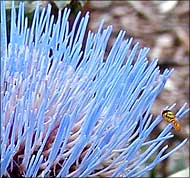 Outside of the artichokes here in the Garden, I've never heard of anyone who grew artichokes. Whether the ones here will grow to maturity and realize their destiny on a plate beside a bowl of melted butter I don't know. But the tufts that they form when they are in bloom are a dazzling electric blue. I can only image what a field of California artichokes in bloom must look like. Outside of the artichokes here in the Garden, I've never heard of anyone who grew artichokes. Whether the ones here will grow to maturity and realize their destiny on a plate beside a bowl of melted butter I don't know. But the tufts that they form when they are in bloom are a dazzling electric blue. I can only image what a field of California artichokes in bloom must look like. clear: cooling breeze: 71º clear: cooling breeze: 71ºJust a week ago the display gardens were what their planners hoped they would be when they picked the plants they would feature this summer. Luxuriant, full, voluptuous growth hiding every trace of the earth. Now after a week of crushing late summer heat, the plants are beginning to show their age: stems that should stand straight now droop and lean; colors that ought to hold true have bleached and grayed; tips of leaves that were green a week ago have started to brown and curl. Pat says the display gardens are now a lot like Sophia Loren: mature, but still breathtaking. The fall migration of hummingbirds must have begun. Rarely do we see any hummers in the garden. This morning we saw at least six, some in pairs. The birds are not the easily identifiable ruby-throated hummingbirds. Most of the ones we saw had a patch of iridescent green feathers on their throats. A few were very tiny, mostly gray birds. They all seemed intent on conserving energy often preferring to light on tree branches after feeding rather than angling off at warp speed. I tried to get a picture of some birds that returned again and again to feed at the same red canna, but my digital camera wasn't nimble enough for these agile creatures. Last year as the weather cooled and the birds slowed, I did get one picture though. I'll wait for cooler days and try again. On a hummer website I read that the fall migration of hummingbirds is longer and less organized than the flight north. Some of the younger birds dawdle until late October or November before heading to southern states, Mexico, Central- or South America. Under the strange but not true category, another website debunked the myth that hummingbirds get a first class ride south on the backs of geese or an economy ticket coasting on the back drafts of bigger birds. 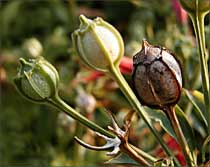 Everywhere plants are making seeds. I look at flowers and trees to see what kinds of chambers they make to ripen their seeds. The lantern-like papery hulls of Japanese Raintree and the overlapping shingles of the Hop Hornbeam are attention-getters. But, if I had to pick one seed machine, it would be the poppy-like pods of the exotic Lily of the Incas. Its six-sided pods topped by a finial looks like a classical urn or an ecclesiastical vessel. For me they bring to mind a chalice or a medieval reliquary filled with the organs of some saint. Everywhere plants are making seeds. I look at flowers and trees to see what kinds of chambers they make to ripen their seeds. The lantern-like papery hulls of Japanese Raintree and the overlapping shingles of the Hop Hornbeam are attention-getters. But, if I had to pick one seed machine, it would be the poppy-like pods of the exotic Lily of the Incas. Its six-sided pods topped by a finial looks like a classical urn or an ecclesiastical vessel. For me they bring to mind a chalice or a medieval reliquary filled with the organs of some saint.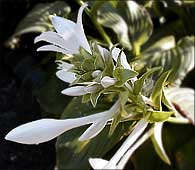 Fragrant hostas have begun to dominate the Garden. Tall sturdy scapes bearing dense clusters of pure white flowers - some six inches long and three inches across. These are the flowers of the Hosta plantagineas - the pure white, gigantic trumpets that add their fragrance to the night. The Hosta Handbook, not prone to hyperbole, says are they are "the most horticulturally significant hosta for the last 200 years." Since plantagineas have been mainstays of American gardens for at least a century, I decided they weren't a fad, so I bought one called 'Aphodite' --a newer,double flowered variety-- at the spring Hosta sale. The seller cautioned me that the one I bought was too small to bloom this year. He was right: no blooms, no night fragrance this year. But the plant is healthy and growing ever larger. We planters of things share the creed of baseball fans: wait 'till next year.
 sun through haze: calm: 79º sun through haze: calm: 79º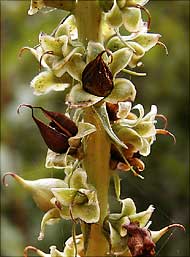 The seedpods on the stalks of the foxgloves are beginning to ripen. As the pods mature they slowly open. I doubt if I would have noticed them had it not been for their similarity to a couple of fledging robins in a nest tucked into the crotch of one of the downspouts on our house. The extended beaks of birds begging for worms and foxglove seedpods just breaking open have a lot in common. The seedpods on the stalks of the foxgloves are beginning to ripen. As the pods mature they slowly open. I doubt if I would have noticed them had it not been for their similarity to a couple of fledging robins in a nest tucked into the crotch of one of the downspouts on our house. The extended beaks of birds begging for worms and foxglove seedpods just breaking open have a lot in common.For years I watched a patch of unplanted, untended White Snakeroot (Eupatorium rugosum) that thrived under the scrub trees behind our garage. After the asters had flowered and the mums faded, the flat tufts of the gray-white snakeroot flowers began to bloom. For me, seeing the snakeroots in flower meant that the growing season was ending. They marked an impending change of season much as snowdrops did in late winter. In a shady spot in the English Woodland Garden, one of these harbingers of fall is blooming. Then, as if to confirm summer's end, I saw an Autumn Crocus (Colchicum) poking though the limestone in the rock garden. Signs or flukes? With heat indices well over 100 degrees and not a golden mum anywhere to be seen yet, I think I will ignore the snakeroot and the autumn crocus and wait instead for the newspaper reports on thinkness of the wooly caterpillar's coat before predicting an early frost. The Oak Leaf Hydrangeas (Hydrangea quercifolia) have begun to develop the patina that sets them apart from the run-of-the-mill shrubs. Imperceptibly they are losing their bleached white sheen and as they fade to translucent brown through shades of lime and hellebore-like purples and roses. 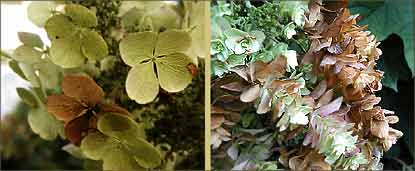 In nursery catalogs I often see pictures of a variety of Oak Leaf called 'Snowflake.' Unlike the more sedate oak leafs with flowerettes of four petals, the 'Snowflake' blooms are double-flowers of four within flowers of four. This morning I saw a 'Snowflake' in full bloom near a more ordinary 'Snow Queen'. The effect of double upon double upon double turned the shrub into what looked like a cluster of pine cones. The weight of so many flowers bent many of the willowy branches over forcing the flowers to touch the ground like some common mophead hydragea. Until breeders develop plants with wood that can bear the weight of these massive flowers, the older 'Snow Queen' still will be my pick. I printed a list of my dozen favorite daylilies of 2003 so I could be prepared for the Garden's annual selloff of their daylilies. The sale started at 9:00 a.m on Sunday morning. I dawdled so I didn't arrive until about five minutes after the Garden opened. The main exhibit hall was lined with long rows of 8'x4' tables placed end to end. Buyers were already three-deep around the tables. On top of the tables were stacks of green mesh sacks. In each sack was a fan or two of a daylily cultivar along with the name of its developer, the year it was developed, the height of the plant, the size of the blossom, and a thumbnail description of the color of the bloom. When I entered the hall I was handed an Excel-formatted table of the 465 different varieties of daylilies on sale that day. Then I was pointed toward a table where pictures of each daylily helped whet my acquisition instinct. I didn't stand a chance against the early-bird daylily pros. They came with alphabetized want lists (A real asset since the varieties were sorted alphabetically). The serious shoppers roamed the tables in teams with each team member trying to bag his or her assigned quarry. Joining the frenzy, I snaked though the tables looking, grabbing, and sacking whatever prey I could find. Eight of the twelve daylilies on my list were being offered that day. I could get only two - 'Bold Tiger' and 'Siloam Jim Cooper.' I wonder if daylily nuts camp outside the doors to be at the head of the line? A sign in the hosta garden says that hostas have overtaken daylilies as America's favorite perennial. Maybe so, but now that I've been to both the daylily sale and hosta sale I can say for sure that the daylily lovers have the passion and chutzpa of Beanie baby collectors at the height of that craze. Later over a cup of coffee, I looked over the daylily sale list a little more. I was looking for high-low prices. Predictably the lowest was the daylily none of us ever seem to tire of or will ever grow to hate- the 'Stella d'Oro.' Topping the price list at $40.00 a fan were 'Kendra Jannell' (1992) , and 'Larry Grace' (1994) . A friend who raises hostas told me that new varieties of hostas tend to be the priciest. With daylilies it must be different since both of the most expensive varities have been around for long enough to have gone forth and multiplied.  clear: calm: 74º clear: calm: 74º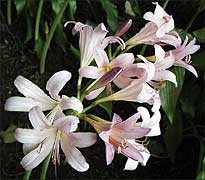 Magic Lily or Resurrection Lily. Take your pick. Some signs say one; some the other. All agree on the Latin: Lycoris, named for an actress who was a mistress of Mark Antony. Here in the garden and in the many lawns and gardens that I pass getting to the garden, the annual display of Lycoris lilies has begun. As if from nowhere these naked stocks topped with trumpets of soft, blurred orchid appear every year at this time. They aren't the surprise they were the first time I noticed them rising from dense bed of hosta trying to fool me into thinking I was seeing a most unusual hosta scape. Because I know their tricks, I like them even more. They bring to mind a jack-in-box toy. Turn the crank on the side of the box and a music box plays the tune "All around the cobbler's bench the monkey chased the weasel." When the melody gets to "POP," out pops Jack. Each time, every time, never varies. Yet kids and us big people too, keep on turning the crank waiting to be surprised and startled by a Jack who never fails to appear. Magic Lily or Resurrection Lily. Take your pick. Some signs say one; some the other. All agree on the Latin: Lycoris, named for an actress who was a mistress of Mark Antony. Here in the garden and in the many lawns and gardens that I pass getting to the garden, the annual display of Lycoris lilies has begun. As if from nowhere these naked stocks topped with trumpets of soft, blurred orchid appear every year at this time. They aren't the surprise they were the first time I noticed them rising from dense bed of hosta trying to fool me into thinking I was seeing a most unusual hosta scape. Because I know their tricks, I like them even more. They bring to mind a jack-in-box toy. Turn the crank on the side of the box and a music box plays the tune "All around the cobbler's bench the monkey chased the weasel." When the melody gets to "POP," out pops Jack. Each time, every time, never varies. Yet kids and us big people too, keep on turning the crank waiting to be surprised and startled by a Jack who never fails to appear.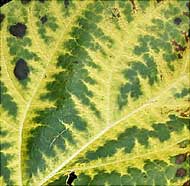 One of the Paulownia trees is staging a sneak preview of fall. Out to its dripline the tree has dropped dozens of its heart-shaped leaves months before expected. Fall is not the tree's finest season. Its leaves usually turn from green to drab, then shrivel and drop. The leaves falling now though are splendid. Along the veins the natural green has turned to lime leaving patches of frond-shaped green. One of the Paulownia trees is staging a sneak preview of fall. Out to its dripline the tree has dropped dozens of its heart-shaped leaves months before expected. Fall is not the tree's finest season. Its leaves usually turn from green to drab, then shrivel and drop. The leaves falling now though are splendid. Along the veins the natural green has turned to lime leaving patches of frond-shaped green.The daylily season is over. A sure sign that end has come are clipped fans on the plants destined to be dug and sold at next Sunday. I've made my picks for the dozen best daylilies of 2003. The cultivars that made my list are there because they met one criterion: I liked them. 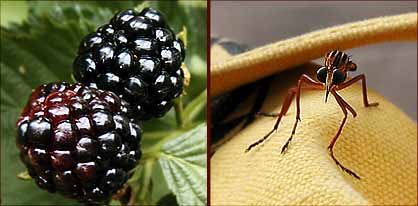 I didn't notice they had anything in common until I looked at the pictures: The thornless blackberries (Rubus 'Chester') planted in the berry garden and the bug that joined us for coffee on the patio of the Garden Café. 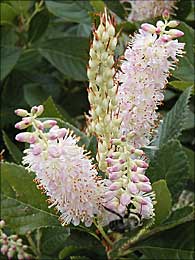 The heady scent of sweetpepper bushes (Clethra alnifolia) marks huge sections of the Garden this morning. I leaned over to smell vying with dozens of bees who also want to get close to the cattail-shaped clusters of flowers. Most of the bushes have white flowers. A few are gently tinted with pink. I like the pink better (Clethra alnifolia 'Pink Spires'). Gardener and garden writer Robert Dash thinks differently: "The native variety [white] should be planted more. The hybrid trinket on the market now is a thoughtless pink, and pink is not what clethra is about at all." The heady scent of sweetpepper bushes (Clethra alnifolia) marks huge sections of the Garden this morning. I leaned over to smell vying with dozens of bees who also want to get close to the cattail-shaped clusters of flowers. Most of the bushes have white flowers. A few are gently tinted with pink. I like the pink better (Clethra alnifolia 'Pink Spires'). Gardener and garden writer Robert Dash thinks differently: "The native variety [white] should be planted more. The hybrid trinket on the market now is a thoughtless pink, and pink is not what clethra is about at all." |